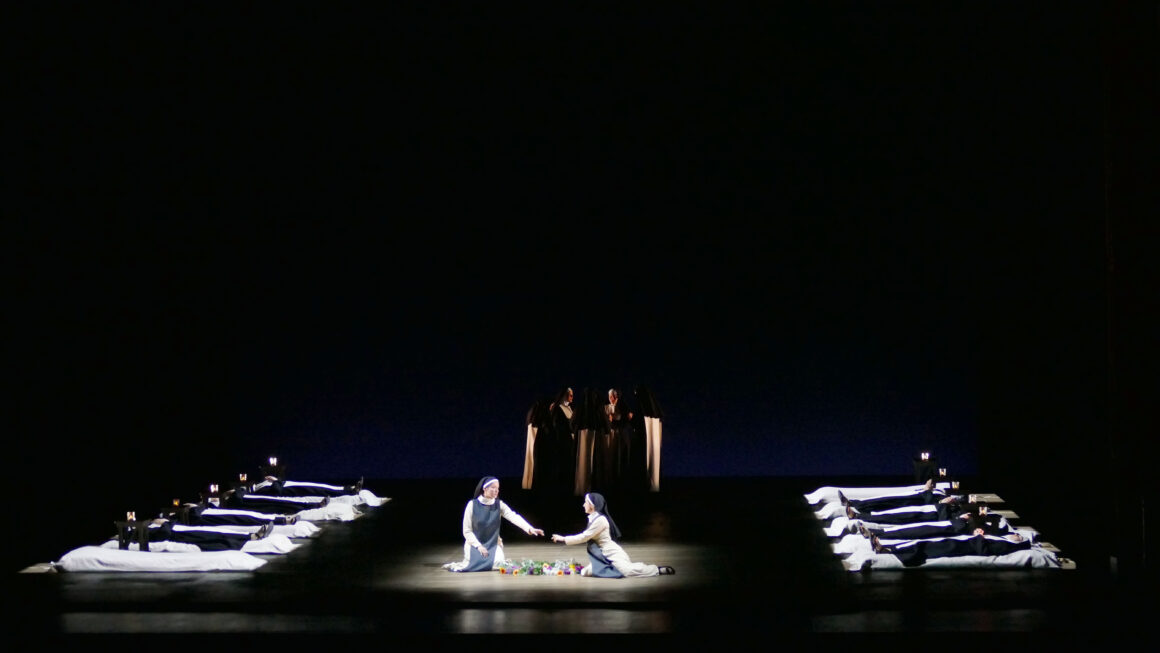
The production of Nabucco, which inaugurated the year 2026 at the most beautiful theater in theworld, can be considered the perfect synthesis of the Lissner/Tzempetonidis management, recentlyconcluded with the designation of the new Sovrintendente Fulvio Macciardi: the best voices on theinternational scene today, accurate and routine conducting, and ugly productions German province style.
First of all, the theater management deserves credit for offering the debuts of Marina Rebeka and Ludovic Tézier in two of the most challenging and iconic roles in the entire operatic repertoire, flanked by two true champions of Verdi singing: Michele Pertusi and Piero Pretti.
Tézier is undoubtedly the finest baritone of today opera scene, who recently triumphed in Naples with a moving Simon Boccanegra and a highly elegant Renato in Ballo in Maschera. His eagerly awaited debut as Nabucco confirms the artist’s vocal and interpretive qualities: a soft and confident singing line, noble and penetrating phrasing, a masterly legato, and a strong and penetrating upper register. He portrays a tormented character, torn between regal pride and paternal affection. A prime example of this is his performance of the Act IV aria “Dio di Giuda,” in which Tézier stands out for his beautiful legato and his faithfulness to Verdi’s writing. The subsequent cabaletta “cadran, cadranno i perfidi” is performed with great energy and determination, concluding with an uncertain high A-flat, not written by Verdi, that gets lost in the confusion of the stage performance.
After Norma and Lucrezia Borgia, Marina Rebeka approaches another dramatic soprano role, and what a role: Abigaille is one of the most formidable and grueling part in the repertoire; according to tradition, it helped destroy the voice of Giuseppina Strepponi, the first singer and future Signora Verdi. The role requires mastery of impressive technical difficulties, octave leaps, dips into the lower register, acuti and sopracuti to be reached forcefully and pianissimo, coloraturas, trills, and every kind of embellishments. It’s striking to recall that on December 20, 1949, the Teatro San Carlo opened its season with Maria Callas’s Abigaille, a role she remains unsurpassed in today.
Rebeka tackles this formidable character with the strength of her beauty and perfect technical mastery of her voice: her singing is firm, confident, and rises with great ease and insolence to the high register, where the Latvian soprano plays her best cards. Even the descents into the low notes are handled intelligently, without ever forcing or darkening the color of her voice. The soprano brings to bear all her experience as a bel canto singer, and executes the forceful trills, roulades, and vocalises with exemplary precision. The soprano portrays a strong and determined Abigaille, always determined but never a virago, much less a catwoman, as in a recent production at the Verona Arena. Her stage presence is always magnetic, and the beauty of her figure enhances her Traviata-style costume.
Michele Pertusi, in the role of Zaccaria, demonstrates once again that singing Verdi requires great basses capable of phrasing and mastering the “parola scenica”; a performance of great intensity that culminates in the prayer “Tu sul labbra de’ veggenti,” delivered with empathy and moving “messe di voce,” concluding with an evocative pianissimo low G. Piero Pretti as Ismaele is a true luxury; in the first act trio, he stands out with his mastery of Verdi’s writing and his ease in the high register, portraying a character who is both warrior and lover.
The choice to entrust the role of Fenena to a light soprano rather than a mezzo-soprano, as is traditional and evident from the vocal tessitura, seems unusual, even with the intention of differentiating the two female voices. Despite this inappropriate choice, Cassandre Berthon sings with buon gusto and participation, and the famous passage “Oh, dischiuso è il firmamento” is performed with Mozartian grace and style.
The secondary parts are also fine, particularly the excellent tenor Francesco Domenico Doto in
the role of Abdallo. Conductor Riccardo Frizza delivers a confident and accurate performance; the tempi are relaxed and expansive, avoiding the excessive impetus of famous interpretations. The balance with the stage is excellent, but ultimately the character and color of what is the most Verdi-like of all Verdi’s operas are lacking. The Chorus, the true protagonist of the opera, gave a very good performance, well prepared by Fabrizio Cassi, singing a moving rendition of “va pensiero” that received the warmest applause of the evening.
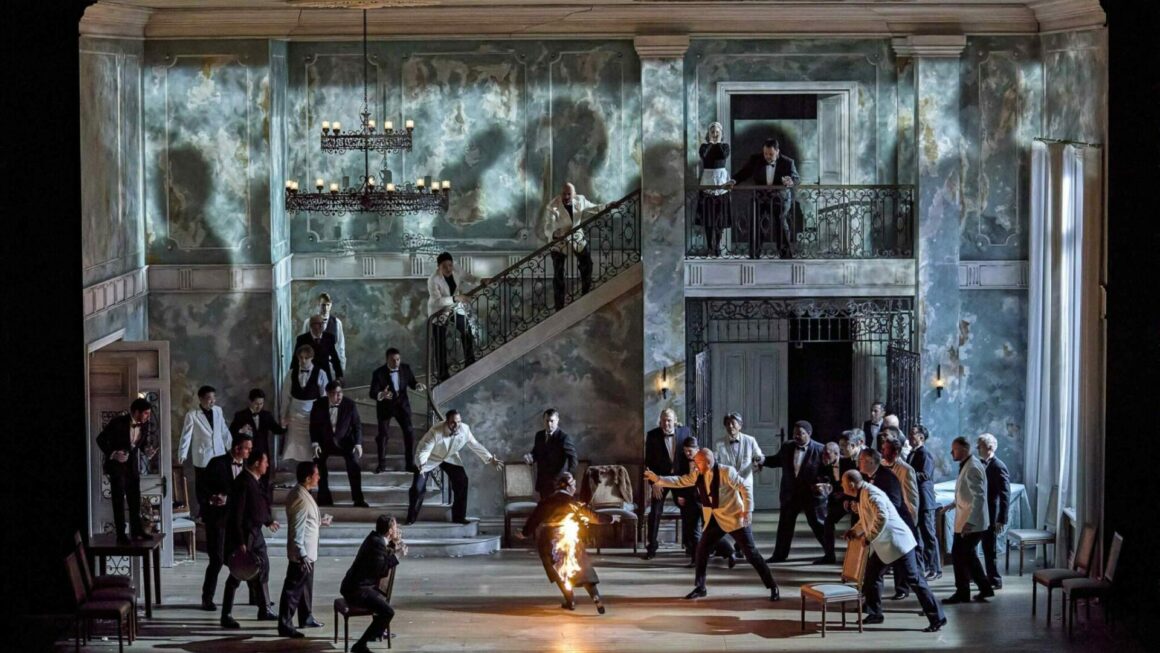
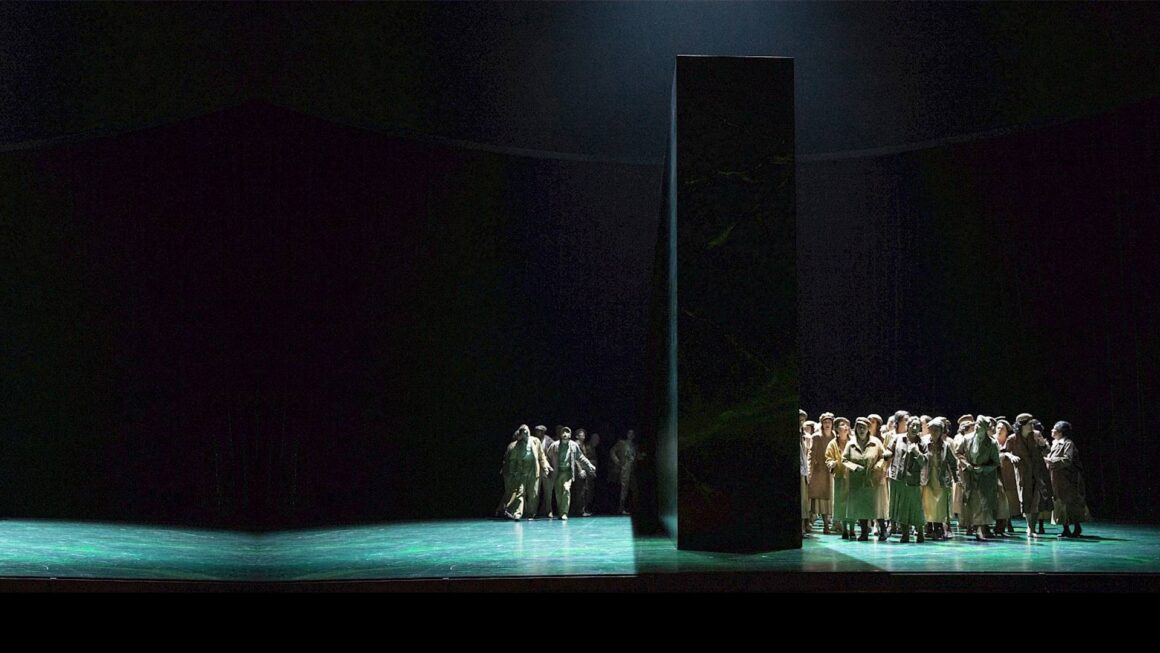
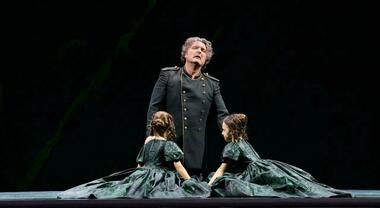
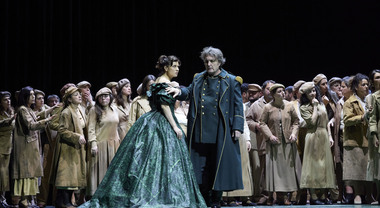
For this important occasion, the San Carlo imported a production from the Opernhaus Zürich, directed by Andreas Homoki, a hideous and pointless spectacle. At the first notes of the Symphony, Abigaille and Fenena appear on stage as children, seemingly straight out of Velázquez’s “Las Meninas,” fighting for the attentions of their father, Nabucco. The entire opera is consequently and uniquely interpreted in the light of family conflicts and traumas. The sets are nonexistent, just a moss-green floor and a moving wall that delimits the stage spaces, with fixed lights throughout the opera, set in the 19th century during Verdi’s time. The chorus, dressed in
beige, divides itself between tableaux vivants à la Pellizza da Volpedo’s “il quarto stato” and ridiculous choreographies reminiscent of Ponnelle’s “The Barber of Seville.”
The theater, sold out for days, declared the performance a resounding success, with some protests over the direction.
:::::::::::::::::::::::::::::::::::::::::::::::::::::::::::
CAST
Nabucco | Ludovic Tézier
Ismaele | Piero Pretti
Zaccaria | Michele Pertusi
Abigaille | Marina Rebeka
Fenena | Cassandre Berthon
Il gran Sacerdote | Lorenzo Mazzucchelli
Abdallo | Francesco Domenico Doto #
Anna | Caterina Marchesini
Conductor | Riccardo Frizza
Stage Director | Andreas Homoki ♭
Set Designer | Wolfgang Gussmann
Costumes | Wolfgang Gussmann, Susana Mendoza
Lighting Designer | Franck Evin
Orchestra e Coro del Teatro di San Carlo
Master of the Chorus | Fabrizio Cassi