“Since I have never in my life enjoyed the true happiness of love, I intend to erect a further monument to this most beautiful of dreams, a monument in which this love will be properly sated from beginning to end: I have planned in my head a Tristan and Isolde, the simplest, but most full- blooded musical conception; with the ‘black flag’ which flutters at the end, I shall then cover myself over, in order—to die”
With these words from a famous letter written in 1854, Wagner announced the composition of Tristan und Isolde to his friend Franz Liszt, whose illegitimate daughter Cosima he would marry a few years later. There was great expectation in Genoa for the return to the Carlo Felice after 16 years of absence of the opera that forever changed the system of tonal harmony that had dominated European musical history for centuries, opening the door to modernity; a bit like when, in physics, Einstein’s theory of relativity surpassed Newton’s classical mechanics.
This new, eagerly awaited production at the Carlo Felice has been entrusted to the baton of veteran conductor Donato Renzetti and directed by Laurence Dale, who, after an important career as a tenor, has created in this theater excellent productions of Britten’s "A Midsummer Night’s Dreams; and Richard Strauss’s ;Die Liebe der Danae.
Dealing with what he calls, the perfect opera in his directors notes, Dale creates a visually satisfying but ultimately disappointing performance. Personally, I believe the perfect opera is La Bohéme, chacun à son goût, but Tristan is undoubtedly the opera with the most extensive bibliography and the greatest philosophical and conceptual implications of the entire operatic repertoire. Curiously, all the Wagner productions performed in Italy in the last year, particularly McVicar’s Ring at La Scala, follow the same approach. The premises are as follows: Italians have little familiarity with Wagner’s theater, and Italians love the Regietheater like they love “pineapple pizza” and “cappuccino after noon”. Hence a fundamentally didactic approach, a Wagner for dummies, halfway between fantasy movie and Game of Thrones.
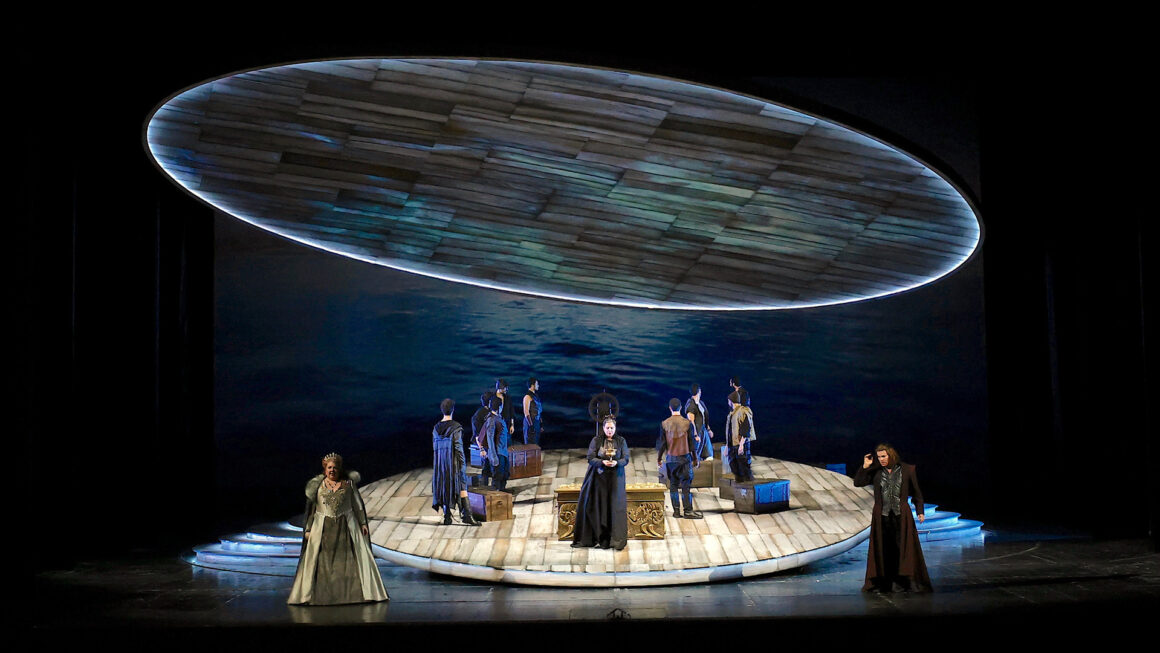
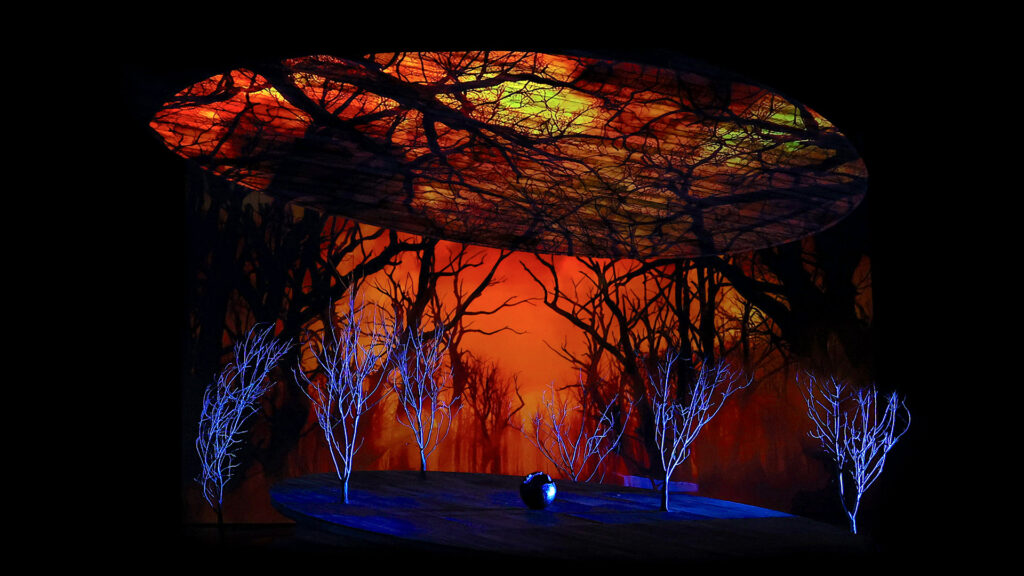
Dale creates a visually simple and captivating show, aided by the now ubiquitous video projections, more interested in recounting Breton legends than Schopenhauer philosophy. Onstage is present a large, movable circular platform, upon which a mirrored oval platform is suspended, creating the geometries within which the characters move. In the first act, the platform is the keel of the ship carrying Isolde to Cornwall. Dale does not fail to show us the background story on stage, with the duel between Morold and Tristan/Tantris. The sailors movements in the stormy sea are beautiful, and the dialogue between Brangäne and Isolde is well-defined, with the latter—a directorial license—pulling from the chest “Den Kopf des Jochanaan;! The second act is the least successful; the video projections are banal, and the play of light is lacking to adequately convey the night, the true protagonist of the act, and the turning off of the lamp that initiates the protagonists; extraordinary love duet is very little evocative.
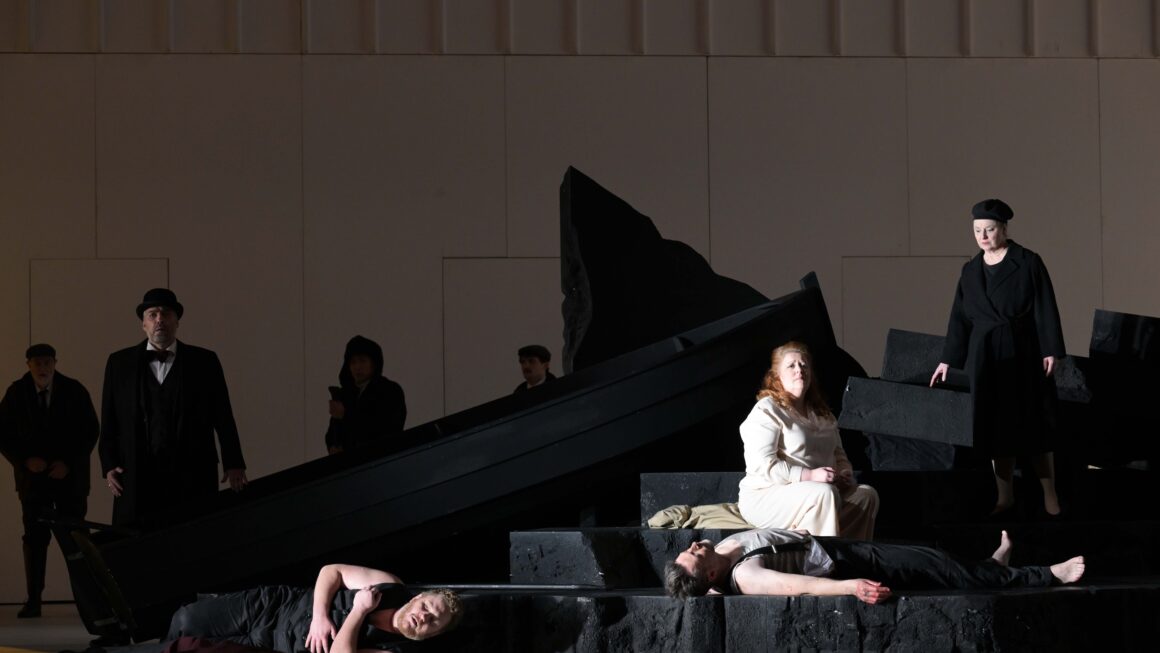
Instead, the third act is very successful in its scenic simplicity, with the changing lighting and the excellent acting of the protagonist; the stage rendering of the Liebestod is effective and evocative, even if in the finale, with Tristan revived and embracing Isolde, the “Titanic effect” comes close. It's worthappreciating, however, how Dale, an excellent musician, always stays within the music and eventries to visualize the many leitmotifs on stage, such as the love potion one, very well portrayed.The show was a resounding success with the audience, with warm applause for Dale and his entireteam. The question of how and whether Wagner's theatre interpretation should be renewedremains open, archived the era of Lohengrin with rats and the Gods ascending to Valhalla inelevator.
Donato Renzetti’s conducting was absolutely superb, leading the Carlo Felice orchestra in splendid form. From the performance of the celebrated prelude and the appearance of the legendary Tristan Akkord in the score, Renzetti sets the tone with an elegant and rigorous interpretation, in which the many leitmotifs unravel and intertwine as if in a single sonic fabric of voices and instruments, and chromaticism becomes an integral part of the narrative. Renzetti, at times stretching the tempo, manages to maintain the uninterrupted flow of sound in Wagner’s masterpiece, creating moments of authentic lyricism and pathos, particularly in the Act II love duet ;O sink hernieder, Nacht der Liebe, gib Vergessen, dass ich lebe” and in the Liebestod, elevated by a crescendo of supreme emotional tension. The instrumental solos were truly remarkable, particularly the cor anglais at the beginning of Act III.
Turning to the singers, German tenor Tilmann Unger performed Tristan, one of the most arduous roles in the entire repertoire, and this is not just a matter of legend. The first interpreter, Ludwig Schnorr von Carolsfeld, died suddenly at the age of just 29 after the historic premiere on June 10, 1865, and three performances in Munich. Many blamed Wagner and the immense physical and emotional effort required to sing a role that would long be considered unperformable. Unger sang and acted very well, and was very engaging in the long monologue in the third act; unfortunately, his voice did not carry across the room and struggled to overcome the barrier of the orchestra and the waves of sound that would require a true heldentenor voice.
As Isolde, we find German soprano Soonjin Moon-Sebastian, a last-minute replacement for the expected Marjorie Owens. The singer has a remarkable vocal range; her voice is full in the mids, rich in the bass, and expressive and powerful in the highs. I personally felt that Owens was a falcon soprano. The character emerges beautifully, vocally and scenically, regal in the first act, enamored in the second, and tragic in the third. Her Liebestod was vocally solid and moving, complementing the exceptional velvety sound laid down by Renzetti.
Daniela Barcellona was a masterful Brangäne; the mezzo-soprano from Trieste never ceases to amaze us. It’s true that, as she herself stated in an interview ;whoever can sing Rossini can sing everythings but it’s rare to hear such a powerful Wagner, so sculpted in diction and phrasing.
Barcellona’ naturally amber timbre and vocal power allow her to play a handmaid who is also one of the protagonist of the drama; her appearance on stage and her piercing cry at the end of the love duet in the second act were a moment of great theater and pure emotion.
Evgeny Stavinsky’s King Marke was excellent, with a dark timbre that was both noble and hieratic; the long monologue in the second act; was sung very well, fully conveying the pain and dismay at the betrayal of the two young lovers.
Nicolò Ceriani’s Kurwenal also performed very well. In a role we might call of Heldenbariton, he easily asserted himself over the orchestra with a rich, sonorous voice, performing well in both the warlike and lyrical moments of the tragic finale.
Saverio Fiore’s Melot has a beautiful tenor voice and is well-rendered in the second act, when he interrupts the scene and reveals Tristan’s betrayal to King Marke.
Tenor Andrea Schifaudo excels in the dual roles of the young sailor and the shepherd; his youthful, melancholic timbre perfectly captures the beautiful melody that opens the opera Westwärts schweift der Blick; from offstage; the tenor also finds great emotional intensity in the melancholy melody with the cor anglais of the third act.
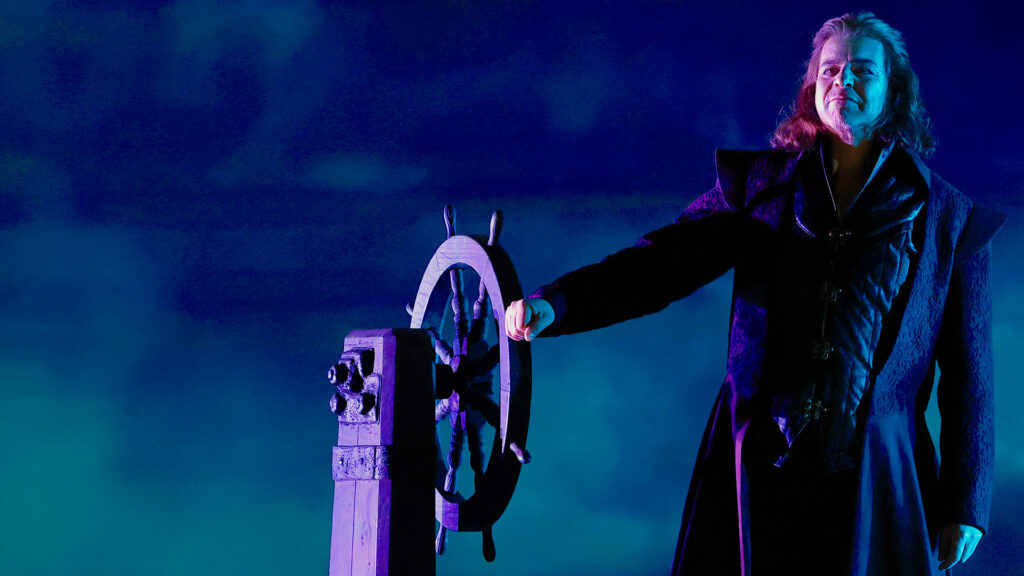
In the brief part of the helmsman, Matteo Peirone showcases all the qualities that make him one of the leading character actors in the Italian repertoire: a beautiful baritone timbre, sculpted diction, and an incisive stage presence. The show, in all its aspects, was a resounding success with a large, attentive and focused audience; we hope the Teatro Carlo Felice continues to present this repertoire.
::::::::::::::::::::::::::::::::::::::
CAST
Tristan
Tilmann Unger
König Marke
Evgeny Stavinsky
Isolde
Soonjin Moon-Sebastian
Kurwenal
Nicolò Ceriani
Melot
Saverio Fiore
Brangäne
Daniela Barcellona
Ein Seemann/Ein Hirt
Andrea Schifaudo
Ein Steuermann
Matteo Peirone
–
Conductor
Donato Renzetti
Director
Laurence Dale
Scenes and costumes
Gary McCann
Lighting
John Bishop
Video design
Leandro Summo
Assistant director and choreographer
Carmine De Amicis
Choir Director
Claudio Marino Moretti