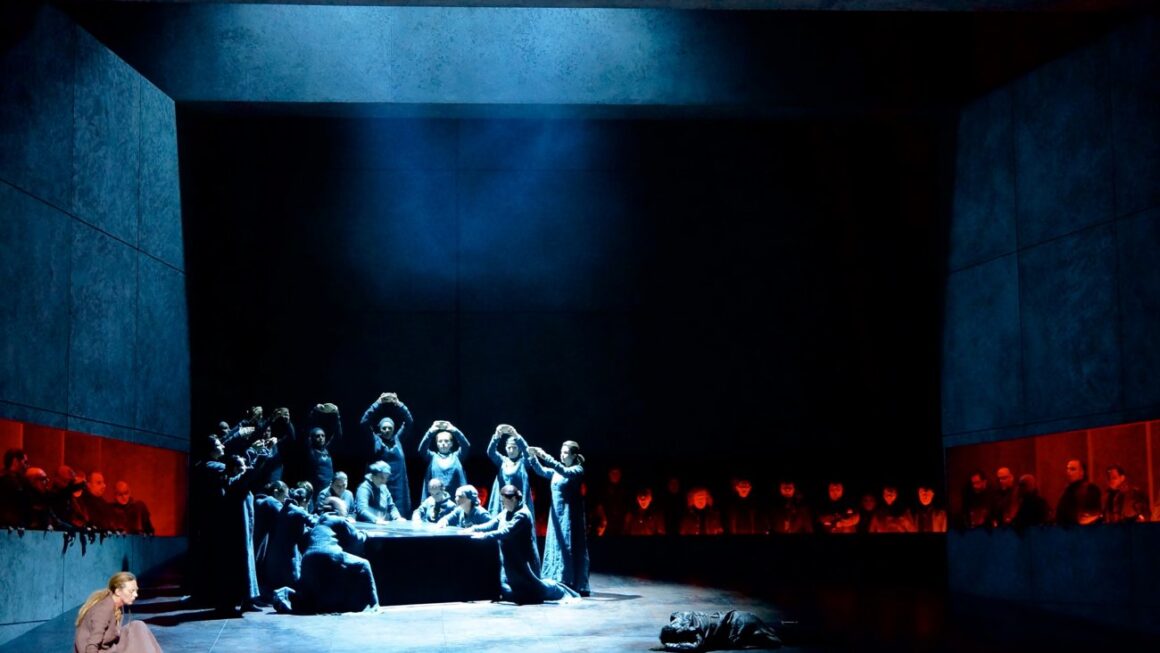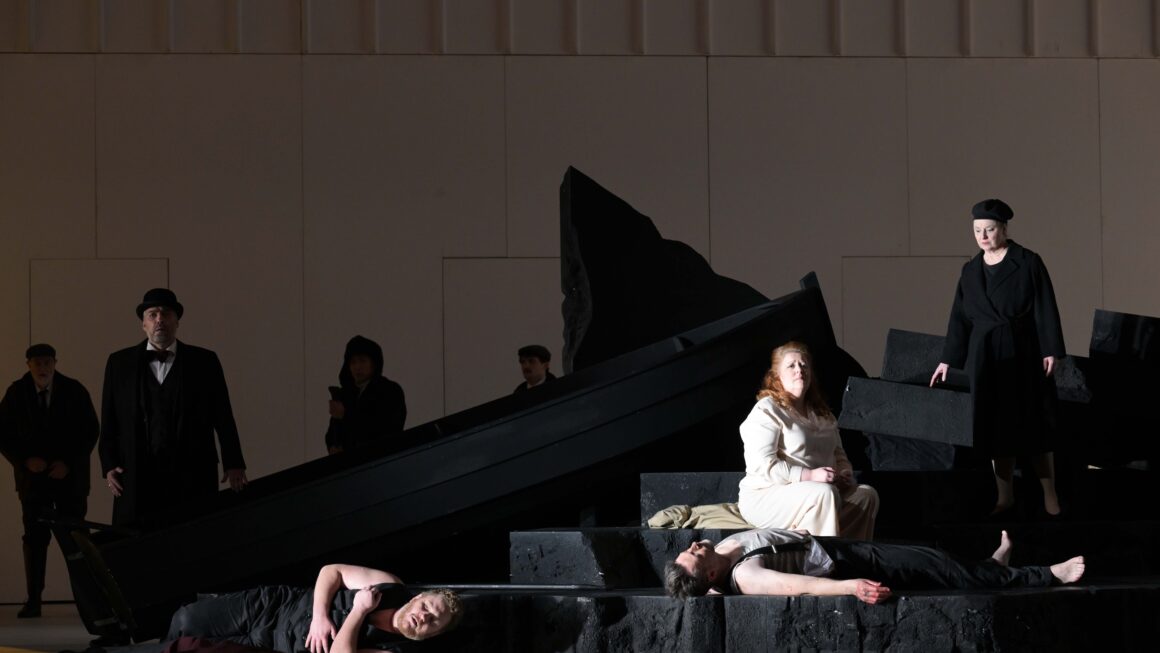
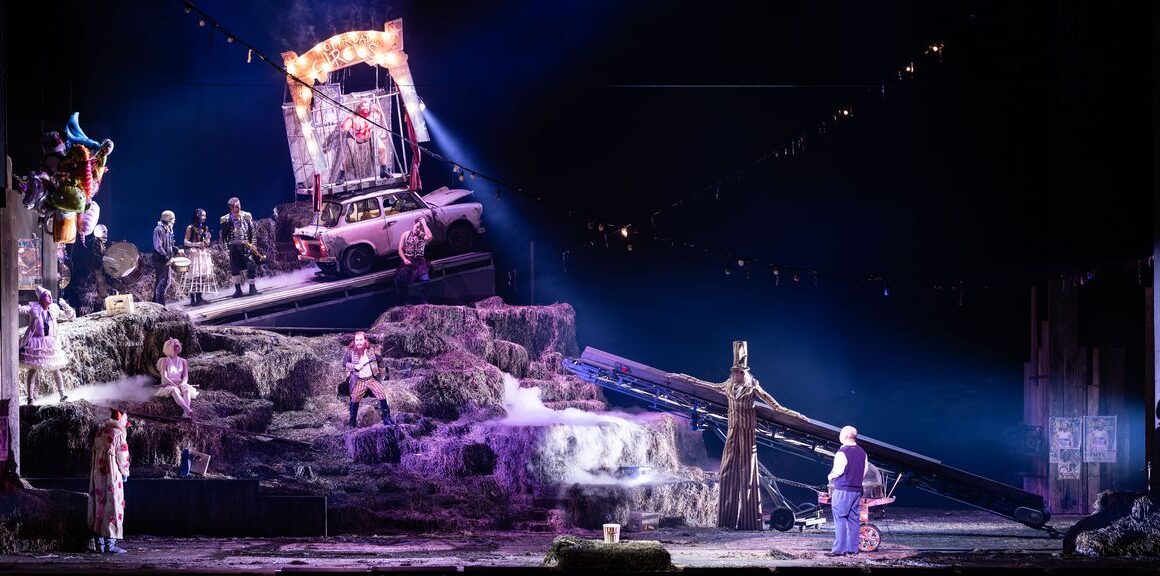
The lightness of an opera sometimes becomes its greatest strength — evenings where the joy onstage mirrors the joy in the room, and where a packed audience full of young faces transforms the performance into something brighter than the score alone. This Verkaufte Braut was exactly that kind of night: quick-witted, generous, and charged with the kind of fresh energy that reminds you why this opera has been winning hearts for 150 years. What struck first was the atmosphere: the house buzzing, laughter rolling warm and unforced, an ease in the air that felt almost like a collective sigh of relief. David Bösch’s staging played directly into that — colourful, lively, intentionally relaxed, offering theatrical clarity without ever talking down to its audience. The comedy landed, the rhythm carried, and nothing ever felt cheap. Just craftsmanship serving joy.
At the centre of it all, Emily Pogorelc’s Marie was pure delight. She sang with a flexibility that made every phrase glide, with elegance in line and sparkle in the upper register, and with a natural charisma that made her the gravitational point of the whole story. Nothing felt forced. Her Marie was clever, charming, emotionally quick on her feet — a portrayal shaped with instinct rather than affectation, and one that fit this production like a glove. Opposite her, Ya‑Chung Huang once again proved himself one of the house’s great treasures. As Wenzel he was irresistibly sincere, vocally luminous, and utterly disarming. The timbre — that warm, golden glow — seems to soften the air around him each time he sings. His comic timing was impeccable, but even better was the humanity underneath: no caricature, no mugging, just a young man drawn with tenderness, vulnerability, and technical ease. Every appearance felt too short.
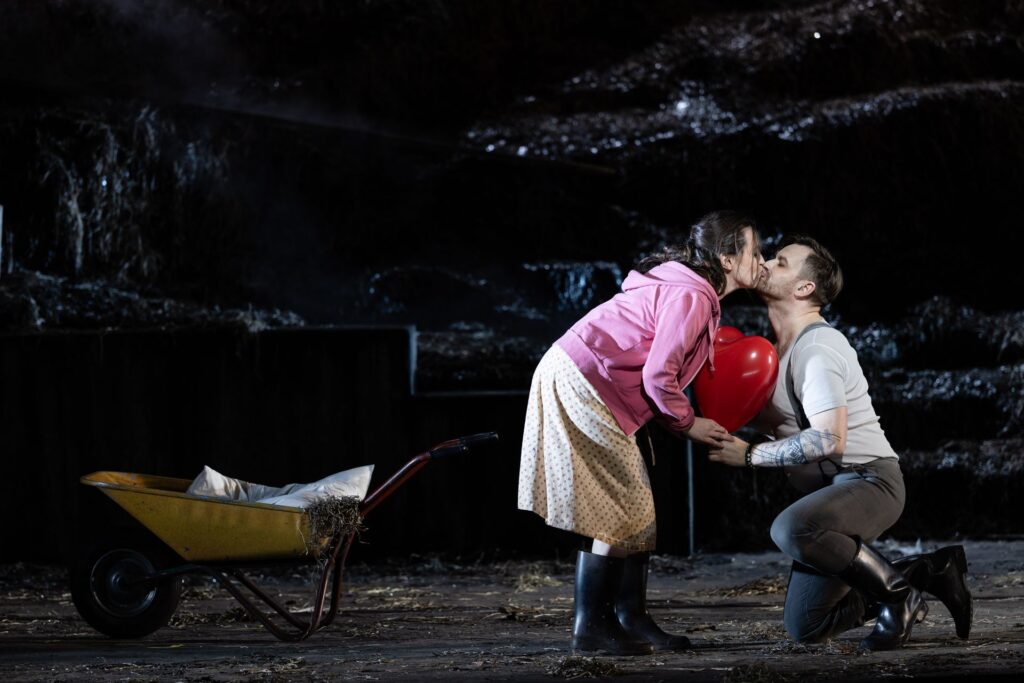
Among the supporting cast, Pawel Horodyski, as Muff, stood out strongly. It’s a small role, but he stamped every entrance with crisp diction, steady tone, and a confidence that made him immediately noticeable. He is one of those singers who fills his stage time without inflating it, and it was a pleasure to see him shine. Christian Rieger’s Kruschina opened the evening with sturdy, good-natured authority; Juliane Banse brought warmth and finesse to Kathinka; Martin Snell was a solid, grounded Micha; Katja Pieweck’s Agnes had bite and personality, an earthy presence that carried well.Mario Lerchenberger gave a bright, buoyant Hans with clean projection, while Martin Winkler threw himself into Kezal with the right mix of vocal weight and comic bravado. Jinxu Xiahou, replacing Kevin Conners as Springer, brought welcome precision and charm, and Erika Baikoff’s Esmeralda added a touch of sparkle and vocal freshness that lifted her scenes.
And then, in the pit, Tomáš Hanus held the whole musical machine together with remarkable flair. He conducted not only with buoyancy and lightness — though both were abundant — but with a sense of precision inside the joy. Too often, in this repertoire, conductors equate “comic opera” with “let it all go and hope for the best.” Hanus did the opposite: he shaped the music with clarity, drove the rhythms with infectious swing, and animated the textures without ever turning them hectic. The orchestral playing had a spring in its step, but also elegance and discipline. What impressed most was the coherence: crisp articulations, warm phrasing, and a tempo sense that served the singers at every turn while keeping the evening moving with irresistible momentum. The BSO orchestra sounded genuinely engaged — not just accompanying, but participating in the comedy with subtle detail and colour. Franz Obermair’s chorus matched that with bright tone and lively dramatic presence, completing the sense of a full company working in one direction.
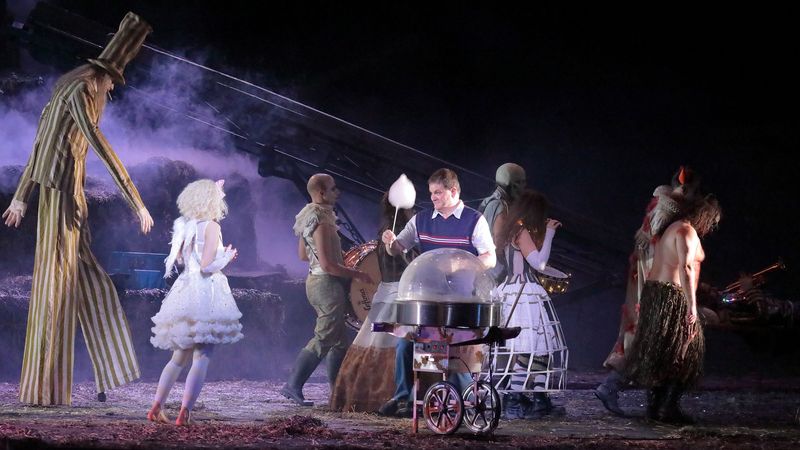
The end result was an opera evening that felt totally uninhibited, fully alive, and refreshingly free of cynicism. Die verkaufte Braut thrives on exactly that mix of charm and craft, and here it came wrapped in the happy shock of a house full of young people laughing, cheering, and discovering — some maybe for the first time — that opera can be fun, quick, modern, human. This was not a night of big statements or grand ambitions. It was something rarer: an evening that simply made everyone feel good, without ever sacrificing musical quality. And that is its own form of artistry.
***
Cast
Kruschina: Christian Rieger
Kathinka: Juliane Banse
Marie: Emily Pogorelc
Micha: Martin Snell
Agnes: Katja Pieweck
Wenzel: Ya‑Chung Huang
Hans: Mario Lerchenberger
Kezal: Martin Winkler
Springer: Jinxu Xiahou
Esmeralda: Erika Baikoff
Muff: Paweł Horodyski
Musikalische Leitung: Tomáš Hanus
Inszenierung: David Bösch
Bühne: Patrick Bannwart
Kostüme: Falko Herold
Licht: Michael Bauer
Chor: Franz Obermair
Dramaturgie: Rainer Karlitschek, Lukas Leipfinger