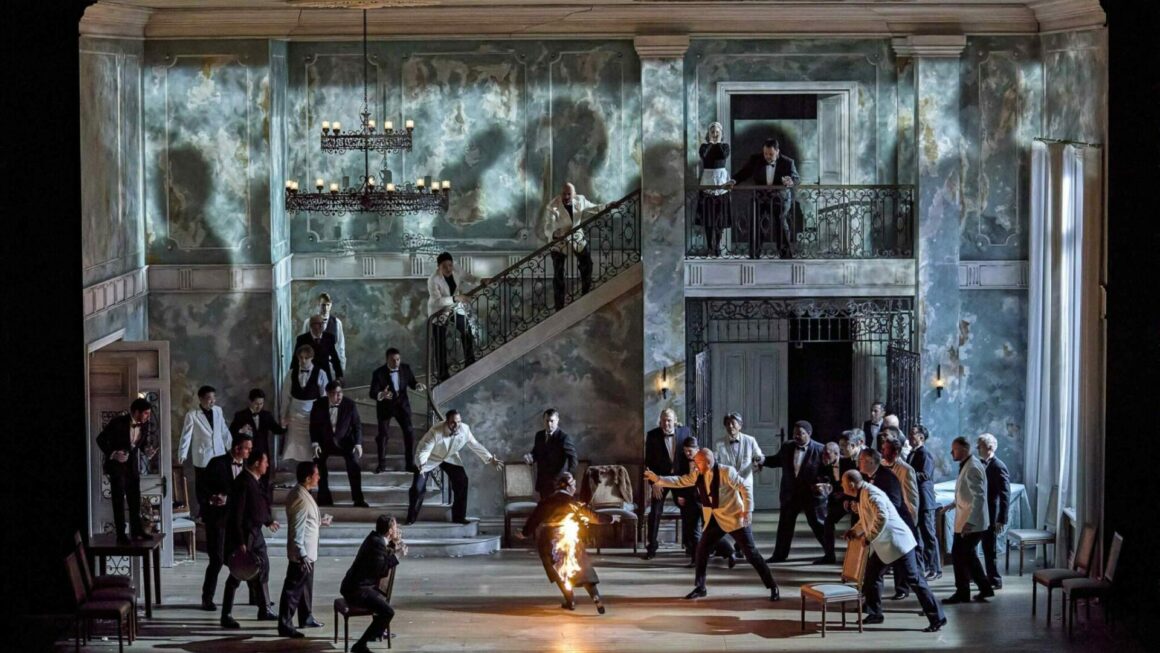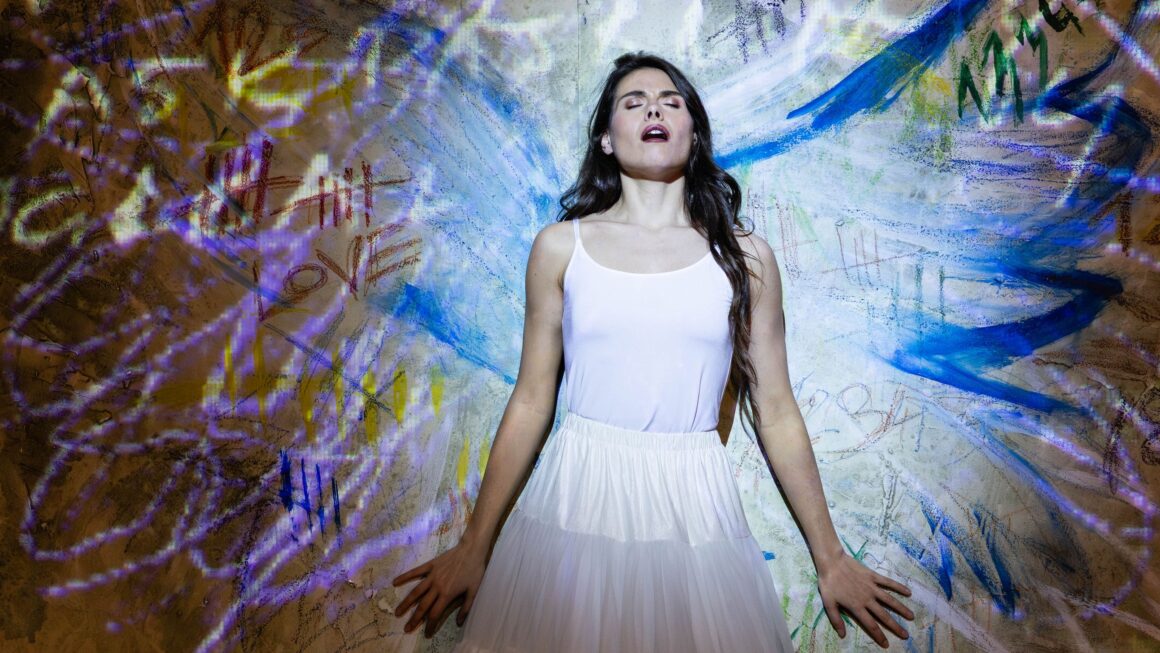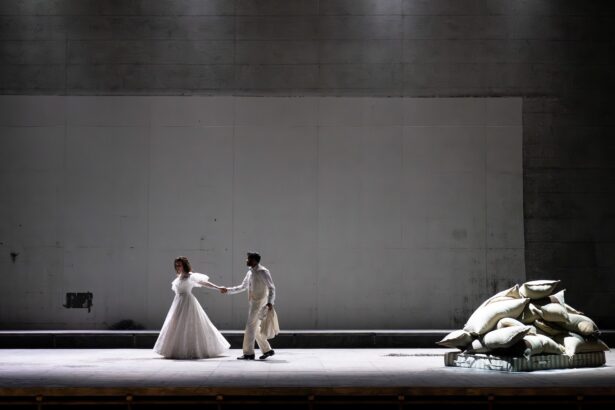
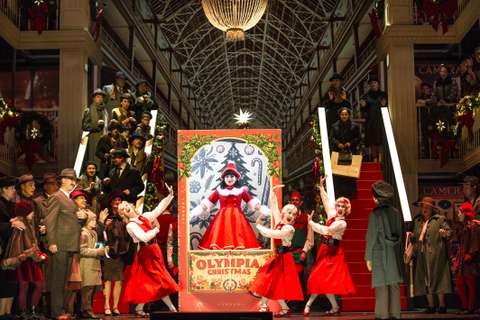
Few works demand such a precarious equilibrium between fantasy and coherence as Les contes d’Hoffmann. Too much caricature, and the piece collapses into vulgarity; too much restraint, and its surreal poetry evaporates. Lydia Steier’s production navigates this tightrope with notable intelligence, embracing both the grotesque and the refined without ever allowing one to cancel out the other. The result is a series of striking tableaux—visually accomplished, rhythmically alive, and above all theatrically functional. It works.
In the pit, Pierre Dumoussaud delivers what can only be described as a benchmark performance. From the outset, his reading imposes itself through its theatrical vitality, its rhythmic precision, and a constantly renewed palette of colors. This is not merely well-conducted Offenbach; it is thought Offenbach, shaped with a clear dramaturgical vision. The Antonia act, in particular, reveals details and inner lines rarely perceived with such clarity, as if the score were being rediscovered in real time. One senses throughout an acute understanding of the work’s hybrid nature—half opéra-comique, half proto-symbolist dream—and Dumoussaud proves himself here as a major reference in this repertoire.
At the center of the evening, Benjamin Bernheim confirms—if confirmation were still needed—his status as the leading Hoffmann of today. The performance is remarkable not only for its vocal perfection but for its stylistic intelligence and consistency across the opera’s shifting aesthetics. From the lyrical expansion of “Il était une fois à la cour d’Eisenach” to the poetic introspection of “Ô Dieu! de quelle ivresse,” and the radiant line of “C’est une chanson d’amour,” everything is in place: impeccable diction, effortless projection, and a timbre that combines brightness with substance. Above all, Bernheim succeeds in maintaining a coherent character throughout the three acts, despite their contrasting demands—a rare achievement in this notoriously fragmented role.
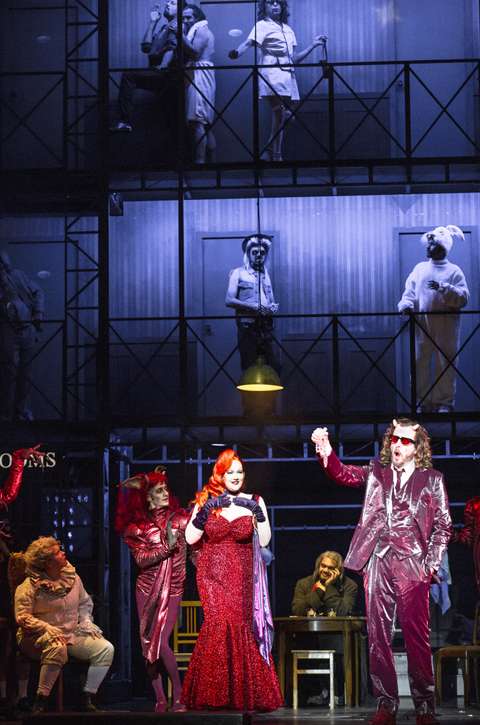
Facing him, Alex Esposito delivers a masterclass in characterization across the four villain roles. Too often reduced to a unidimensional figure of evil, the diabolical presence here gains nuance and depth through Esposito’s combined vocal and theatrical intelligence. The timbre remains consistently beautiful, but it is his ability to inflect it—by turns seductive, unsettling, and openly menacing—that truly impresses. His interventions, from Coppélius’ grotesque irony to Dr. Miracle’s chilling authority and Dapertutto’s dangerous elegance (notably in “Scintille, diamant”), structure the evening and provide it with its necessary dramatic spine. A captivating, disturbing, and always credible embodiment.
A particular mention must be made of Ema Nikolovska, stepping in as the Muse/Nicklausse under demanding circumstances. Such last-minute appearances often reveal their limits; here, the opposite occurs. She not only meets the challenge but fully rises to it, delivering a performance of remarkable musical and dramatic coherence. The voice blends seamlessly with Bernheim’s in their shared scenes, while maintaining a distinct identity—warm, flexible, and expressive. Beyond the technical success, it is the artistic authority of the performance that impresses most: nothing feels improvised or approximate.
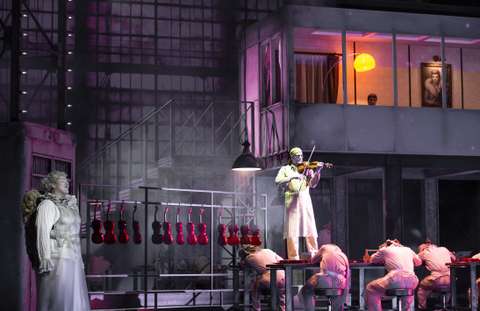
Among the secondary roles, Andrés Moreno García emerges as a genuine revelation. In his multiple appearances (Andrès, Cochenille, Frantz, Pitichinaccio), he displays a tenor of striking freshness and brilliance, immediately catching the ear. The timbre is vibrant, the projection easy, and the musical instincts evident. One leaves wondering how such a voice could have remained under the radar until now.
The three female protagonists each fulfill their demanding assignments with precision and stylistic awareness. Regina Koncz’s Olympia delivers the expected virtuosity in “Les oiseaux dans la charmille,” combining agility with a controlled mechanical edge that avoids caricature. Siobhan Stagg’s Antonia finds the right balance between lyricism and fragility, her “Elle a fui, la tourterelle” shaped with sincerity and line, while the great trio with Dr. Miracle reaches a convincing dramatic intensity. Sandra Laagus’ Giulietta brings the necessary allure and vocal presence to the Venetian act, notably in the Barcarolle, ensuring that this often problematic episode retains its seductive power.
Around them, the ensemble proves consistently strong: Irakli Pkhaladze (Luther), David Oštrek (Hermann), Junho Hwang (Nathanaël), Florian Hoffmann (Spalanzani), and Bálint Szabó (Crespel) all contribute with solidity and style, while the chorus, prepared by Dani Juris, fulfills its role effectively within Steier’s fluid staging.
In sum, an evening carried by a rare conjunction of elements: a conductor who redefines expectations, a tenor at the absolute peak of his art, and a production that understands the delicate nature of the work it serves. Under such conditions, Les contes d’Hoffmann ceases to be a problematic masterpiece and becomes, quite simply, great theatre.
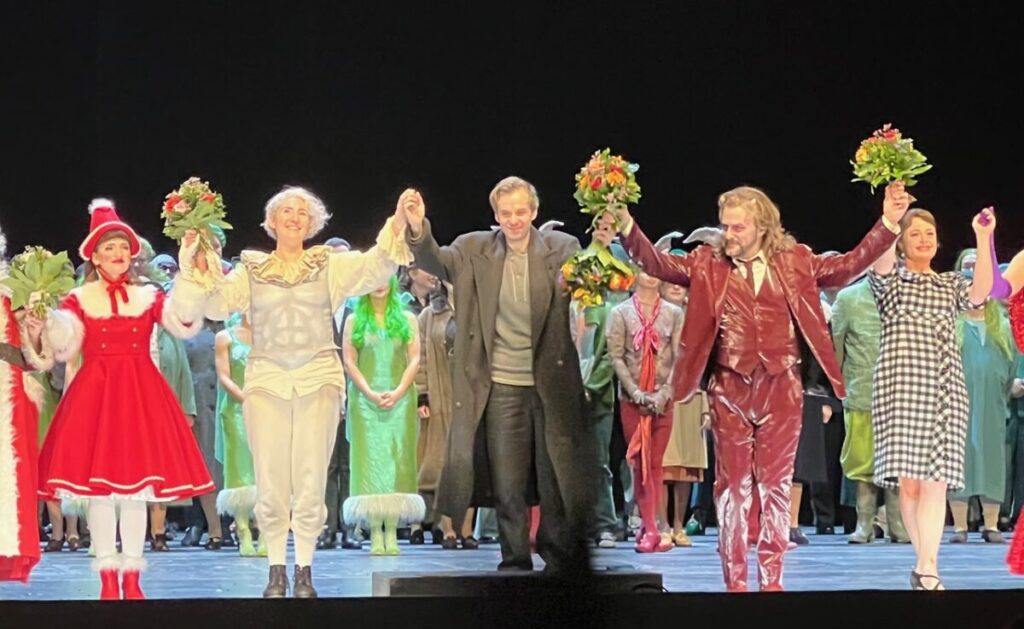
CAST
Hoffmann
Benjamin Bernheim
Olympia
Regina Koncz
Antonia
Siobhan Stagg
Giulietta
Sandra Laagus
Lindorf / Coppélius / Dr. Miracle / Dapertutto
Alex Esposito
La Muse / Nicklausse
Ema Nikolovska
Cochenille / Frantz / Pitichinaccio / Andrès
Andrés Moreno García
Luther
Irakli Pkhaladze
Hermann
David Oštrek
Nathanaël
Junho Hwang
Spalanzani
Florian Hoffmann
Crespel
Bálint Szabó
Stimme aus dem Grab
Natalia Skrycka
Schlémil
Jaka Mihelač
Die alte Dame
Brigitte Eisenfeld
———
Musical Team
Conductor
Pierre Dumoussaud
Chorus Master
Dani Juris
———
Production Team
Director
Lydia Steier
Revival Direction
Leander Teßmer, Katharina Lang
Set & Video Design
Momme Hinrichs
Costume Design
Ursula Kudrna
Lighting Design
Olaf Freese
Choreography
Tabatha McFadyen
Dramaturgy
Maurice Lenhard, Christoph Lang