There is something quietly miraculous about Il Trovatore. Dismissed by snobs and adored by the masses, Verdi’s most melodically concentrated opera has always thrived on a certain paradox: the more absurd the plot, the more overwhelming the music. On this Saturday evening at the Opéra de Monte-Carlo — that jewel of a house where the chandeliers and the welcome are equally warm — the paradox resolved itself with spectacular ease, thanks to a cast of such consistent quality that the evening became, by its final curtain, something considerably more than the sum of its parts.
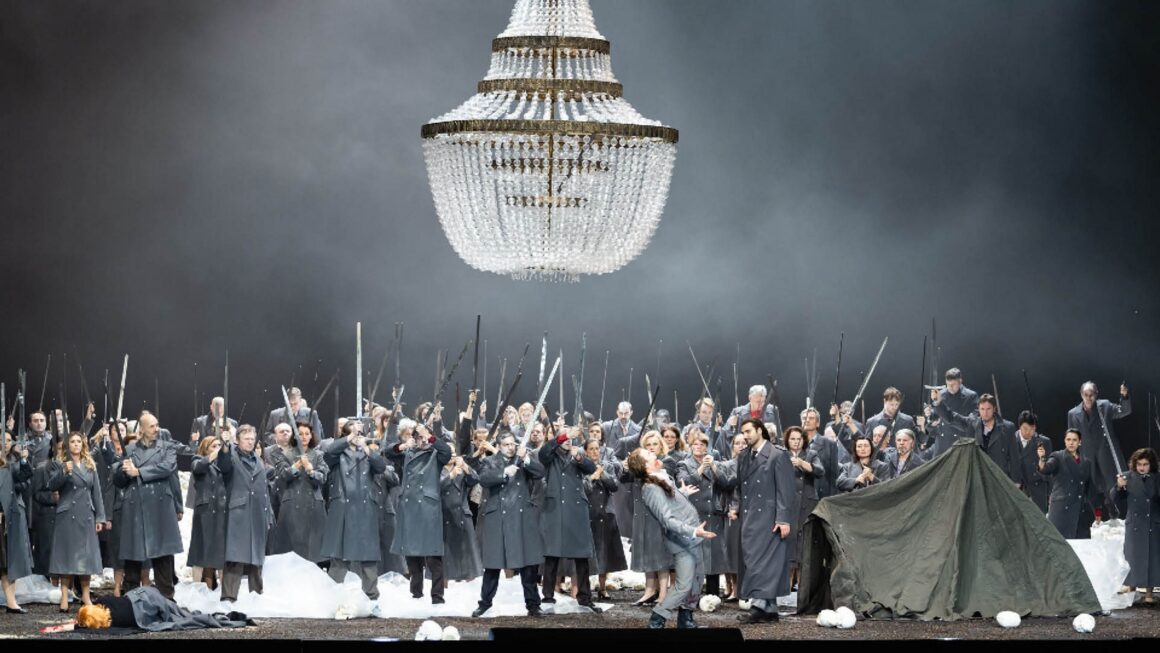
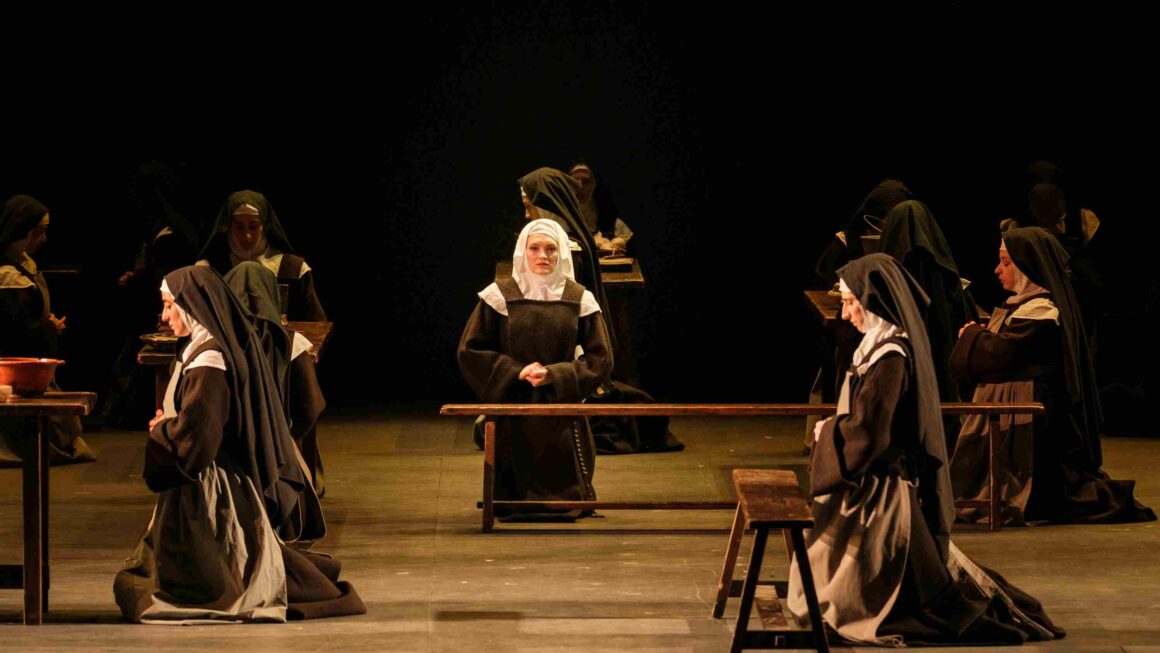
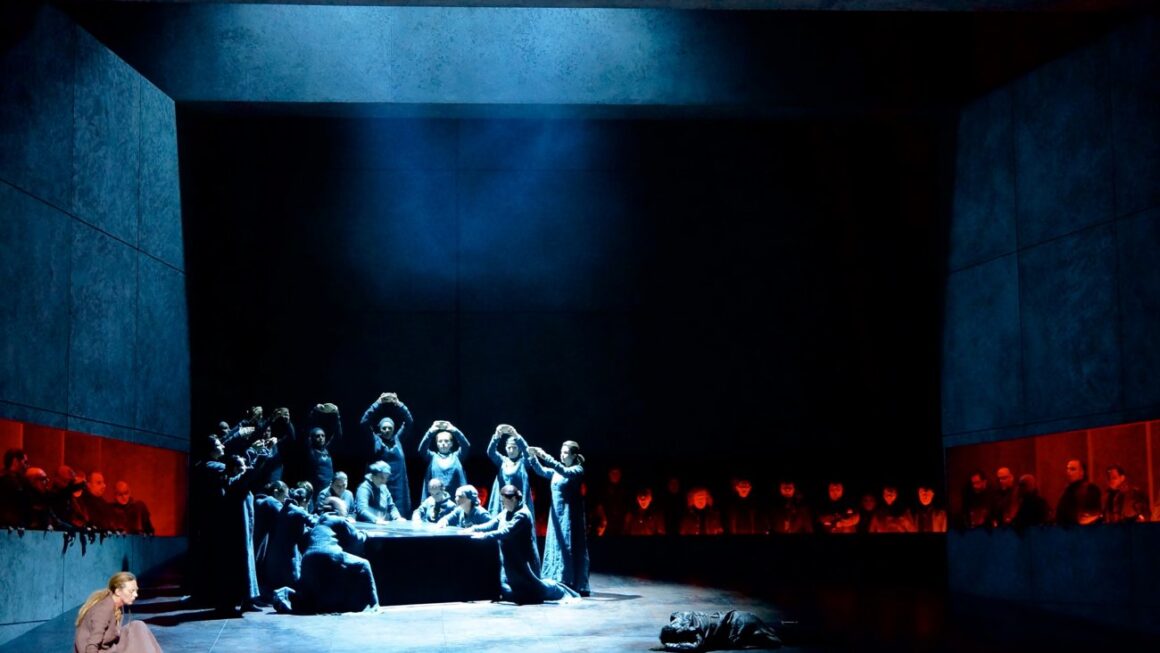
Francisco Negrin’s production, designed with elegant austerity by Louis Désiré and burnished by Bruno Poet’s lighting, provides an intelligent theatrical framework — somewhere between ritual and shadow play — that serves the score without competing with it. The aesthetic is sober, occasionally austere, but always purposeful: dark, striated sets allow the singers to inhabit the drama rather than simply navigate it. Giacomo Sagripanti, on the podium, brings his customary surgical precision and theatrical instinct to bear on the Orchestre Philharmonique de Monte-Carlo, whose rich, supple sound proves wonderfully suited to Verdian lyricism. He knows this music intimately, and it shows: tempi are alive, never willful; the ensemble breathes with its singers; and the orchestra’s colours — warm brass, tender strings — fill the intimate hall with something close to inevitability.
The evening’s most striking discovery is Varduhi Abrahamyan as Azucena. Everything one could ask for is here — the smouldering middle register, the fearless chest tones, the intelligence that transforms a seemingly irrational role into one of Verdi’s most psychologically compelling figures. Her “Stride la vampa” arrives like a premonition, and her Act II narration — coiled, volcanic, brilliantly paced — holds the theatre in near-paralysis. Her final scene, alongside Manrico, is devastating. It is the kind of singing that makes one grateful for live opera.
As Leonora, Alexandra Marcellier offers a role debut of rare authority. Hers is a true soprano lirico, warm and centered throughout the range, with a tone that carries genuine nobility — the right kind for a woman who chooses death over dishonor. What strikes most is her integration of word and sound: the text is fully inhabited, never decorative. Her long Act IV stretch, from the convent scene through to the dungeon, is sustained with impressive control and emotional coherence: the anguished “D’amor sull’ali rosee” blossoms with both technical assurance and tenderness, while her scenes with the Count and with Manrico crackle with the dramatic urgency that Verdi demands. A debut to remember.
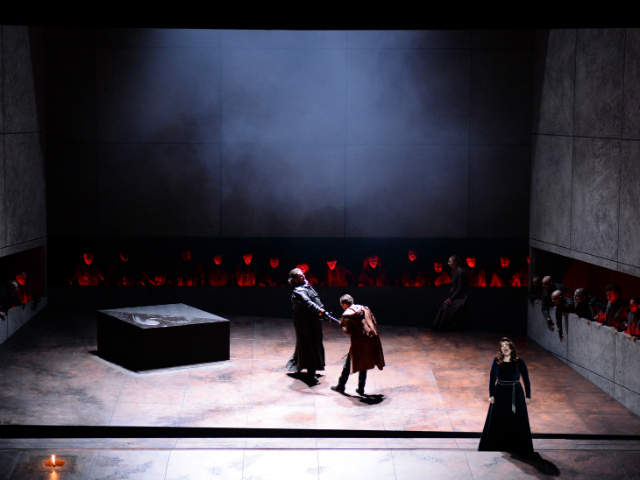
Piero Pretti returns — or rather, reveals himself anew — as Manrico. One had perhaps not heard him in a role of such sustained dramatic intensity, and if the first minutes suggest a certain caution in the warm-up, the rest erases all doubt. By Act II he is fully ignited: his “Parlar non voglio” is majestic, the voice carrying both heroic squillo and expressive depth. The top is ringing and free, the middle warm and well-supported, and the ardor is completely convincing. A Manrico to be reckoned with.
Artur Ruciński confirms everything one already knew about his exceptional Verdian musicianship. The baritone brings to the Conte di Luna a combination of noble timbre, flawless legato, and dramatic intelligence that few can match in this repertoire. His Act II aria — delivered seated at the edge of the stage with almost arrogant ease — is a model of the form: squillo intact, line unbroken, characterisation never sacrificed for effect. The role fits him like a well-tailored coat.
The bass Evgeny Stavinsky completes the picture with a Ferrando of striking presence and vocal warmth. The voice is full and dark without heaviness, the opening narrative dispatched with authority and color — a fine beginning to a thoroughly satisfying evening.
The comprimario roles — Annunziata Vestri’s attentive Inès, Reinaldo Macias’s dependable Ruiz, Benoit Gunalons as the Messenger, Morena di Vico as Azucena’s mother — are all held with care and commitment. The Chorus of the Opéra de Monte-Carlo, prepared by Stefano Visconti, sounds superb: disciplined, engaged, and dramatically present throughout.
One leaves the Salle Garnier in that particular state Il Trovatore alone can produce — somewhere between exhilaration and melancholy, still reverberating with Verdi’s most unstoppable melodic machine. What an opera. What an evening. And what a house.
CAST Le Comte de Luna — Artur Rucinski Leonora — Alexandra Marcellier Azucena — Varduhi Abrahamyan Manrico — Piero Pretti Ferrando — Evgeny Stavinsky Inès — Annunziata Vestri Ruiz — Reinaldo Macias Le Messager — Benoit Gunalons Mère d’Azucena — Morena di Vico Chœur de l’Opéra de Monte-Carlo Orchestre Philharmonique de Monte-Carlo
Direction musicale — Giacomo Sagripanti Mise en scène — Francisco Negrin Décors et costumes — Louis Désiré Lumières — Bruno Poet Chef de Chœur — Stefano Visconti Chef de chant — David Zobel Assistant à la mise en scène — Jean-Michel Criqui Assistant aux costumes — Nicolo Cristiano Assistant aux lumières — Robert Butler