Verdi was thirty-three years old. The great trilogy did not yet exist. Rigoletto, Trovatore, Traviata — none of it. And yet here he was, producing this: an opera about guilt and madness, about power that corrodes and blood that will not wash away, with a musical language of such maturity and such darkness that he himself would never quite find his way back to it. The mystery of Macbeth lies partly there — in that vertiginous precocity, in the sense that Verdi had touched something essential before he had even fully constructed his own idiom. Every new encounter confirms and deepens it. And if one were searching for the most radical argument in favour of opera as a superior art form — superior to theatre alone, superior to the concert hall, capable of things neither can achieve — Macbeth may be the single most crushing piece of evidence available. The music does not illustrate the characters’ psychology: it is that psychology. Precisely where Shakespeare’s language reaches its limits, Verdi’s begins.
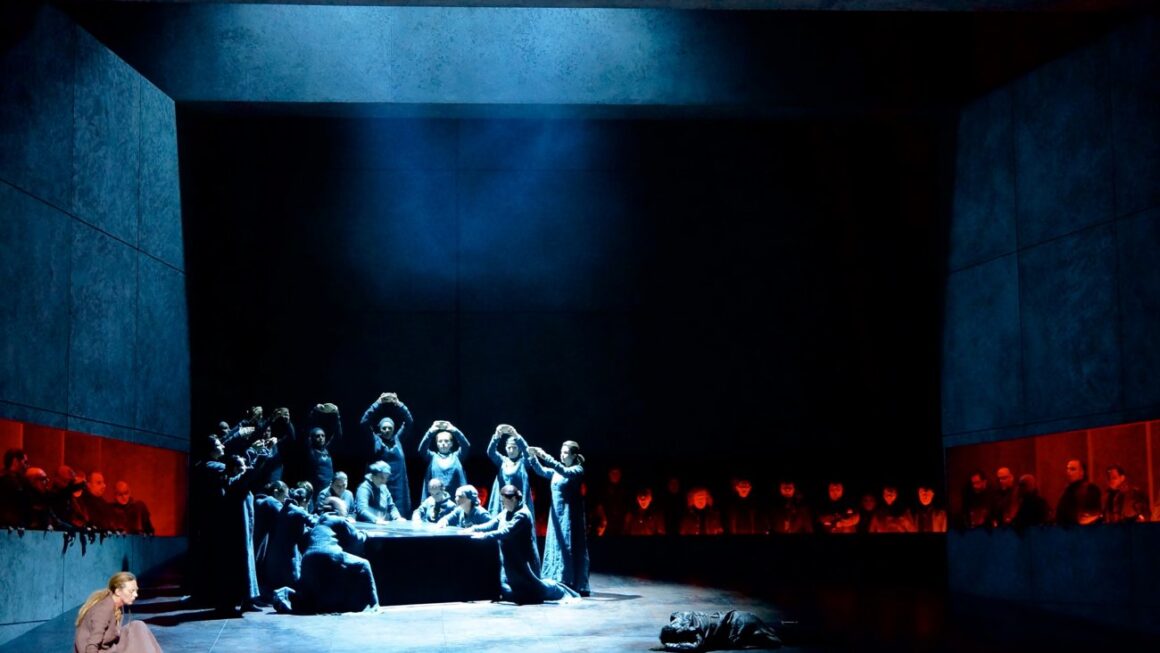
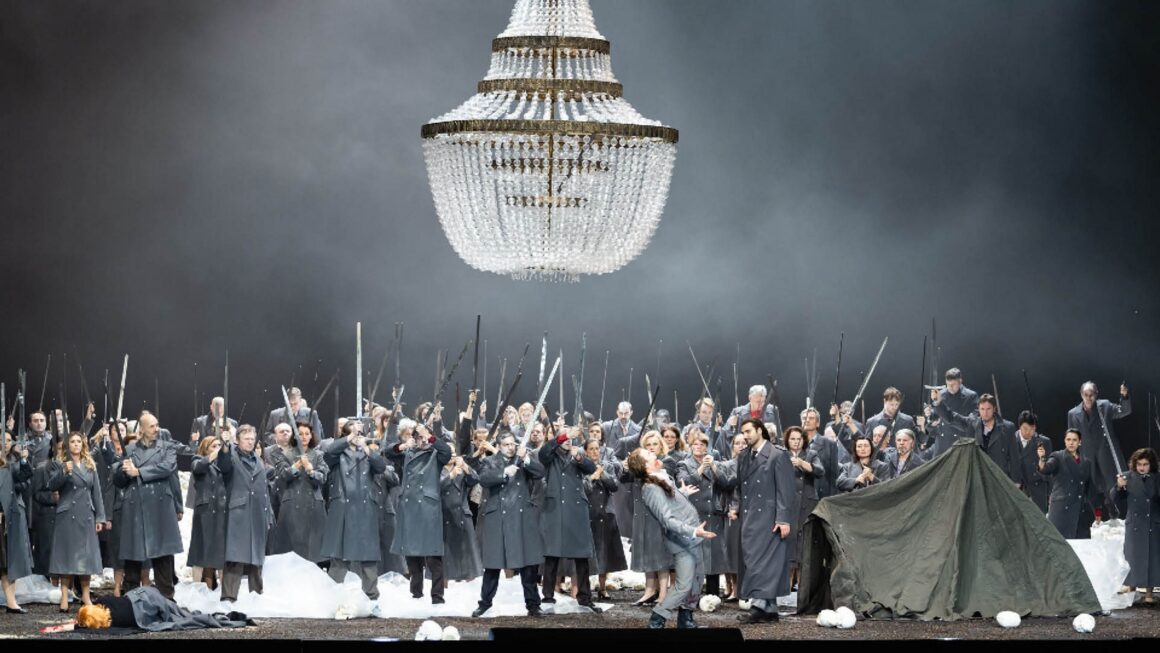
Martin Kušej‘s production, familiar to Munich audiences from several revivals, continues to deliver on its dark promise. The staging presses relentlessly on the psychotic core of the drama: there is no grandeur here, no pageantry, only a creeping, airless paranoia rendered concrete by Martin Zehetgruber‘s austere set design and — above all — by Reinhard Traub‘s lighting, which deserves a paragraph of its own. What Traub does with shadow and oblique cold light in this production is nothing short of monstrous, in the best possible sense: faces loom and vanish, thrones materialize from blackness, the witches emerge as though secreted by the walls themselves. The cumulative effect is of a world where visibility itself has become unreliable — a perfect visual correlate for minds that can no longer distinguish between what is real and what guilt has manufactured.
Andrea Battistoni, who knows this production intimately, draws playing of exceptional relief and brilliance from the Bayerisches Staatsorchester. His reading is relentlessly theatrical: the witches’ music crackles with a percussive ferocity that jolts the hall, the sleepwalking scene is reduced to a barely breathing pianissimo of devastating fragility, and the transitions between public spectacle and private anguish are navigated with impressive control. The orchestra sounds as though it has absorbed the opera’s own instability — glittering when it should, murderous when it must. The chorus, prepared by Christoph Heil, is magnificent throughout, from the snarling opening to the exultant finale.
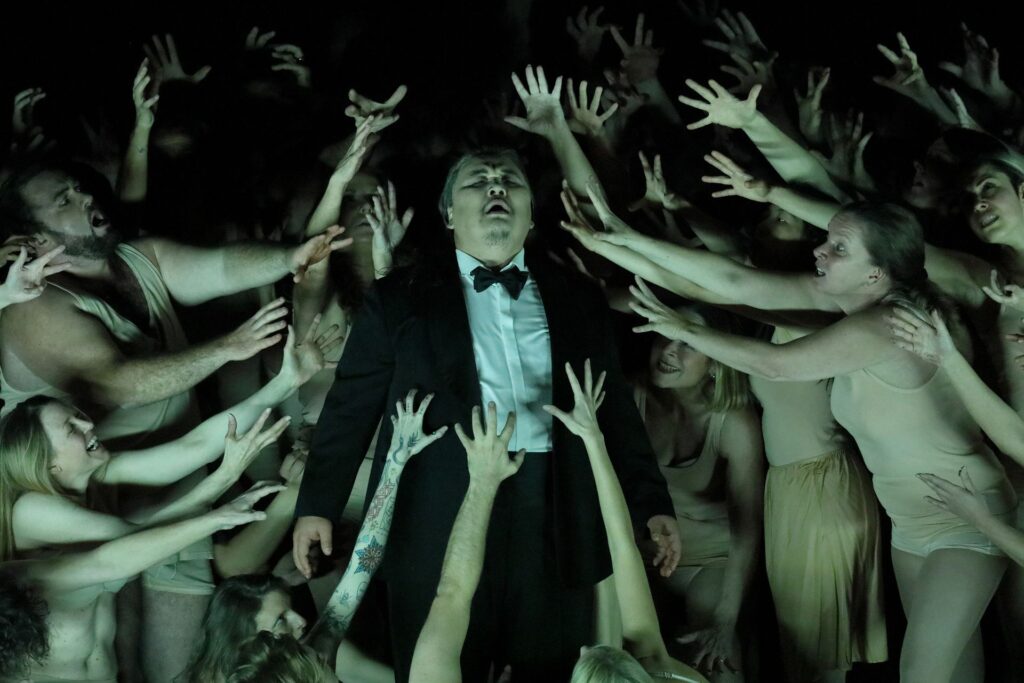
Then there is Amartuvshin Enkhbat. One wishes there were a way to say this without sounding hyperbolic, but having considered it carefully: there is no need for restraint. This is a Macbeth of absolute, unqualified greatness — the kind that arrives perhaps once or twice in a generation, and that those who witness it will recount for the rest of their lives. One finds oneself hoping, genuinely and almost urgently, that audiences understand the privilege. Not since the legendary recordings of the past does one encounter a Verdian baritone in whom every element converges so completely: the natural beauty of the timbre, the ease of the high register, the weight in the middle voice, the legato that breathes across long phrases without apparent effort, the squillo that cuts through the largest orchestral textures without hardening into a weapon. And beyond the purely vocal: an actor of total inhabitation, a man visibly consumed by the role’s catastrophic arc. His final aria — “Mal per me che m’affidai” — is the summit of the evening, and possibly of the season. The high notes arrive warm and effortless, without the slightest suggestion of strain or calculation. There are, in that final stretch, shivers and tears — not as a figure of speech, but as a simple statement of fact. Go and hear this man while you can. It is a privilege without equivalent in the current operatic landscape.
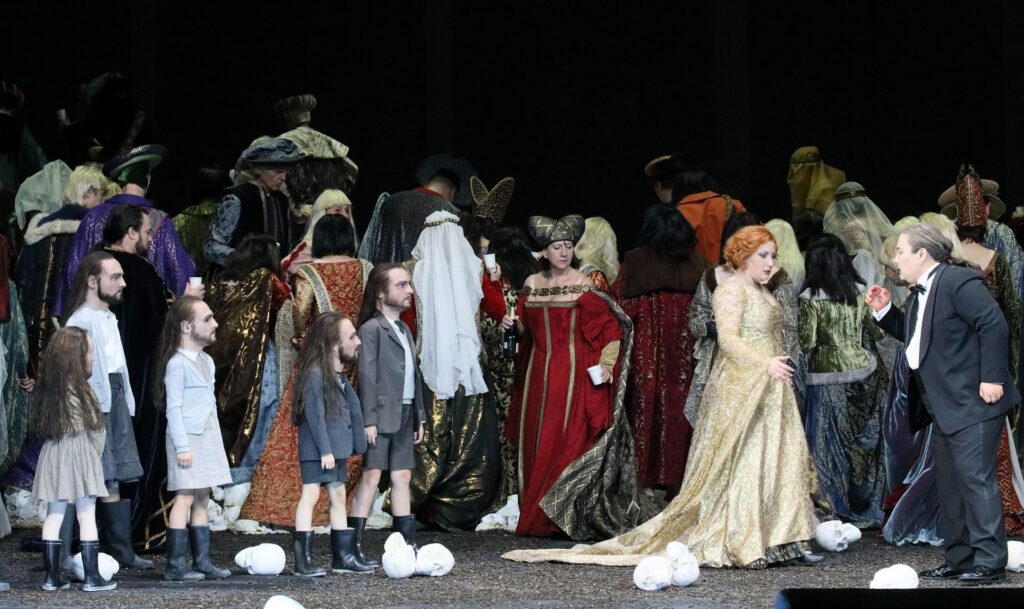
Beside him, Saioa Hernández inhabits Lady Macbeth as though the role were written with her particular instrument in mind — which, in a meaningful sense, it was. The role is a marathon of the most pitiless kind: Verdi asks for a voice that is simultaneously seductive and ferocious, capable of the softest mezza voce and the most cutting dramatic thrust, and that can sustain coherent characterisation across an arc of devastating psychological deterioration. Hernández meets every demand. Her Act II finale — the banquet scene, where Lady Macbeth attempts to hold the social edifice together through sheer force of will while her husband unravels before the assembled court — is a tour de force of musical acting: the voice bright and commanding on the surface, something unravelling audibly underneath. And her “Una macchia è qui tuttora” — the sleepwalking aria, that extraordinary nocturnal hallucination — is simply harrowing: the tone bleached, the ornaments spectral, the whole thing delivered with the blank, terrible logic of a mind that has gone somewhere it cannot return from.
SeokJong Baek is the evening’s most welcome discovery. His is a voice that feels, frankly, almost too large for Macduff — a heroic instrument built for ampler demands, the kind that makes one immediately curious about what it will do with Radamès, or Otello, or Don Alvaro. But that excess of means produces its own dividend in Act IV: “Ah, la paterna mano” emerges as a sustained cry of grief of considerable force, the voice riding the orchestral swell with total security and genuine emotional weight. Supersized or not, the effect is sublime.
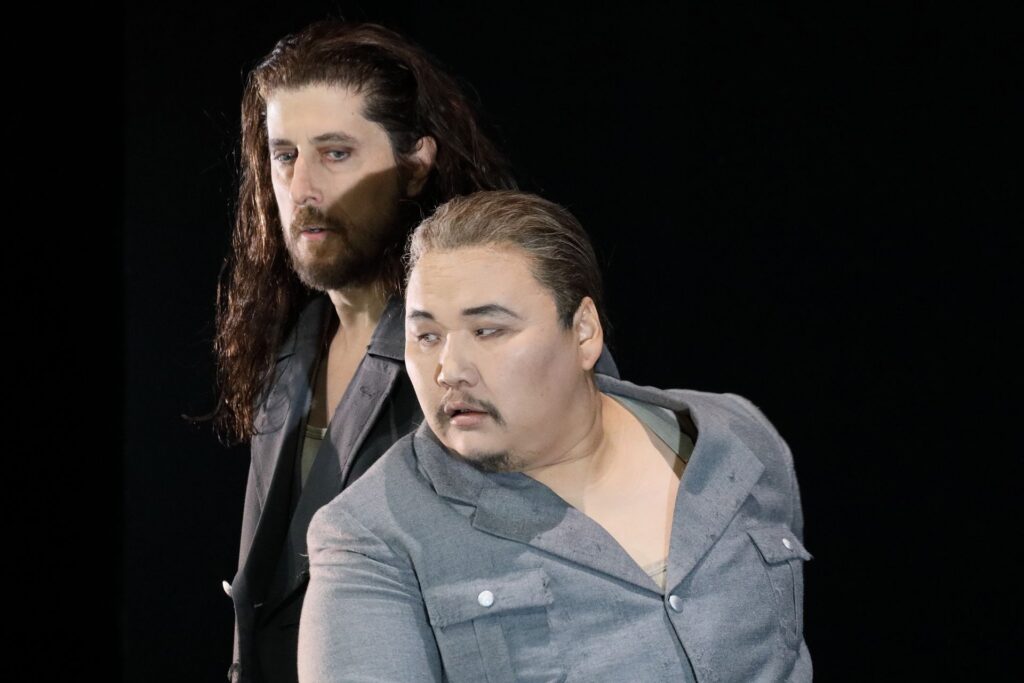
Roberto Tagliavini‘s Banco is, as ever, the very model of what this role requires: dark, noble, immovably present. His “Come dal ciel precipita” settles over the hall like a benediction — warm bass cantilena, impeccable legato, not a syllable wasted. Nontobeko Bhengu brings care and vocal intelligence to the Lady-in-Waiting, earning her moment in the sleepwalking scene with quiet conviction; Samuel Stopford‘s Malcolm is clear-voiced and engaged; Martin Snell‘s Doctor once again demonstrates why ensemble singers of his calibre are the backbone upon which productions of this level depend. Sebastian Huber and Olaf A. Schmitt‘s dramaturgical work ensures that the evening’s conceptual logic never falters.
One leaves the Nationaltheater — that most imposing of houses — with the strange, heightened sensation that great Verdi uniquely produces: shaken, exhilarated, and somehow more awake to the world’s precariousness than one was three hours before. This is what absolute and total art does. Long live Verdi, long live opera, and long live the extraordinary artists who make evenings like this possible.
BESETZUNG
- Macbeth — Amartuvshin Enkhbat
- Banco — Roberto Tagliavini
- Lady Macbeth — Saioa Hernández
- Macduff — SeokJong Baek
- Malcolm — Samuel Stopford
- Dame der Lady Macbeth — Nontobeko Bhengu
- Arzt — Martin Snell
- Diener / Mörder — Christian Rieger
- Erscheinung 1 — Bruno Khouri
- Erscheinung 2 — Iana Aivazian
- Erscheinung 3 — Solist(en) des Tölzer Knabenchors
PRODUCTION
- Musikalische Leitung — Andrea Battistoni
- Regie — Martin Kušej
- Bühne — Martin Zehetgruber
- Kostüme — Werner Fritz
- Licht — Reinhard Traub
- Chor — Christoph Heil
- Dramaturgie — Sebastian Huber, Olaf A. Schmitt