RIGOLETTO | Bayerische Staatsoper

New Rigoletto at the Bayerische Staatsoper. Should we go? And if so, why? For the story? Not really, as it belongs to that category of operas whose libretto reveals all its secrets and nuances after just a few listens. For the music? Certainly, as this little operatic gem, when well performed, continues to surprise with each hearing through its intensity and its irresistible forward momentum. For the love of live performance? Definitely—especially in this configuration, and in the sacred temple that is the Bayerische Staatsoper.
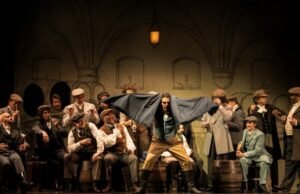
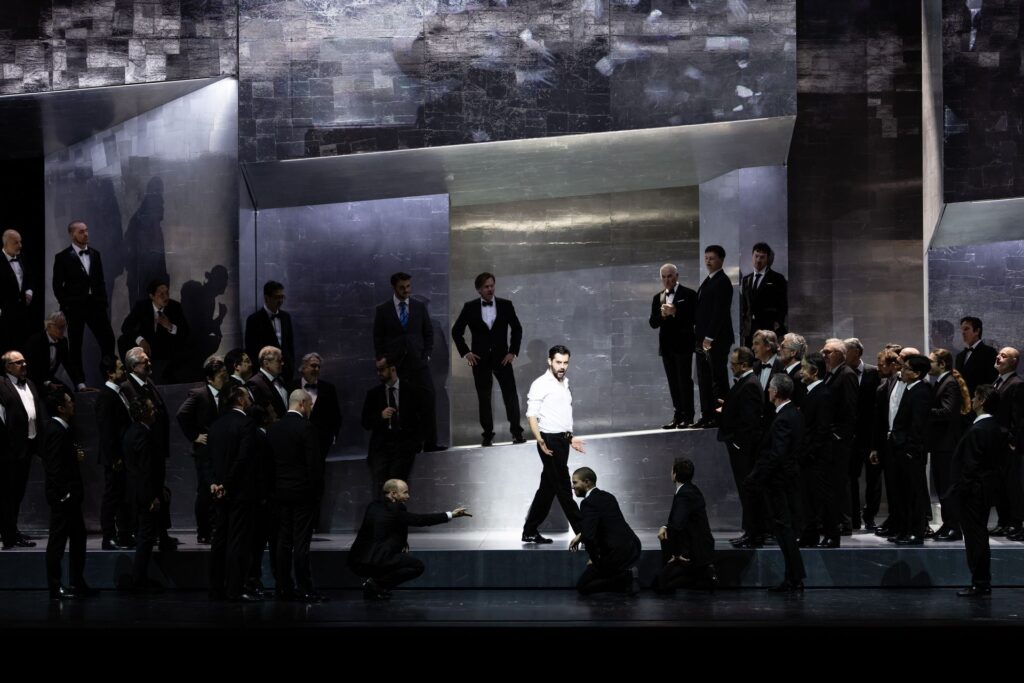
That configuration: a promising new production by Barbara Wysocka, with Barbara Hanicka on staging, somewhere between glittery, underground, and BDSM aesthetics. After all, perfectly suited to this work—highly theatrical, yet at the same time very much anchored in its historical context. The concept works: if it does not mark a strikingly innovative break from what has been seen in recent years for the first installment of the Trilogia popolare, it nonetheless provides an intelligent framework and structure for the full flourishing of the score (one example among others: the quartet Bella figlia dell’amore, sung with the four protagonists side by side rather than scattered across the stage as is often the case, helping to achieve a more organic and unified sound in this pivotal moment of the opera). Special mention must be made of Julia Kornacka (costumes), Marc Heinz (lighting), and Malte Krasting (dramaturgy), as well as their respective teams, whose work proves essential to the smooth unfolding of a production at such a high level of quality.
In theory, then, ideal conditions for the orchestra to thrive… which in fact proves to be the evening’s Achilles’ heel. The cause: Maurizio Benini’s almost symphonic approach, whose warm colors drawn at times from the Bavarian orchestra come at the expense of theatricality and vocal comfort. While certain passages verge on perfection (such as the extended exchange between Rigoletto and the courtiers in Act II), others almost elicit sympathy for the singers, at times out of breath, worn down by very slow tempi whose artistic added value is not always evident. A pity for a score so full of vital impulse. By contrast, the sublime instrumental timbres of the Bavarian orchestra and the equally impressive chorus prepared by Christoph Heil (one can hardly keep still during the Machiavellian Zitti, zitti, however often heard) provide the soloists with a reliable and comfortable foundation.
The true cornerstones of this Munich Rigoletto, the singers each deliver impeccable performances, ultimately ensuring the production’s overall success.
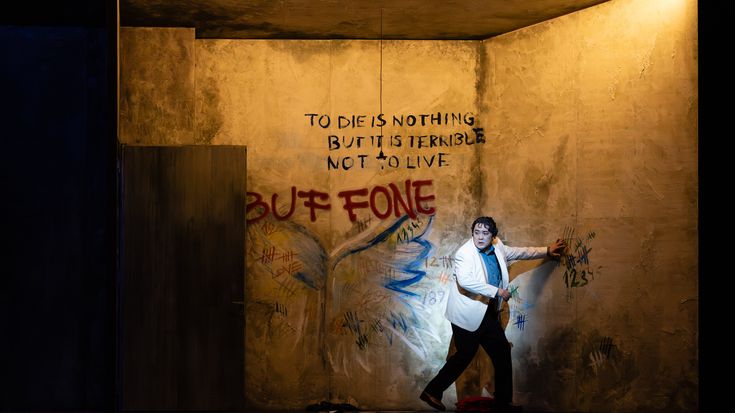
First among equals, Ariunbaatar Ganbaatar further confirms the as surprising as welcome status Mongolia has acquired in recent years on the operatic scene: that of a reservoir of the finest Verdi baritones in the industry. Beyond the apparent ease and the natural beauty of the timbre, everything is in place: flawless projection and squillo, an excellent passaggio, abundant colors, and perfectly balanced bel canto inflections. If it is difficult to single out a particular moment within this ocean of quality, his final scene stands as a model of its kind (the sublime near-final phrase Se t’involi, che sol rimarrei, non morire, o ch’io teco morrò! resonates with particular poignancy).
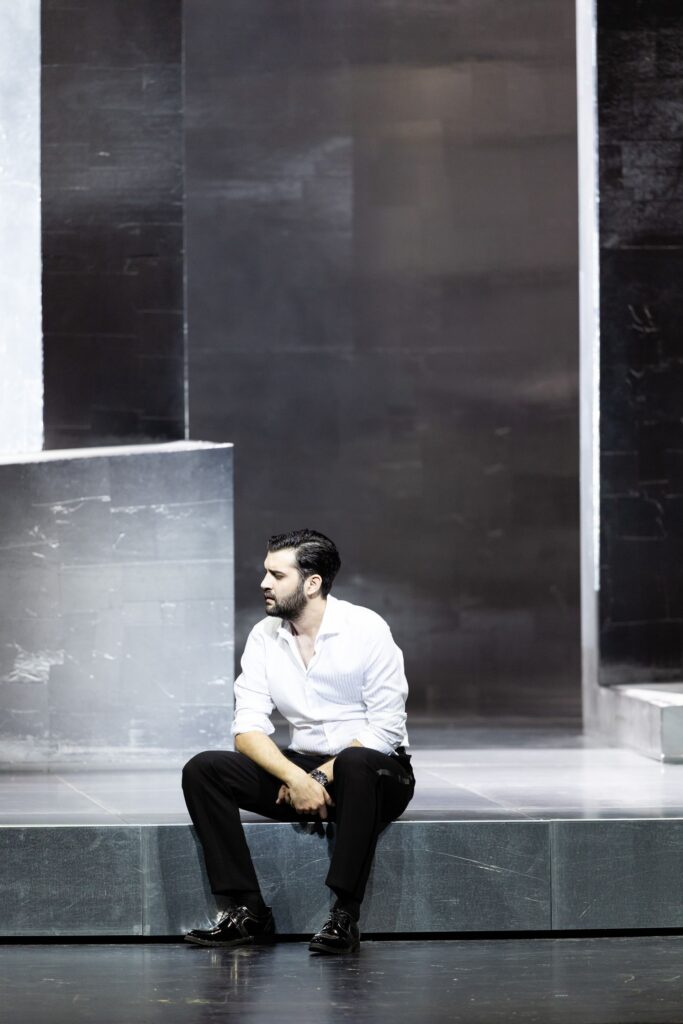
To match such a Rigoletto, one needs a Duke as unrestrained as he is balanced—a typically Verdian tightrope act, which Bekhzod Davronov meets with both poise and virtuosity. His impressive toolkit, perfectly suited to this repertoire, continues to assert itself month after month, production after production: flexibility in the upper register, support and density in the middle, and a golden timbre increasingly refined toward the standards of his most illustrious predecessors. His Act III, crowned by La donna è mobile, encapsulates this overall impression. One should also note an acting style that is becoming ever more natural and convincing—apparently healthy, intelligent, and coherent with his instrument.
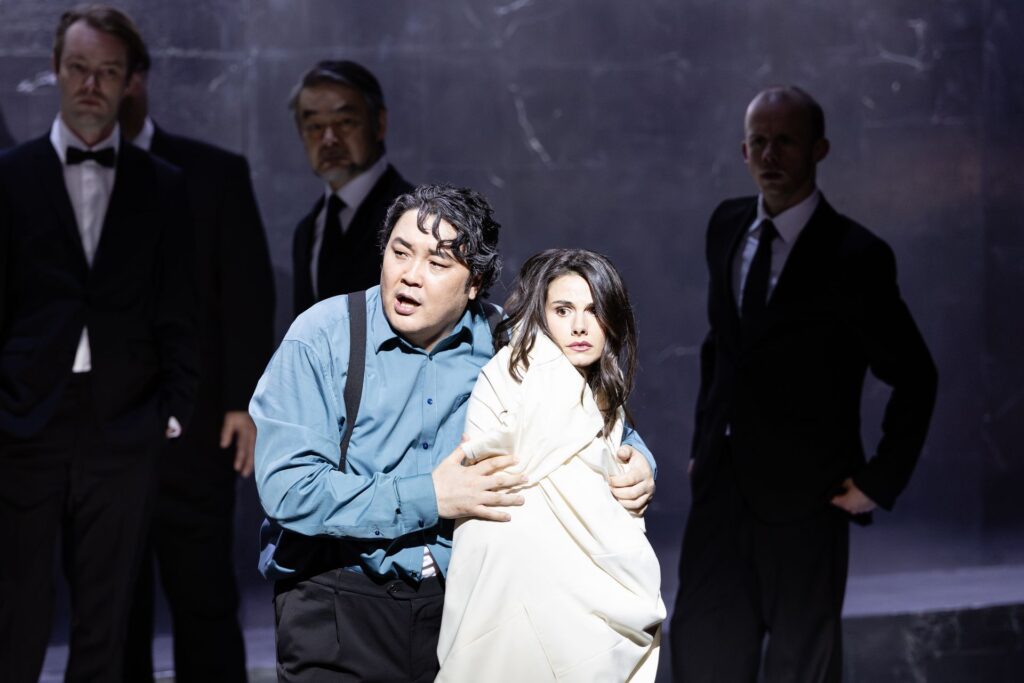
A role debut for Serena Sáenz? Impossible to tell, and indeed hard to believe, as the young Barcelona-born soprano embodies a Gilda of both fragility and vulnerability with authority and without concession. Far from being overshadowed by the two superb voices described above, she projects throughout the Staatsoper with striking ease all that her timbre has to offer, from velvety middle tones to supple high notes, demonstrating a fully mastered coloratura technique while hinting at a broader expressive range to come. Theatrically convincing and vocally compelling, the generous ovations that greeted her Caro nome and her final curtain call come as no surprise. One awaits her future Verdian roles with keen anticipation.
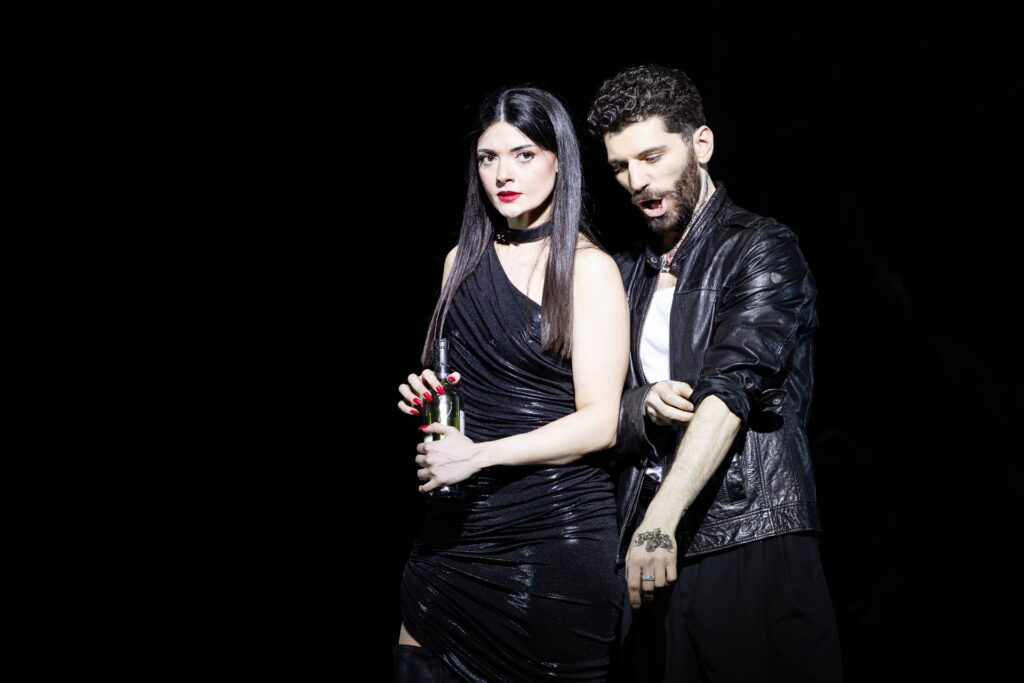
The less prominent brother–sister pair, Riccardo Fassi (Sparafucile) and Elmina Hasan (Maddalena), bring a welcome and interesting balance to the whole. The former shapes a discreet yet unsettling hired assassin, dark and lyrical, lurking in the shadows of the drama until his fatal blows. The latter gives Maddalena all the theatrical and vocal instability the role demands, aided in this regard by Wysocka’s decision to portray her as a BDSM dominatrix—assertive yet uncertain. One savors to the very last note the quartet mentioned earlier, Bella figlia dell’amore, where her sublime background line, almost Mozartean in its writing, emerges measure after measure, forming a pillar upon which baritone, tenor, and soprano can unfold their long, harmonious bel canto lines. A pure moment of live opera, due in no small part to the Azerbaijani mezzo-soprano.
Yet the defining feature of this production remains the remarkable level of the supporting roles, almost all significantly overcast, to the great and admittedly selfish delight of opera enthusiasts eager for quality in every corner of such a masterpiece. What a pleasure to hear these secondary moments scattered throughout the score delivered by such fine voices. The reason lies in the impressive level of the Staatsoper ensemble, whose younger members already display a degree of artistic maturity well beyond what is usually encountered in these brief yet dramaturgically crucial roles.
Granit Musliu’s Matteo Borsa offers a striking example: already entrusted with leading tenor roles in major houses (and having sung a well-received Alfredo here earlier this season), he brings unusual depth to this courtier. The exchange between the two tenors at the opening sounds unexpectedly full, and one is immediately struck by Di quella giovin che vedete al tempio?, the timbre having very little to envy in that of Davronov’s refined and golden Duke.
The same holds for Thomas Mole, whose Cavaliere Marullo resonates with a force and musicality less voluminous yet entirely comparable to those of the title role—the decade separating the two baritones being particularly significant at this stage of their careers. After such a foretaste, it is difficult not to look forward to hearing the young British baritone in the title role. The third of the principal courtiers, Roman Chabaranok, gives the Count of Ceprano all the presence required to stand out within this abundance of quality. His much-courted wife for the evening, Nontobeko Bhengu (Countess Ceprano), a member of the Bavarian studio, along with Daniel Vening (usher) and Lucy Altus (page to the Duchess), fulfill their tasks admirably and suggest a promising future for both the institution and the industry.
In the same vein, one also appreciates the voice and stage presence of Shannon Keegan as Giovanna, here far less inconspicuous and far more memorable than is often the case for this brief role. What an actress. What a singer. Her Suzuki earlier this season had already created a strong desire to hear her again; even within this more limited part, one recognizes with satisfaction traces of what had impressed so strongly, and one can only praise the intensity and accuracy she brings to her few minutes on stage. It may be a long wait before encountering a Giovanna so well served again.
The cast is completed by the ever-reliable Martin Snell, also a member of the ensemble, though—unlike the others mentioned—his already rich career is well established. Not something to be taken for granted, he does not sacrifice the color of Monterone’s lines to sheer fury, in each of his two brief yet dramaturgically essential appearances.
As one leaves the Staatsoper, the mind still resonating with this music and these magnificent timbres, a thought emerges: perhaps in a few years’ time, we will proudly pull out the evening’s program when recounting the most memorable performances we have attended over the course of our operatic journey. For if this production may not leave an indelible mark on the history of the art form, it is nevertheless highly likely to provoke surprise—if not astonishment—when one reads through the names in the cast. No one will be surprised to see Ariunbaatar Ganbaatar in the title role, Bekhzod Davronov as the Duke, or Serena Sáenz as Gilda; but to find Shannon Keegan listed as Giovanna, Granit Musliu as Matteo Borsa, and Thomas Mole as Cavaliere Marullo? More than one skeptic will envy having experienced such a richly cast performance, witnessing these artists in full ascent—and perhaps the more nostalgic among them will even be tempted to call this a golden age of opera, lamenting that bygone era when every role could truly sing and act. The bets are open.
Production Team
- Director: Barbara Wysocka
- Set Design: Barbara Hanicka
- Costume Design: Julia Kornacka
- Lighting Design: Marc Heinz
- Dramaturgy: Malte Krasting
Musical Team
- Conductor: Maurizio Benini
- Chorus Master: Christoph Heil
Cast
- Rigoletto: Ariunbaatar Ganbaatar
- Il Duca di Mantova: Bekhzod Davronov
- Gilda: Serena Sáenz
- Sparafucile: Riccardo Fassi
- Maddalena: Elmina Hasan
Supporting Roles
- Matteo Borsa: Granit Musliu
- Cavaliere Marullo: Thomas Mole
- Conte di Ceprano: Roman Chabaranok
- Contessa di Ceprano: Nontobeko Bhengu
- Giovanna: Shannon Keegan
- Un usciere di corte: Daniel Vening
- Un paggio della Duchessa: Lucy Altus
- Conte di Monterone: Martin Snell
About the Author