Elīna Garanča | Opera de Monte-Carlo

Concluding a refined and significantly stimulating season, the Monte-Carlo Opera presented an operatic recital with orchestra by Latvian mezzo-soprano Elīna Garanča. She is undoubtedly one of the most charismatic and authoritative performers of the first quarter of this century, having debuted in the early 2000s in Mozart’s Sesto, Annio, and Dorabella, as well as bel canto roles such as Romeo and Giovanna Seymour. Today, she is a leading interpreter of the most demanding mezzo-soprano roles, from Kundry to Eboli, and her Carmen, which she has performed in major theaters around the world, is a standout. At the dawn of transitioning to the soprano register, she will be Ariadne at the Salzburg Festival, this orchestral recital paid homage to some of her most celebrated roles and interpretations, in a fiery evening that allowed Garanča to showcase all the qualities that have crowned her queen of opera: a burnished timbre, a first class voice technique, , homogeneity in all registers, with powerful and dazzling high notes, gigantic musicality, perfect diction in over five languages, and last but not least, the face of an actress and the figure of a mannequin.
The program, which alternated arias with symphonic and choral operatic pieces, focused essentially on the second half of the 19th century in Italy, France, and Russia, with an intrusion into Cilea’s early 20th century. It was an ideal terrain for Garanča’s vocal talent, starting with her first aria, “Da, chas nastal,” from Tchaikovsky’s Maid of Orleans, a signature tune for famous mezzo-sopranos such as Irina Archipova and Elena Obratsova, where Garanča, interpreted and phrased with great intensity Giovanna’s farewell to her homeland, concluding with a high A of great power and dramatic intensity.
Dalila’s aria, “Mon cœur s’ouvre à ta voix,” belongs to one of her most frequently performed roles, and offers an opportunity to show off seductive and refined mezzo-voices, even though the final high note Bb, performed by Samson in the opera but often sung by the mezzo-soprano in the concert version, is avoided.
At the end of the first part, Garanča performs a true bravery, singing both Adriana’s aria from the first act, “Io son l’umile ancella,” and that of her antagonist, the Princess of Bouillon, “Acerba voluttà.” The singer has often performed Adriana’s aria as an encore in recitals, and it is executed with confidence and control of the tessitura; but the singer is certainly more at ease as the princess, a veritable hurricane of sound, accompanied by the acting of a great tragedian.
In the second act, the mezzo-soprano offers her Santuzza from Cavalleria Rusticana, a performance that could be considered historic, offering a woman who is not agitated and frantic, but rather painful and introspective in her tragedy, where she demonstrates once again that verismo can be sung in a bel canto-style and emotionally intense manner.
Her Carmen, the blonde Carmen who has captivated audiences around the world, is not missing, and Garanča delights in playing with the habanera, engaging the audience on stage.
Closing the concert, the singer performs the aria “Las Carceleras” from the zarzuela “Las Hijas del Zebedeo,” displaying great vocal agility and a voice capable of easily mastering wide register shifts.
A curious choice was made to perform, in the only encore allowed, the famous Neapolitan song “Marechiare” by Francesco Paolo Tosti, made iconic by legendary tenors such as Tito Schipa, Giuseppe Di Stefano, and Luciano Pavarotti, demonstrating also a mastery of the Neapolitan style and language.
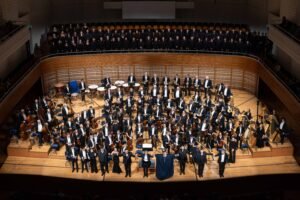
Henrik Nánási‘s conducting seemed excessively heavy, with sonorities ranging from mezzoforte to fortissimo, poor balance between sections, and a lack of abandon and sensuality in the more lyrical moments, sometimes putting in difficulties Garanča herself. The gestures and body movements also seemed excessive. The orchestra’s performance was good overall, and the chorus, conducted by Stefano Visconti, performed excellently.
The sold-out Auditorium Rainier III for the occasion marked a well-deserved success for Elina Garanča, who received a floral tribute from artistic director Cecilia Bartoli.
–
Conductor | Henrik Nánási
Choirmaster | Stefano Visconti
Mezzosoprano | Elina Garanca
Chœur de l’Opéra de Monte-Carlo
Orchestre Philharmonique de Monte-Carlo
–
Musical program:
Mikhaïl Glinka (1804-1857)
Ruslan et Ludmila
Ouverture (orchestre)
Piotr Ilitch Tchaïkovski (1840-1893)
La Pucelle d’Orléans
« Da, chas nastal »
Camille Saint-Saëns (1835-1921)
Samson et Dalila
« L’aube qui blanchit déjà les coteaux » (chœur) et Bacchanale
« Mon cœur s’ouvre à ta voix »
Amilcare Ponchielli (1834-1886)
La Gioconda
« Feste, pane! » (chœur)
Francesco Cilea (1866-1950)
Adriana Lecouvreur
« Io son l’umile ancella »
« Acerba voluttà ».
Giuseppe Verdi (1813-1901)
La forza del destino
Sinfonia (orchestre)
Giuseppe Verdi (1813-1901)
I lombardi alla prima crociata
«O signore, dal tetto natio» (chœur)
Pietro Mascagni (1863-1945)
Cavalleria rusticana
« Voi lo sapete, o mamma »
Intermezzo (orchestre)
« Regina Coeli… Inneggiamo, il Signor» (soliste et chœur)
Georges Bizet (1838-1875)
Carmen
Prélude (orchestre)
Chœur des cigarières (chœur)
« Habanera » (soliste et chœur)
Ruperto Chapí (1851-1909)
Las hijas del Zebedeo
Carceleras
BIS
Marechiare
Neapolitan song by Francesco Paolo Tosti with lyrics by Salvatore Di Giacomo
About the Author