
DIALOGUES DES CARMELITES | Teatro Regio Torino
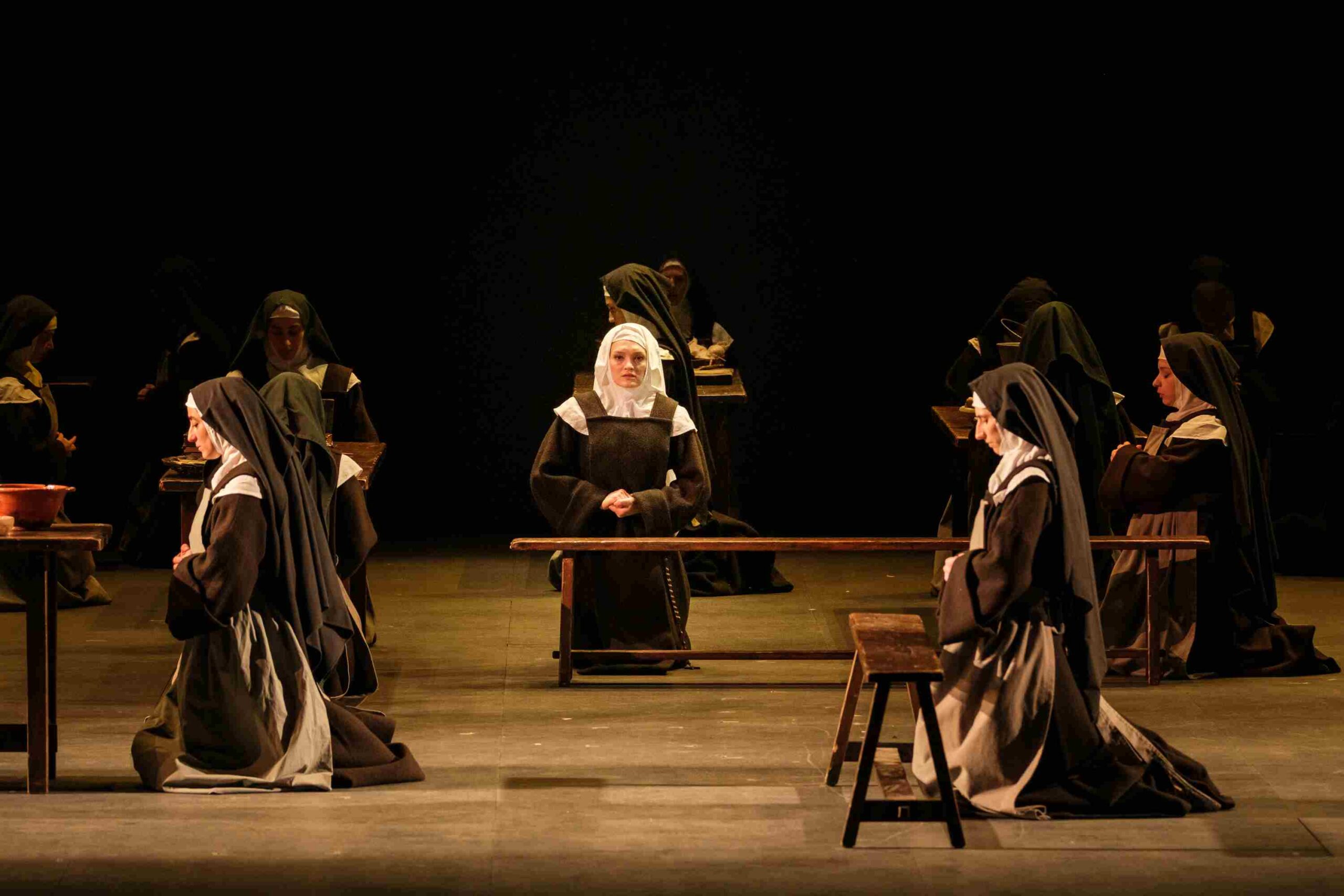
It is noteworthy that Poulenc’s masterpiece has enjoyed a growing presence on Italian stages in recent years. After Rome and Venice, Turin has now presented “Dialogues des Carmélites” for the first time on the prestigious stage of the Teatro Regio. The opera was commissioned by La Scala, where it premiered in January 1957 with exceptional performers such as Leyla Gencer, Virginia Zeani, Gianna Pederzini and Fiorenza Cossotto. Poulenc set music to Georges Bernanos’s play, based on a true story during the French Revolution, when sixteen French nuns, the Martyrs of Compiegne, who refused to renounce their vows, were sent to the guillotine.
This opera was ostracized by the Marxist and left-wing dominant cultural milieu in postwar Europe, which accused Poulenc of being Catholic fundamentalist and reactionary. Even in our days, we still await full recognition of the greatness of his entire production, such as concertos for piano and orchestra, chamber music, the Stabat Mater, still too little performed in theatres and concert halls. The great public success of these Turin performances underscores the French composer’s profound relevance and modernity in this engaging and moving opera that speaks of the fear of life, the fear of death, and the courage of faith.
The Teatro Regio went all out for the occasion, presenting a historic production, a conductor by one of the greatest specialists, and a top-notch singing company in all roles.
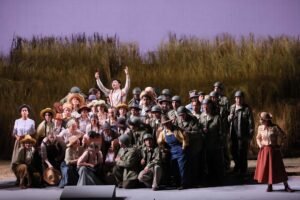
The revival of Robert Carsen‘s iconic production, conceived in 1997 at the Dutch National Opera in Amsterdam and revived at La Scala in 2000 and 2004 under the direction of Riccardo Muti, was a huge impact on Turin audiences. Thirty years later, it remains highly modern, embracing and enhancing the ensemble of the music and the lyrics: the bare stage, transformed into various scenic spaces by a few symbolic elements, narrates the dramatic flow, recreating the atmosphere of Blanche’s home, the convent, without resorting to any religious symbols, with an exceptional use of the lighting. The protagonists’ beautiful period costumes contrast with the modern and timeless costumes of the revolutionary people, who witness the relentless and ferocious drama like the chorus of a Greek tragedy. Famous and widely celebrated, the Stabat Mater, perhaps the most beautiful opera finale of the entire twentieth century, still strikes the audience, with the 16 protagonists, dressed only in white robes, dancing waiting for the martyrdom and falling to the ground before the blows of the guillotine.
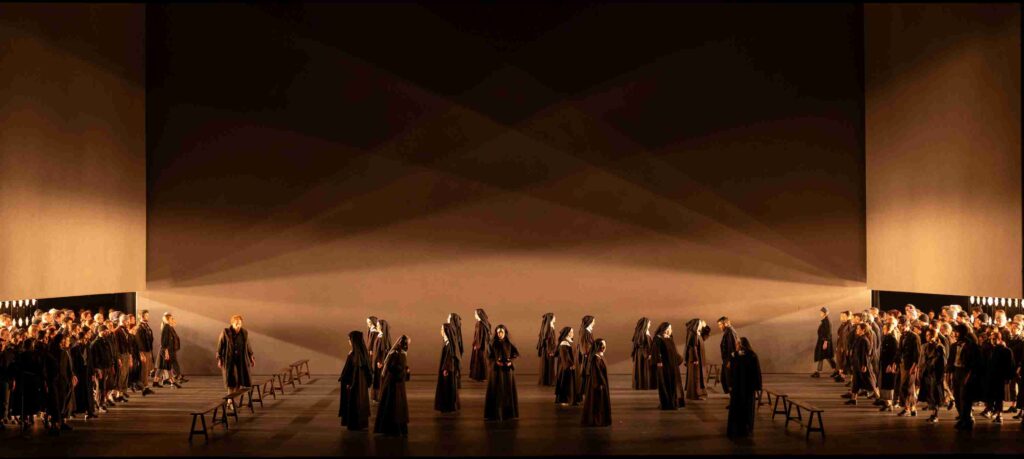
Canadian conductor Yves Abel is a specialist in this score, conducting it exemplarily, attentive to instrumental detail while also maintaining the unrelenting flow of musical invention. Thanks to the excellent Teatro Regio orchestra, despite some imperfections in the brass, Abel skilfully depicts the entire timbral palette of Poulenc’s orchestra, from the piano used as a percussive instrument to the celesta, drums, and all the percussion instruments. This uniformity of tone pervades the entire opera, from the interludes to the most dramatic moments, such as the death of the old prioress, amidst the anguish and realism of physical pain and labored breathing. This orchestral reading fully succeeds in bringing the literary depth of the text into dialogue with the musical soundscape.
The singing company is of a high standard; in the title role of Blanche de la Force, soprano Ekaterina Bakanova delivers a magnificent performance, both vocally and theatrically. Her timbre is perfect for the role, a full, lyric soprano voice of adamantine clarity, with crystalline high notes that beautifully portray Blanche’s adolescent purity and mystical tension. Bakanova masters Poulenc’s lyrical declamation, which oscillates between Monteverdi and Debussy, bringing out the fragile character’s anxiety and emotionality, particularly in her confrontation with the old Prioress, and throughout her psychological evolution until her final martyrdom, which she faces with great awareness and determination, both on stage and in her emotional voice.
Another outstanding performer is mezzo-soprano Sylvie Brunet-Grupposo, who plays the elderly prioress Madame de Croissy, a role with a strong visual and emotional impact. The French singer has the dark, authoritative voice required by the vocal writing, and perfectly masters the challenging vocal declamation, both in the descents to the chest register and in the sudden shifts to the high register during the most tense and dramatic moments. Brunet-Grupposo, as native French speaker, offers a perfect vocal declamation of Bernanos’s verses, carefully crafting the accents and the prosody of the sung text, with an exemplary use of liaison. Her rendition of the delirium and agony of the death scene was of great emotional impact, thanks also to Carsen’s exceptional direction.
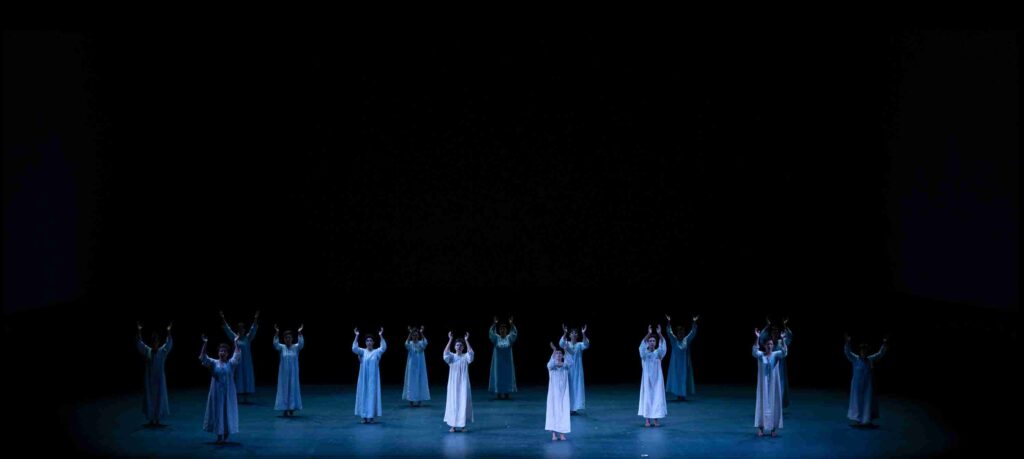
In the role of the new Prioress, Madame Lidoine, we find Sally Matthews, a lyric spinto soprano, who tackles the long monologue in Act II with vocal confidence and an authoritative accent. She then finds truly moving phrasing and accents in her moving speech to the imprisoned nuns, in which Matthews manages to convey with great intensity the nun’s strength and serene faith.
Mezzo-soprano Antoinette Dennefeld, in the role of Mère Marie de l’Incarnation, also gives a very good performance. She manages to convey with confidence and excellent vocal prowess the proud and stern tone required by Poulenc, as well as the affection and attachment to the young Blanche.
Francesca Pia Vitale is superb as Sœur Costance, Blanche’s lively and cheerful alter ego. Her light lyric soprano voice is clear and brilliant, rising easily to the high notes, even reaching C6 with confidence and precision. Vitale is flawless in her vocal and stage portrayal of the character’s youth and carefree spirit, and reaches heights of heartfelt emotion in her final martyrdom, which she faces serenely with joy and sincere faith.
Also noteworthy in the overall success of the show are Mére Jeanne de Lorrie Garcia and Sœur Mathilde de Martina Myskohlid, the latter an artist of the Regio Ensemble.
In an all-female opera, the performances of the male cast were also excellent: Jean-François Lapointe plays the Marquis de la Force with an authoritative baritone voice, vocally confident as a mature nobleman and a father anxious for the fate of his daughter Blanche.
Tenor Valentin Thill was truly excellent as Chevalier de la Force, with a clear, youthful timbre that stands out for his absolute mastery of the declamation and his beautiful French diction, which was careful to convey all the psychological nuances and accents of the text, up to an exceptional scene in the convent’s parlor, where he tries in vain to convince his sister to flee.
Also worthy of mention are all the other male performers and the Teatro Regio chorus, which stands out for its highly musical and precise performances.
The show was a genuine and resounding success with the audience, with long, enthusiastic applause for the entire cast!
Marquis de la Force Jean-François Lapointe
Blanche de la Force Ekaterina Bakanova
Le Chevalier de la Force Valentin Thill
Madame de Croissy Sylvie Brunet-Grupposo
Madame Lidoine Sally Matthews
Mère Marie de l’Incarnation Antoinette Dennefeld
Soeur Constance de Saint-Denis Francesca Pia Vitale
Mère Jeanne de l’Enfant-Jésus Lorrie Garcia
Soeur Mathilde Martina Myskohlid
Il cappellano del Carmelo Krystian Adam
Il carceriere e Secondo commissario Isaac Galán
Un ufficiale e Thierry Roberto Accurso
Primo commissario Matthieu Justine
Monsieur Javilenot Eduardo Martínez
–
Conductor: Yves Abel
Direction: Robert Carsen
Revival of direction: Christophe Gayral
Sets: Michael Levine
Costumes: Falk Bauer
Lighting: Robert Carsen, Cor van den Brink
Choreography: Philippe Giraudeau
Chorus Master: Gea Garatti Ansini
About the Author

Et quelle musique magnifique…