THE DEATH OF KLINGHOFFER | Teatro del Maggio Musicale Fiorentino
The day that I and my enemy sit peacefully each putting his case and working towards peace
That day our hope dies and I shall die too.
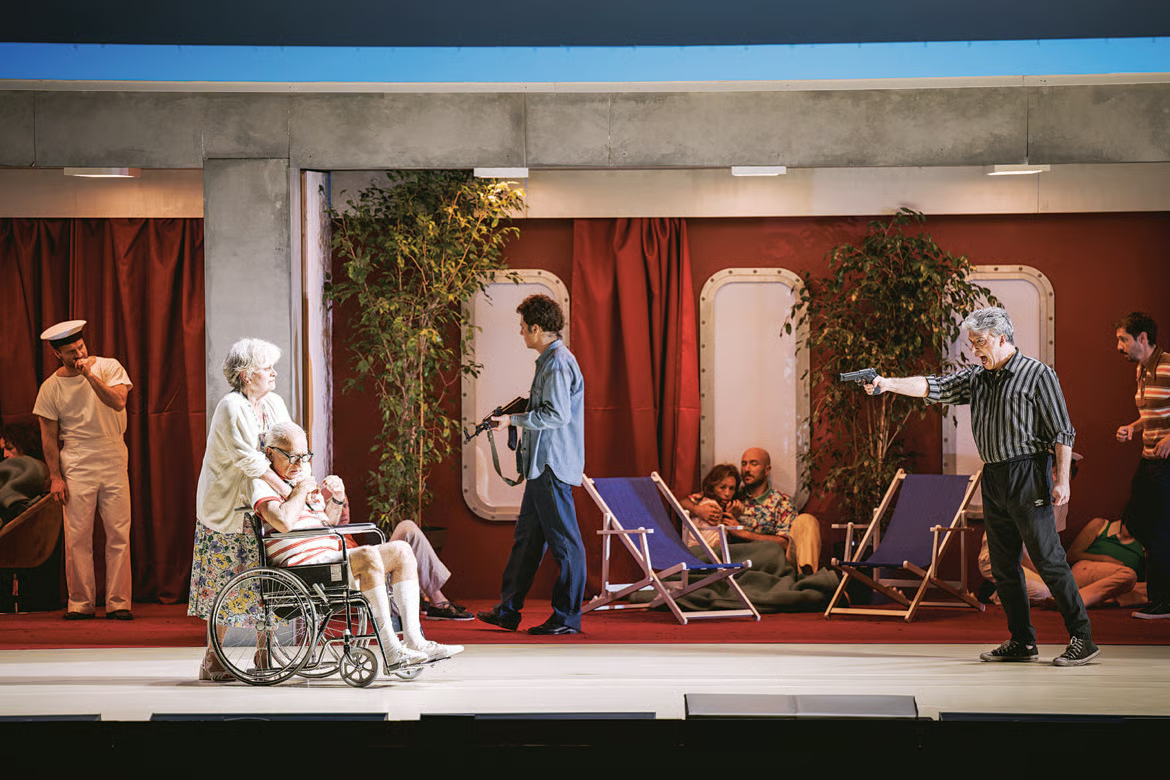
Certainly a courageous inauguration of the 88th Maggio Musicale Fiorentino festival, with one of the most controversial opera titles of the late twentieth century; a CNN opera, according to some, inspired by a true event: the hijacking of the Italian ocean cruise ship Achille Lauro in 1985 off the coast of Egypt by four terrorists from the Palestine Liberation Front, a hijacking that culminated in the killing on board of Leonard Klinghoffer, a 69-year-old Jewish American citizen confined to a wheelchair.
The opera was composed by one of the leading contemporary American composers, John Adams, born in 1947, fresh from the success of Nixon in China, where he put Nixon, Kissinger, and Mao Zedong singing on stage. The libretto, written by the Jewish-American poet Alice Goodman, convert to the Anglican Church during the composition, is packed with philosophical and political implications, biblical and even Quranic references. The model and inspiration for the work was not so much the classic opera as Bach’s oratorios and Passions, with great space given to the Choirs that comment on the events, and the monologues by the ship’s captain, the Klinghoffers, the Palestinians and the hostages.
First performed in Brussels at the Théâtre de la Monnaie in 1991, the Death of Klinghoffer opens with two choruses, that of the Palestinian exiles and that of the Jewish exiles, in the proximate keys of G minor and F minor. At each performance, the opera has been accused of anti-Semitism and of justifying terrorism by depicting Palestinians, despite the brutality of their actions, as people with their own histories, emotions, and childhood memories. The 2014 performances at the Metropolitan Opera were marked by massive protests outside the theater, with hundreds of demonstrators, political and religious figures, calling for its suspension.
The new Florentine production, the second ever in Italy, is the first to be performed after the Hamas attacks of October 7, 2023, and the subsequent bombing of Gaza. Another reason for great expectation was Luca Gaudagnino‘s direction, who dismissed with a few words the case of Timothée Chalamet, protagonist of one of his most successful films “Call Me by Your Name”, case that had set on fire the gentle and oldfashioned world of opera.
Many masters of cinema have attempted operatic masterpieces, from Luchino Visconti to Ingmar Bergman to Woody Allen; notably, Federico Fellini was absent, having declined the Bologna Teatro Comunale’s invitation to stage Aida. Since opera directing is a very different profession from film directing, even great names have often been shattered by the bizarre stage conventions of melodrama and the unavoidable musical requirements.
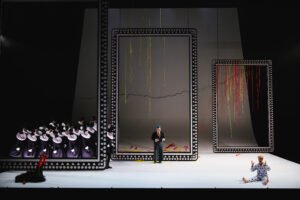
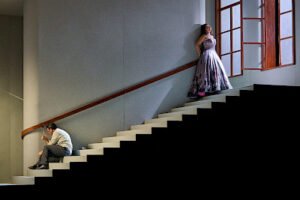
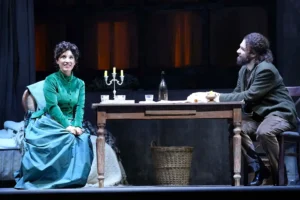
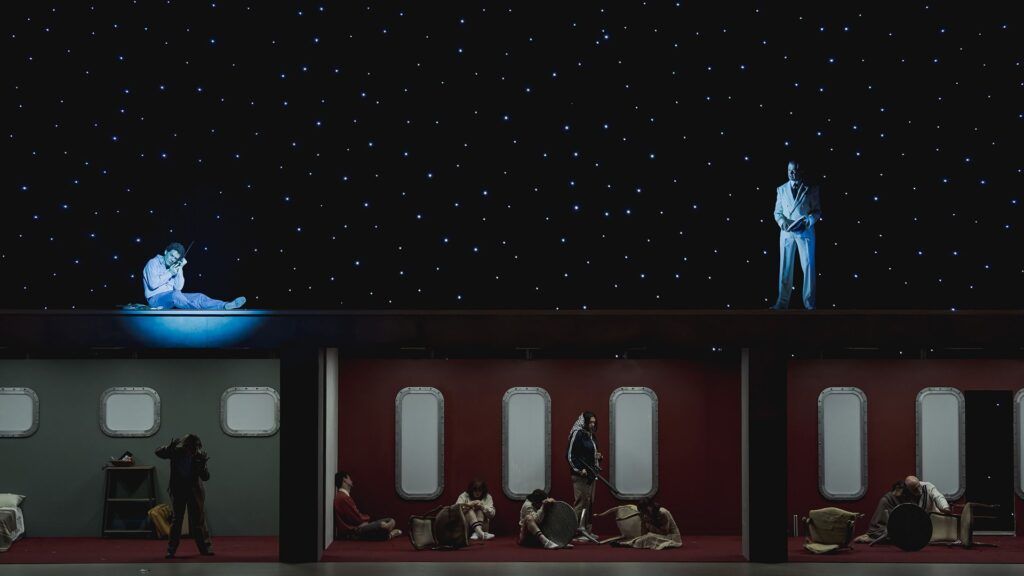
To our great joy, Luca Guadagnino, also responsible for the sets, created an unforgettable performance in Florence, both for its technical perfection and its adherence to the music and text. It was the director himself, a great admirer of Adams, who imposed this opera on the theater, “for the depth of the text and the music that touches and threatens the human spirit.” Guadagnino succeeded in freeing the opera from all ideological polemics, fully restoring its musical purity and its value as a contemporary tragedy. There are very few references to ongoing Middle Eastern conflicts, such as the keffiyeh worn by Yazmir, a character en travesti in the original, here a female terrorist, played by the excellent Marvic Monreal, who dreams of death and Paradise that will end her exile. Likewise, the characters on stage are perfectly portrayed, both in their costumes and their movements, be they cruise tourists, sailors, or terrorists. The use of a mobile platform allows the director to seamlessly delineate the stage show, from the exteriors to the interiors of the Achille Lauro, from the control room to the individual passenger cabins, which appear from below against the backdrop of the starry sky where Mamoud is singing his monologue about his journey, his lost homeland, and the nature of the sea. Peter van Preat’s use of lighting is also formidable, contributing to the scene’s painterly quality and strong emotional impact.
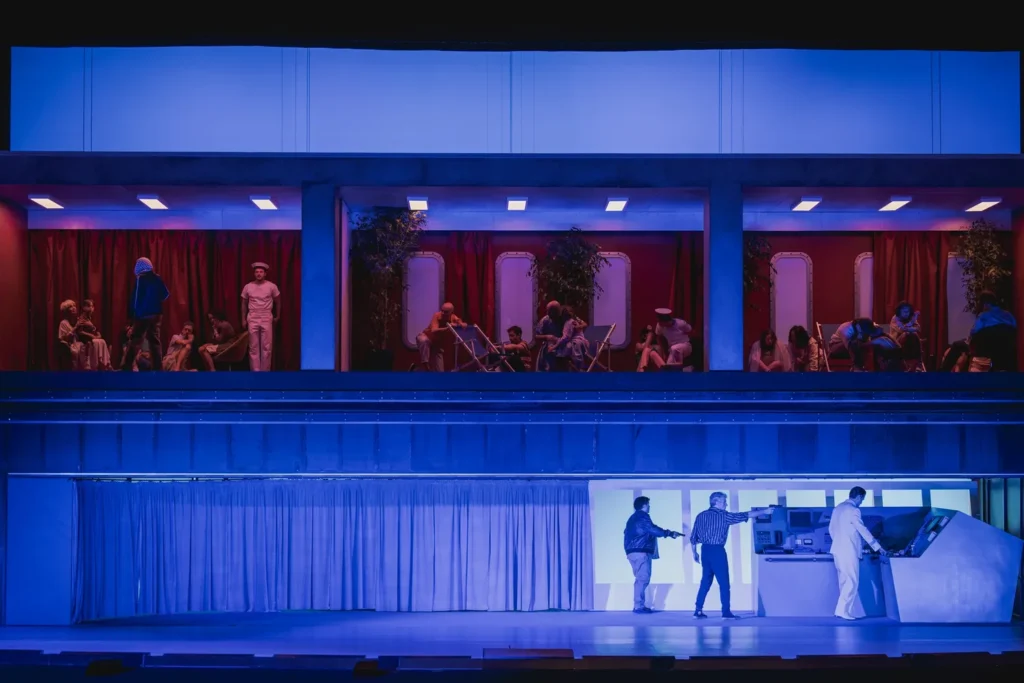
Ella Rothschild‘s choreography becomes a key element of Guadagnino’s production. She employs twelve dancers in a kind of dance theater, their bodies moving and merging on stage to convey the thoughts of the characters and, above all, the chorus, the true protagonists of the opera. This production offers many unforgettable moments, from the realism and violence of Klinghoffer’s murder, which sweeps away any possible moral justification, to the scene in which the old man’s body, a sculpture from Berlinde De Bruyckere, thrown into the sea, is dismembered and torn apart by naked dancers.
Also exceptional is the musical direction of Lawrence Renes, a friend and one of the greatest interpreters of John Adams’s music. With the aid of the Maggio Musicale Fiorentino’s formidable orchestral and choral ensembles, Renes illuminates and enhances a very difficult score for fifty musicians, in which minimalism alternates with Bachian-style choruses, Sprechgesang, and Broadway musical, as in the scene featuring the British dance girl, the brilliant Janeta Hosko. The use of electronic music, the two synthesizers, and the percussion designed by Adams himself is perfectly mastered by the conductor. In Rennes’s interpretation, every single detail of Adams’s music is highlighted in the very flow of the poetic text and in the sense of tragedy that pervades the entire staging.
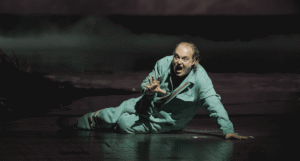
The entire cast assembled for the opera is top-notch, perfect in every single character. French bass-baritone Laurent Naouri is a deeply human Leon Klinghoffer, balancing anger and resignation. Despite being confined to a wheelchair, he asserts himself physically and emotionally, singing the aria “The Falling Body” while lying on the floor with great intensity and dignity.
I’ve always been a great admirer of Susan Bullock‘s art, ever since she played Magda Sorel in Menotti’s “The Consul” at the Spoleto Festival. Finding her again in the role of Marylin Klinghoffer, after so many Brunhildes, was a unique experience. The performer is masterful, her diction and words delve into the pain of the elderly wife, angry and emotional in her final monologue that closes the opera: “They should have killed me, I wanted to die.”
After many Cherubinos and Rosinas, we were delighted to welcome Marina Comparato back on stage, perfect in the roles of the Swiss Grandmother and the Austrian Woman, with her excellent phrasing and brilliant stage presence. Daniel Okulitch was remarkable as Captain, with his authoritative bass-baritone voice and impressive figure on stage. An honorable mention goes to Levent Bakirci, a lyrical and moving Mamoud in his song of the night, the music, and his memories.
Also vocally and scenically perfect in their roles were Andreas Mattersberger as First Officer, Roy Cornelius Smith as Molqi, and Joshua Bloom as Rambo.
As already mentioned, the performance of the choir conducted by Lorenzo Fratini was phenomenal.
At the end of the performance, there was prolonged applause from the audience, visibly moved by an evening of incredible beauty and emotion.
***************************
CAST
The Captain: Daniel Okulitch
The first Officer: Andreas Mattersberger
Swiss Grandmother/Austrian Woman; Marina Comparato
Molqi: Roy Cornelius Smith
Mamoud: Levent Bakirci
Leon Klinghoffer: Laurent Naouri
Rambo: Joshua Bloom
British dancing girl :Janetka Hoșco
Yazmir: Marvic Monreal
Marylin Klinghoffer: Susan Bullock
–
Conductor: Lawrence Renes
Chorus master: Lorenzo Fratini
Director and sets: Luca Guadagnino
Choreography: Ella Rothschild
Lights: Peter van Praet
Sound designer: Mark Grey
Costumes: Marta Solari
Sculpture: Berlinde De Bruyckere
Maggio Musicale Fiorentino Orchestra and Chorus
About the Author