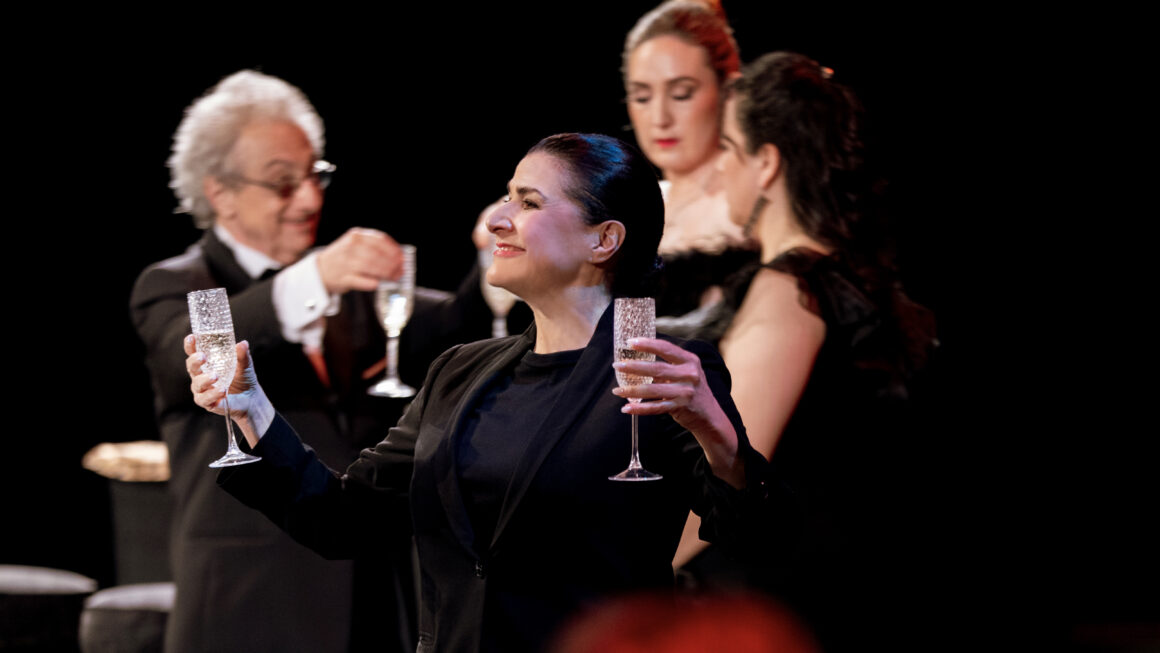
Don Alfonso sings, “The faith of women is like the phoenix; everyone says it exists, but no one knows where it is!”, paraphrasing a famous aria by Metastasio. The third panel of the Mozart/Da Ponte triptych is the most literary sophisticated but perhaps the most misunderstood. Beethoven detested it as a frivolous and licentious work, but at the same time took open inspiration from Fiordiligi’s rondò to express the turmoil of his Leonora.
There were at least three reasons for the appeal of this Monegasque production, a single date sold out for months: the presence of the Wiener Staatsoper Orchestra, Alessandro Corbelli’s Don Alfonso, one of the greatest interpreters of Mozart and Rossini, the last heir to the great tradition of Italian basses stretching from Sesto Bruscantini to Rolando Panerei and Enzo Dara; and, of course, the diva Cecilia, who triumphed in this opera in theaters around the world, magnificently singing all three female roles. And the wait was worth it: the Wiener Staatsoper Orchestra, Alessandro Corbelli, and Cecilia Bartoli brought Wolfgang Amadeus Mozart and Lorenzo da Ponte direct to Heaven. Alongside them, in the roles of the two breaking up couples, was a quartet of young but already established singers, vocally and scenically at ease in Mozart’s difficult bel canto and in the many recitatives, among the most beautiful written by the genius from Salzburg.
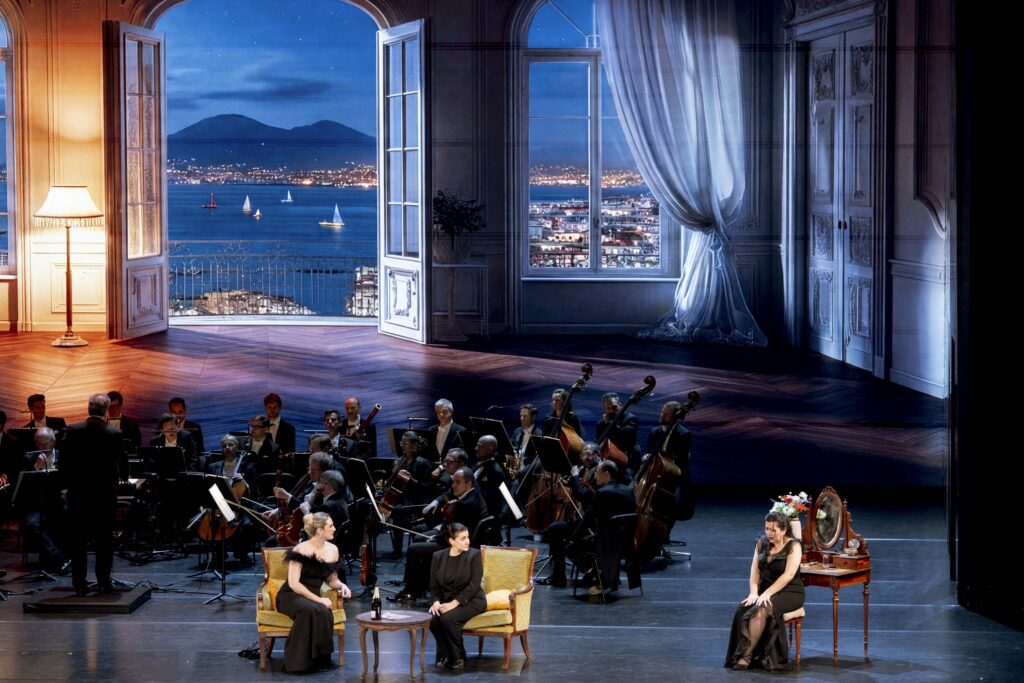
In the role of Fiordiligi, we find Guatemalan soprano Adriana González; the singer possesses a beautiful lyric soprano voice, technically proficient, that easily reaches the high notes both pianissimo and with full voice. The role of Fiordiligi was written by Mozart for the singer Adriana Ferraresi Del Bene, whose exceptional vocal virtuosity allowed her to sing great leaps between registers. González delivers a crescendo throughout the performance: in “Come scoglio immoto resta,” the soprano confidently masters both the coloratura and the terrifying descents into the lower register, included an A below the staff.
But the high point of her performance was the execution of the Act II rondo “Per pietà, ben mio, perdona.” The soprano displays a velvety delivery and a style appropriate to this “opera seria” piece and finds moments of great emotion in the pianissimo reprise of the opening theme, perfectly supported by the orchestra’s sound texture, and where she inserts appropriate variations and even a striking puntatura. From a scenic and interpretative standpoint, too, the soprano perfectly delineates the character of Fiordiligi, the more serious and thoughtful of the two sisters, but also more passionate in yielding to her suitor.
Filipe Manu plays Ferrando, the more sentimental and gallant of the two lovers. The tenor, originally from the island of Tongo, has a clear, light lyric tenor voice, well-articulated and consistent throughout the tessitura, which lends itself well to the character’s languid, dreamy nature. He fully masters Mozart’s style, with good diction and well-defined mezzo- voices. His performance of “Un’aura amorosa”, one of the most beautiful tenor arias ever written, was truly excellent. Manu bends his tenor voice with great sensitivity to Mozart’s sweet melody, inserting beautiful variations in the ripresa in pianissimo and elegantly concluding the marvelous final cadenza and trill on the final “porgerà.” He is fur sure one of the most promising tenors, certainly one to keep an eye on. For the record, it’s worth noting that we had the traditional cut of the aria “Ah, lo veggio, quell’anima bella” in a performance of the opera, which was otherwise complete.
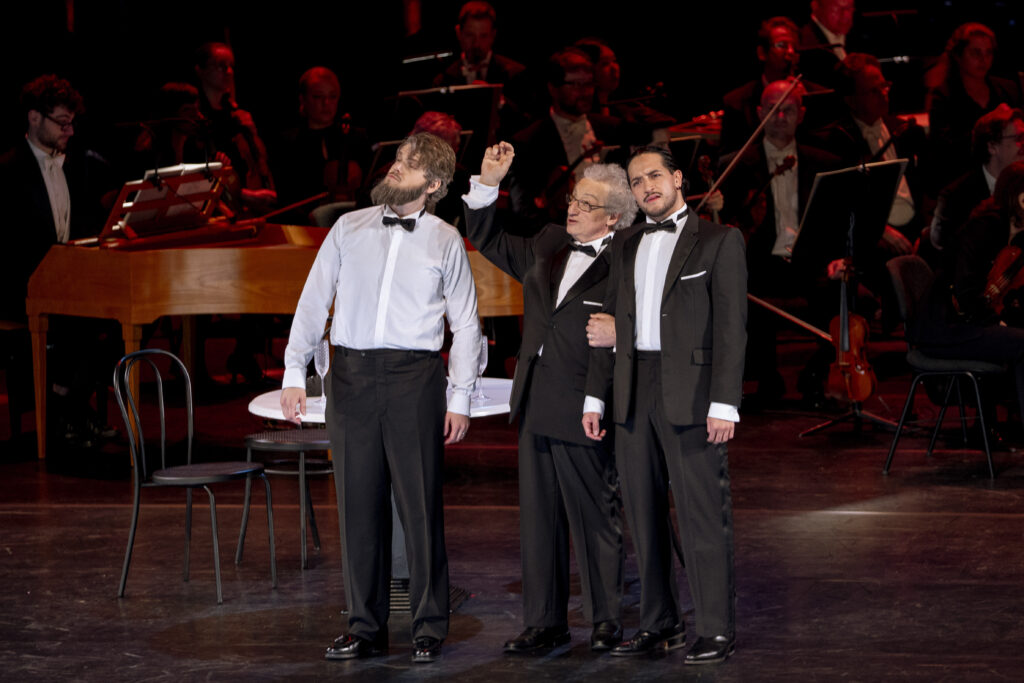
American mezzo-soprano Samantha Hankey has a nearly ideal voice and timbre for Dorabella, perfectly contrasting with her sister’s. Hankey portrays the younger, carefree, and impulsive sister with charisma and great vocal and stage presence. Her voice is full in the mids and easily reaches the acuti, and the two arias “Smanie implacabili” and “È amore un ladroncello” were technically and expressively accomplished, fully capturing the character’s impetuous and strong-willed nature.
Before the performance, it was announced that baritone Peter Kellner, who played the role of Guglielmo, was indisposed. Despite his hoarseness and vocal discomfort, the singer performed with great professionalism, distinguishing himself for his excellent stage presence and confidence.
Alessandro Corbelli’s Don Alfonso was a miracle of vocal freshness and stage presence; every single word of the magnificent libretto and every musical nuance of the score were exalted and interpreted by the Turin-born singer, in the finest tradition of the Italian school, portraying a cynical philosopher who is simultaneously amused by the playfulness. As an Italian, I must emphasize that only Mozart sung and performed by native-speaking singers does full justice to the genius of Salzburg and his phenomenal librettist. This consideration is even more true for Cecilia Bartoli’s Despina, who has made working on the word, expression, and technical perfection her signature style. In the vast Mozart catalogue she has performed, Despina remains a character of choice, precisely because it allows Bartoli to play all her best cards, in the arias, the recitatives, and in the two “travestimenti”, the doctor and the notary, for each of which she finds irresistible vocal disguises. “La Bartoli è la Bartoli e non si discute!”
The opera was presented with a beautiful “mise en espace” by Lisa Padouvas, a Viennese director of Greek origin. The orchestra was positioned on the large stage of the Grimaldi Forum, against a backdrop of video projections and with the stage props in the foreground; the setting was contemporary and thoroughly Neapolitan, a city that in Mozart’s time was the capital of music and opera buffa. Despina’s very name is a precise reference and homage to Serpina, the protagonist of Pergolesi’s La Serva Padrona. The café where the opera opens becomes the “giardino della Fesseria,” a double entendre à la Da Ponte, considering that in Neapolitan “la fessa” is the female genital organ. The two sisters’ home is a villa in Posillipo neighbour with a stunning view of the gulf, with the lights gradually shifting to a fiery sunset. The modern-day setting doesn’t distort the plot, and some of the scenic ideas are pleasant, such as Ferrando and Guglielmo dressing up as rappers instead of Albanians.
We left the Wiener Staatsoper Orchestra, conducted by Patrick Lange, for last; it’s impossible to imagine a better Mozart than the one played by his fellow countrymen; crystal-clear and brilliant sound, perfect attacks, precise brass instruments, incredible dynamics and tempos. It was phenomenal how, in the most beautiful trio in the history of music, “soave sia il vento,” the flowing sixteenth notes of the violins poetically reproduced the trembling of the waves.
A memorable evening, which concluded with complete success for all the performers, with Bartoli handing out roses to all the singers!
:::::::::::::::::::::::::::::::::::::::::::
CAST
Fiordiligi | Adriana Gonzalez
Dorabella | Samantha Hankey
Despina | Cecilia Bartoli
Guglielmo | Peter Kellner
Ferrando | Filipe Manu
Don Alfonso | Alessandro Corbelli
Conductor | Patrick Lange
Stage Director | Lisa Padouvas
Chorimaster | Stefano Visconti
Vidéos | Emma Zimmel
Choir of the l’Opéra de Monte-Carlo
Orchestra of Wiener Staatsoper