DIE MEISTERSINGER VON NÜRNBERG | Staatsoper Stuttgart
Opening night for this production, and for many of its soloists as well: no fewer than seventeen role débuts. A distinct air of renewal, then, for an opera that demands unwavering musical and theatrical stamina and efficiency. Among the works regularly performed in their entirety within a single evening, it remains the longest in the repertoire.
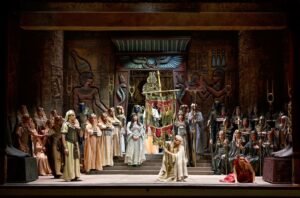
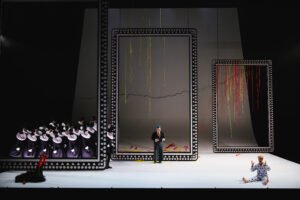
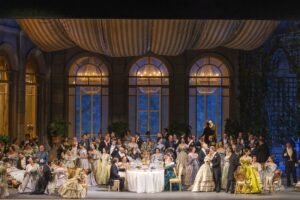
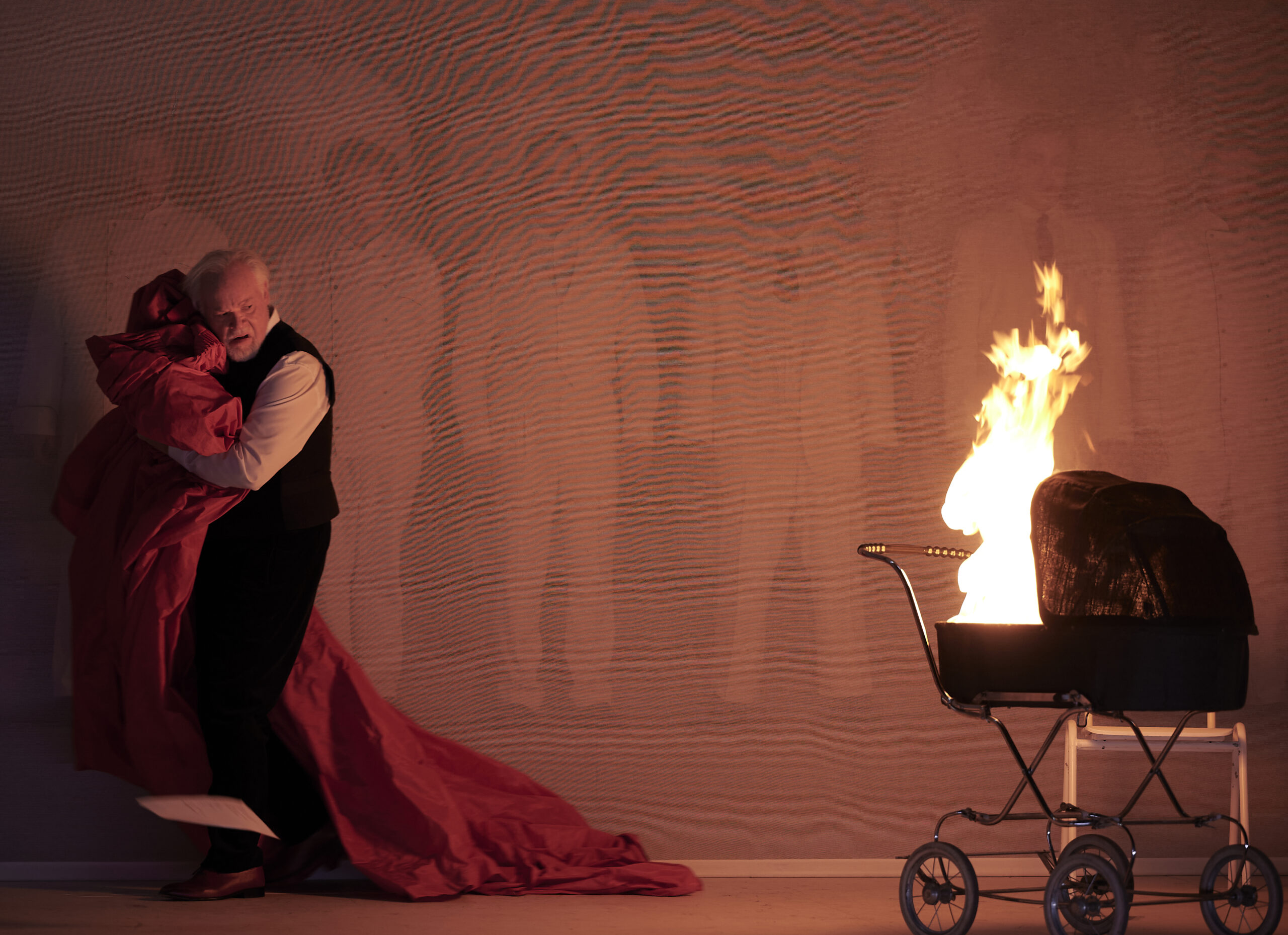
The question that arises at once is whether this renewal truly materialised. In certain respects, yes, for the greater part, even; yet in others, one was left with the impression of an attempt, only partially successful, to fashion something new out of something old. The first element to inspire a measure of reserve lies in Elisabeth Stöppler’s fragmented reading. On paper, the concept is appealing: few operas offer a director the opportunity to articulate so pointed and intelligible a critique of the grandiloquent self image a nation may cultivate around its own culture, and to foreshadow the dangers that arise when such megalomania is wedded to a political ideology – particularly when that ideology rallies individuals capable of inspiring a fear strong enough to compel the majority to comply. Yet such an undertaking demands subtlety and ingenuity; without them, the result risks seeming cursory, which at best dampens enthusiasm and at worst borders on the ludicrous. On this occasion, the critique at times appeared rudimentary and lacking in contour, relying on a few elements deliberately removed from their context and liable to provoke unfortunate interpretative conflations. Still, one must acknowledge the boldness of opening the work to an alternative reading: the desacralisation of the narrative (and above all of Hans Sachs) and the decision to situate the action within an even more overtly political framework than the one perceptible at first hearing. This, above all, is what will remain.
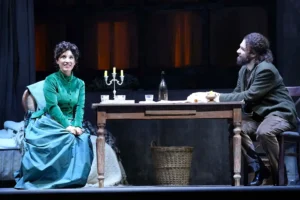
Musically, the production distinguishes itself through a remarkable consistency of quality, from the leader of the orchestra to the last chorister. Esther Dierkes’s Eva does not lack vitality: her acting is fluid, her presence unencumbered, her theatrical instinct finely attuned to the emotional dimension. The timbre, however, proves at times a touch too silvery, too vigorous for the role, to the point of overshadowing the delicacy one expects, particularly in the Act III Selig, wie die Sonne. Despite this reservation, one appreciates the ease with which she projects over the orchestra, offering consistently clear diction and intention. Opposite so assertive an Eva, Maria Theresa Ullrich’s Magdalena may seem slightly overshadowed; yet she nonetheless embodies a convincing confidante – lively, complicit, and endowed with a warm, resonant voice that blends harmoniously with her partner’s.
It is, however, in the male contingent of the cast that critical opinion converges most readily, and with considerable enthusiasm. An accomplished artist in the fullest sense, Björn Bürger offers an ideal Beckmesser: singing, dancing, mimicking, and enduring the assaults of Kai Kluge’s David – radiant, lyrical, and deliciously disagreeable from head to toe. Ever noble and imposing, David Steffens confirms the immense qualities of a bass of rare elegance, perfectly suited to Veit Pogner. Paweł Konik, a baritone of natural authority, brings to Fritz Kothner the requisite solemnity, while distilling just enough irony to render his portrayal both credible and engaging.
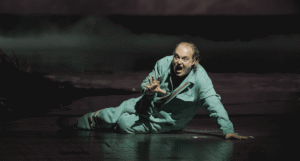
Daniel Behle, for his part, seems to dispatch Walther in a single breath: a luminous voice, refined projection, gleaming top notes, and a stage presence marked by a controlled nonchalance – one is left with the impression that Mozart has fertilised his artistry, making him the ideal interpreter of the young Franconian knight. His appearances may be brief, but they are striking: Michael Nagl’s interventions, delivered with fearless means almost too generous for the dimensions of the house, are a pure delight of deep bass resonance. Martin Gantner’s Hans Sachs, finally, is of striking humanity, uniting the ennobled and the darker facets highlighted by the staging. From amorous nostalgia to the fear of death, he offers a true lesson in singing, imbued with humility, in a role debut warmly greeted by the audience.
From the pit, Cornelius Meister unleashes sumptuous fireworks of beauty and grandeur. With ardent tempi, incandescent strings and brass, and vast symphonic waves that leave no room for ennui or languor, everything unfolds with an irresistible orchestral mischievousness that carries both stage and audience along.
The audience’s vibrant reception – its reactions oscillating over nearly six hours between emotion and laughter – demonstrates to what extent Wagner’s work remains an inexhaustible source of joy, feeling, and refined poetry, even if the manner of telling this story does not command unanimity. No matter: the production’s stance sparks a substantive debate, one all the more welcome in an era when, more than at any time since 1945, such discussions not only have their rightful place but must be pursued with urgency.
********************
DIE MEISTERSINGER VON NÜRNBERG
Oper in drei Aufzügen von Richard Wagner
Text vom Komponisten
Uraufführung am 21. Juni 1868 im Königlichen Hof- und Nationaltheater (München)
Musikalische Leitung | Cornelius Meister · Regie | Elisabeth Stöppler · Bühne | Valentin Köhler · Kostüme | Gesine Völlm · Licht | Elana Siberski · Chor | Manuel Pujol · Dramaturgie | Ingo Gerlac
Hans Sachs, Schuster | Martin Gantner · Veit Pogner, Goldschmied | David Steffens · Kunz Vogelgesang, Kürschner | Torsten Hofmann · Konrad Nachtigal, Spengler | Shigeo Ishino · Sixtus Beckmesser, Stadtschreiber | Björn Bürger · Fritz Kothner, Bäcker | Paweł Konik · Balthasar Zorn, Zinngießer | Heinz Göhrig · Ulrich Eisslinger, Würzkrämer | Dominic Große · Augustin Moser, Schneider | Samuel Harris · Hermann Ortel, Seifensieder | Stephan Bootz · Hans Schwarz, Strumpfwirker | Franz Hawlata · Hans Foltz, Kupferschmied | Torben Jürgens · Walther von Stolzing, ein junger Ritter aus Franken | Daniel Behle · David, Sachsens Lehrbube | Kai Kluge · Eva, Pogners Tochter | Esther Dierkes · Magdalene, Evas Amme | Maria Theresa Ullrich · ein Nachtwächter | Michael Nagl · Staatsopernchor Stuttgart · Extrachor der Staatsoper Stuttgart · Statisterie der Staaatsoper Stuttgart · Staatsorchester Stuttgart · Credit coverture photo: ©Matthias Baus
(For further informations) Link to the Staatsoper Stuttgart website: Die Meistersinger von Nürnberg
About the Author