LUCIA DI LAMMERMOOR | Teatro alla Scala
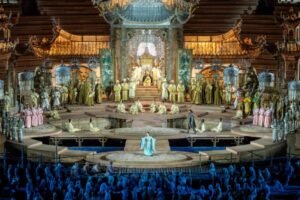
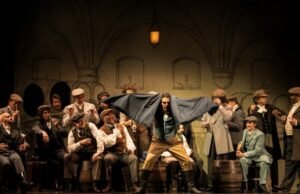
Ph. Brescia – Armisano, © Teatro alla Scala
Performance of July 7th, 2026
***
“In the gorge of a pass or mountain glen, ascending from the fertile plains of East Lothian, there stood in former times an extensive castle, of which only the ruins are now visible. Its ancient proprietors were a race of powerful and warlike barons, who bore the same name with the castle itself, which was Ravenswood.” The bride of Lammermoor, Chapter II
This is how Walter Scott immerses readers in the atmosphere of eighteenth-century Scotland: dark, austere, harsh, and melancholic. Having read this novel in August some years ago, with temperatures of 35 degrees, at times disturbed by the tumult of the beach, I found it difficult to fully grasp the somber atmosphere of this desolate, windswept land with its dangerous coasts and moors shrouded in perpetual mist.
Having such a powerful story in our hands, it becomes essential to understand the surrounding nature, wild, strong, and resilient, much like the hearts of the characters, in order to convey the atmosphere of this story through music and interpretation. It is no coincidence that Maestro Riccardo Muti, during rehearsals of Macbeth by Giuseppe Verdi with young conductors, pauses to precisely describe the moor shrouded in fog in order to achieve a performance with a certain timbral refinement and a disturbing hue in the prelude (100% Muti!) and guess what? still in Scotland.
Yannis Kokkos signs the direction, sets, and costumes of Gaetano Donizetti’s Lucia di Lammermoor, which premiered at Teatro alla Scala in 2023 with Lisette Oropesa and Juan Diego Flórez in the main cast and was revived in the 2025–26 season.
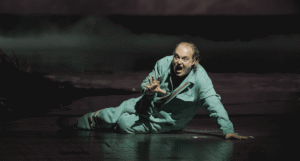
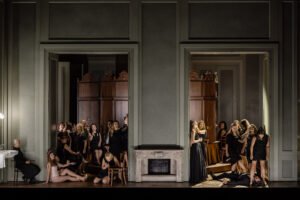
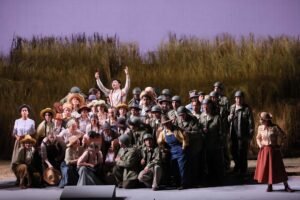
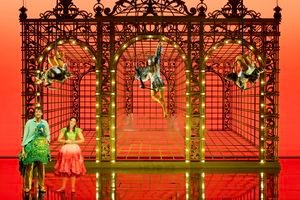
The Greek director, naturalized as French, creates a production that quite effectively reflects the atmosphere described by Scott, shifting the setting to the early twentieth century—therefore moving it away from the traditional Romantic imagination—while preserving Gothic elements that evoke the original era of the novel, resulting in a great dramaturgical coherence.
An elegant, bare, and sombre production, highly symbolic, with the omnipresence of hunting elements — dogs and deer — that become an allegory of Lucia’s oppression; gloomy, dark, and unsettling forests mirror the protagonist’s soul, while restrained lighting effects and a sober chromatic palette focus attention on the human drama.
The staging therefore deliberately becomes a universe that runs parallel to Lucia’s psychological journey: from moral pressure to the descent into madness.
An essential scenography, never merely ornamental, but rather the mirror of a mental condition collapsing into a tragic spiral. This results in a strong visual impact and an effective portrayal of the theme of social and family norms.
“And if someone had asked Lucia how she was and what she truly wanted?”
This was the comment of a child interviewed after a school project in Bergamo a few years ago on the occasion of the Donizetti Opera Festival, organized every year in the composer’s hometown. Ex ore parvulorum veritas! (from the mouths of children [comes] the truth)
This “Lucia di Lammermoor” by Kokkos incisively leads to a reflection on moral violence and the condition of women in a Scotland dominated by male figures and driven by social changes brought about by the end of the aristocracy and the evolution of the feudal system.
Here, Lucia’s madness is perfectly portrayed as the sad result of the forces trying to bend and dominate her: social norms, family, religion, and love. Yes, even Edgardo’s love, who wants to reclaim her by force: “Son tue cifre? A me rispondi!”
Today, one would say that Lucia is a victim of patriarchy (even though, in Scott’s novel, it is Lucia’s mother who orchestrates everything and subjugates both husband and daughter).
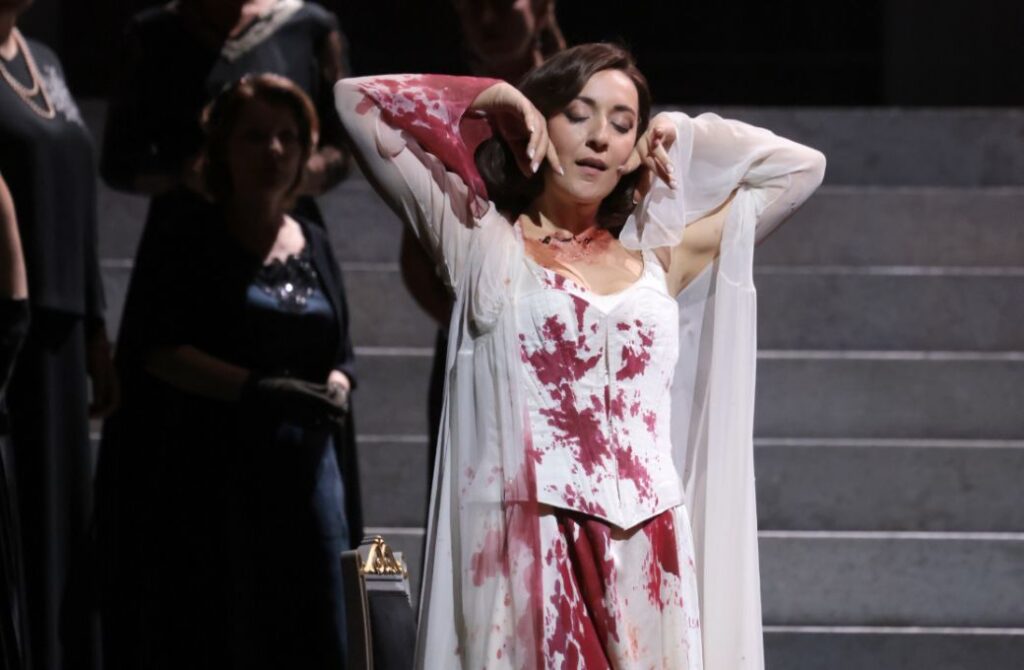
In summary, an elegant, visually sophisticated show that leaves you with strong, lasting images, somewhat at the expense of dramaturgical depth and the direction of the performers. An exception is the slightly erotic interpretation of the mad scene at the end of the first part, in which Lucia finally frees herself from mental manipulation and becomes herself (the only interpretative innovation of this production).
A 5-star Rosa Feola
“Il dolce suono mi colpì di sua voce”. One should not come to listen to “Lucia” only for the mad scene because the opera is filled with duets and choruses of tremendous beauty and intensity, but it is nevertheless inevitable that the audience anticipates this scene, which represents the climax of the drama (and the greatest challenge for the soprano).
Rosa Feola’s technique and interpretative skill are beyond question, but, having heard her live only as Violetta (Traviata) and Mrs. Ford (Falstaff), I was curious to hear her in a different register.
Rosa Feola highlights on stage the main characteristics of the character Lucia: “love, the desire to be free, and on the other hand, oppression and fragility,” as she herself describes in an interview. A richness in interpretative register that gives the artist the opportunity to express various shades and emotions, all managed to perfection in every scene with always appropriate intentions. She brings to life a deeply human Lucia, troubled but never resigned. She perfectly captures all the energy of the stage and the tension in the hall when the mad scene arrives.
She does not only “act” madness but seeks out the deep roots of the character’s psychological distress to express this madness in an emotionally charged outburst of great intensity, without exaggerated expression, alternating fragility, violence, and restlessness.
Rosa Feola offers an interpretation of great authenticity and establishes herself as the absolute focal point of this cast. She perfectly combines vocal technique with a moving interpretation, making the various emotions of Donizetti’s heroine tangible, the result of a deep identification with the character (and the result of the work done together with Renata Scotto, who told her, “When it comes: Ed ecco! [Regnava il silenzio], you have to instill fear!”).
With her clear timbre and high-quality coloratura, she handles the difficulty of this Donizettian writing with grace and fluidity. Her even, agile voice, powerful in the high notes, presents a smooth and convincing vocal line from beginning to end, with musical embellishments used intelligently.
The bel canto repertoire has one of its cornerstones. Rosa Feola’s Lucia, performed with great interpretative skills and sensitivity, marks Donizetti’s operatic heritage with prestige and credibility.
Next step? See her again as Gilda, another character for whom I have infinite tenderness.
Piero Pretti (Edgardo di Ravenswood)
It is always very unsettling to hear, at the beginning of a performance, an official announcement from the theater stating that an artist (in this case Piero Pretti) has been taken ill but has nonetheless chosen to perform. In addition to putting the audience in a cautious frame of mind while listening, it also compromised the performance itself. In particular, to protect both the tenor’s energy and voice, it was decided to eliminate the beginning of Act III: the Tower scene “Orrida è questa notte come il destino mio” followed by the duet between Edgardo and Ashton with the invitation to a duel “Qui del padre ancora respira.” This is a rather significant cut to the plot that had a negative impact on dramaturgy and narrative coherence.
Despite this unexpected event, which is certainly even more challenging for an opera singer, Piero Pretti approached the role with professionalism, demonstrating confidence in his interpretation and offering a good stage presence.
His voice retains a beautiful golden color and is rich in harmonics; the high notes are controlled, the sound is well projected, and the voice remains full despite the fragile conditions announced. In addition to omitting the scenes of the Wolferag Tower, the Sardinian tenor avoids the final high note during the Act I duet “verranno a te sull’aure…” on the word “Addio,” compensated by a beautiful harmony with Rosa Feola that allows for great emotional intensity.
The interpretation does not suffer further setbacks and, on the contrary, finds moments of great dramatic intensity, especially in the sextet “Chi mi frena in tal momento” and later in “T’allontana sciagurato.” These are choral pieces, but the tenor’s voice offers a valuable contribution with passionate and generous accents.
The peak of his interpretation comes in the final scene “Tu che a Dio spiegasti l’ali,” a scene in which the last of the Ravenswoods, through Pretti’s voice, conveys a profound feeling of suffering and despair, earning the appreciation and applause of the La Scala audience.
It is a pity about the absence of signs of blood when Edgardo stabs himself, which, in my opinion, diminished the tragic aspect of the finale (did they use all the fake blood for Rosa Feola in the mad scene?).
On the theatrical side, however, Pretti portrays an authentic and engaging Edgardo, free from melodramatic exaggerations and distinguished by natural and elegant stage gestures and expressions. An interpreter who, that evening, faced and overcame the difficulties caused by his conditions, drawing on his experience and his recognized reliability as a leading tenor in the Italian repertoire.
We will meet again, Piero! Al primo albore! 😉
Boris Pinkhasovich played the role of Enrico Ashton and was already part of the 2023 production alongside Lisette Oropesa. He portrayed a scornful and detached Ashton (as is fitting for stepping into the shoes of the oppressive and calculating brother), combining his acting with excellent technique: particularly regarding vocal range and phrasing. Chills came during the Act II duet with Lucia (first scenes up to “se tradirmi tu potrai”), in which he was able to express an interesting range of colors from dark (to intimidate his sister) to a warm, almost larmoyant tone (to soften her), with brighter nuances revealing the character’s ability to skillfully handle the so-called “dramatic triangle,” shifting from persecutor to victim.
It is truly a shame not to have heard him in the duet of the Wolferag Tower scene with Edgardo.
Leonardo Cortellazzi played the brief but fundamental role of Lord Arturo Bucklaw.
His interpretation has a noble, clear, and brilliant timbre that impeccably reflects the naivety and purity of the character, who is unaware of the background of this arranged marriage and arrives in good faith (a characteristic undoubtedly sought by Donizetti in the selection of the light tenor).
A sober performance, yet one that leaves a mark, despite the role being limited to a few scenes, thanks to great solidity in vocal emission and accuracy in phrasing.
His stage presence is highly credible and offers an essential contribution to the narrative (an aspect that is not to be taken for granted, considering that he is often regarded as a marginal character). It confirms great experience and reliability, especially in the bel canto repertoire.
In the role of Raimondo Bidebent, Michele Pertusi displayed great elegance, confirming his status as an undisputed cornerstone of the Italian repertoire. A natural authority emanates from his presence as soon as he sets foot on stage. He is admired for his in-depth interpretation of the characters he embodies—perhaps most evident and appreciable in leading roles such as Filippo II in Don Carlo… In the role of Lucia’s confidant, with a vocal quality of great intensity and breadth, he manages to offer moving moments, such as in the duet with Lucia in Act II (“Ah! cedi, cedi, o più sciagure ti sovrastano, infelice”), but of course, he was especially awaited in the aria “Dalle stanze ove Lucia,” which precedes the mad scene. Accompanied by the chorus, Pertusi delivers with elegant phrasing and great dramatic depth in an aria where the character appears troubled and as the bearer of tragic news. He rises above the chorus (and the orchestra) with his vocal power, sustaining the line and never neglecting expressive intelligence in such a crucial moment. And if you don’t get chills at “il mio sposo ov’è?” you are probably not human 😉
His deep understanding of the psychology of the characters, the result of decades of experience, greatly enriches the interpretation. A long career that, alas, has affected the color of his voice, which is now slightly less bright and certainly less flexible, though this is not a fundamental characteristic, as the role of Bidebent does not require extreme virtuoso agility.
Chapeau, Maestro.
After listening to Speranza Scappucci’s conducting in “Capuleti e Montecchi” in 2022, I once again find myself following the conductor’s performance in a bel canto repertoire.
In this production, the strong rapport between the Maestra and Rosa Feola is evident, as well as the care in selecting “an intimate cadenza,” as the interpreter of Lucia recounted in an interview.
It can be said that she favored a direct, attentive conducting style that effectively highlighted the voices and the drama. The dramatic tension is present, as is Donizetti’s characteristic musicality right from the opening bars of the prelude, with the dark drum rhythm followed by the horns.
Having attended “Lucia di Lammermoor” conducted by Giacomo Sagripanti in 2024 at the Royal Opera House, I cannot help but compare these two conducting styles.
Sagripanti led the orchestra with a great sense of order, balance, and discipline. I was left with the impression of an exciting but somewhat academic and formal Lucia (even though he managed to move me to tears in the most intense moments, with the help of the outstanding performance of Nadina Sierra in the role of Lucia).
Scappucci, on the other hand, with a more intimate cadenza, creates a more reflective and immersive atmosphere, bringing out sadness and vulnerability. She draws softness from the orchestra and offers interesting lyrical moments.
Both are expert and professional conductors, but with a different sensitivity when it comes to refinement and nuances at the level of dramatic atmosphere.
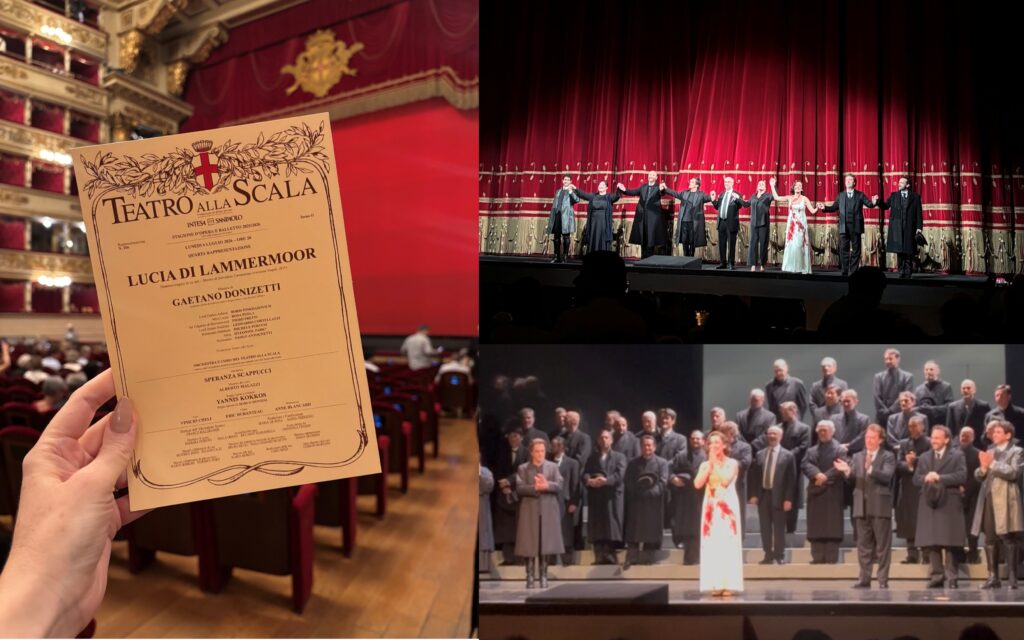
A special recognition goes to the choir, conducted by Maestro Alberto Malazzi, always impeccable.
In the great ensemble pieces — from the famous sextet “Chi mi frena in tal momento” to the moments that precede and follow the mad scene — the choir manages to create a growing dramatic tension with, as always, excellent homogeneity and theatrical intensity.
My favorite moment? When “Oh giusto cielo! Par dalla tomba uscita!” arrives, a moment when I like to observe the shocked expressions on the faces as Lucia enters, usually bloodstained.
The choir is not a simple backdrop but an integral part of the unfolding drama.
***
If you enjoyed “Lucia di Lammermoor,” you will also find “I Puritani” by Vincenzo Bellini fascinating. These are two masterpieces of Italian romantic opera that share remarkable similarities: a tormented love, a protagonist who descends into madness, the austere and dark atmosphere of Northern Europe, set against a backdrop of political tensions and conflicts. “I Puritani” is based on a French plot: Têtes rondes et Cavaliers (Roundheads and Cavaliers), written in 1833 by Jacques-François Ancelot and Joseph Xavier Boniface, which was in turn inspired by Walter Scott’s “Old Mortality.”
It is difficult to explain the tenderness I feel for the character of Lucia, but being able to attend my favorite opera again in the theater I love most was a great privilege. I invite everyone to see this masterpiece of Italian bel canto at least once and, if possible, to deepen their understanding by reading “The Bride of Lammermoor” by Walter Scott, preferably in autumn or winter, near a fireplace…
Interview source of Rosa Feola: https://youtu.be/V6nifHdYrCo?si=kYkvghQi6FQMmIdH
***
Lucia di Lammermoor, music by Gaetano Donizetti
Characters & performers: Enrico Ashton Boris Pinkhasovich ● Lucia Ashton Rosa Feola ● Edgar of Ravenswood Piero Pretti ● Arturo Bucklaw Leonardo Cortellazzi ● Raimondo Bidebent Michele Pertusi ● Alisa Hyeonsol Park ● Normanno Paolo Antognetti
Orchestra and Chorus of Teatro alla Scala ● Conductor Speranza Scappucci ● Chorus Master Alberto Malazzi ● Direction, sets, and costumes Yannis Kokkos ● Lighting Vinicio Cheli
Teatro alla Scala Production 2023
Tragic drama in three acts with libretto by Salvatore Cammarano (Naples version 1835), based on The Bride of Lammermoor by Walter Scott
Aurélie Jouan
July 2026
About the Author