IRIS | Teatro Regio Torino
©Daniele Ratti
The Rising Sun Between Symbolism and Rubble: overshadowed by an inevitable comparison with Puccini’s Japanese opera, Iris is totally immersed in that symbolist and sensual climate that first paved the way for Italian musical exoticism.
The “discovery” of Japan in the second half of the nineteenth century infected Europe and the art world with an exotic image of the country, its fairytale costumes, its floral and stylized nature, and atmospheres suspended between dream and reality of a mysterious Orient, steeped in symbolism and melancholic and erotic suggestions. The Universal Expositions of the second half of the nineteenth century in London and Paris, in addition to inspiring the birth of Art Nouveau, also significantly influenced the European musical and literary world, leading to the birth of important works inspired by the Japanese world. First the operetta The Mikado (1885) by Gilbert and Sullivan, then the novel Madame Chrysanthème (1887) by Pierre Loti, followed by the intense and decadent melodrama Iris (1898) by Pietro Mascagni, and finally the celebrated and revolutionary masterpiece by Giacomo Puccini Madame Butterfly (1904).
The proposal of the Teatro Regio is certainly of great musical and artistic interest, which, as part of the Festival Verismo opening the season, has revived Mascagni’s neglected opera in a highly prestigious production. Overshadowed by an inevitable comparison with Puccini’s opera, but a masterpiece, Iris is totally immersed in that symbolist and sensual climate that first paved the way for Italian musical exoticism. There are many stylistic and conceptual differences between the two Japanese works, which nevertheless share a common creative matrix: the librettist Luigi Illica, sole author of the text for Iris and later joined by Giuseppe Giacosa for the drafting of Madama Butterfly. We thus pass from the abstract and symbolist opera of Mascagni to the psychological and human drama of Puccini. Even from a musical point of view, the differences between the two composers are enormous: Mascagni paints an Orient seen through the lens of European musical Decadentism, an artificial exoticism evoked through highly refined timbral research and suggestive chromatic harmonies. On the contrary, Puccini seeks authenticity through a maniacal study of the costumes, traditions, and music of Japan, which he recreates with pentatonic and hexatonic scales, traditional musical instruments, and authentic melodies.
The story set to music by Mascagni is of great linearity: Iris is a pure and ingenuous maiden who lives together with her blind father and adores nature and the Sun. The wealthy Osaka becomes infatuated with her and her innocence and has her kidnapped by the slimy Kyoto, who shuts her up in a brothel in the famous pleasure district of Yoshiwara. Iris repels Osaka’s attempts at seduction and, cursed by her father who believes her devoted to prostitution, throws herself in despair into a deep and muddy ditch. While agonizing in the mud among the ghosts of her tormentors, the Sun calls her to himself while a carpet of flowers blooms all around.
Sunflowers Among the Rubble: A Striking Post-Atomic Iris at Teatro Regio
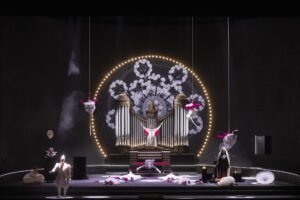
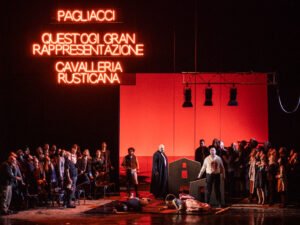
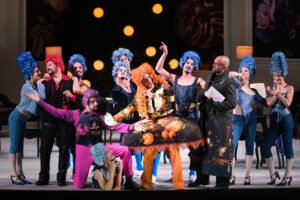
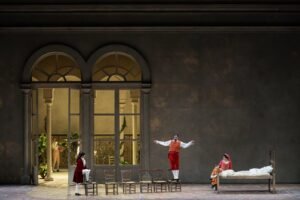
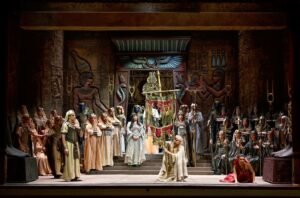
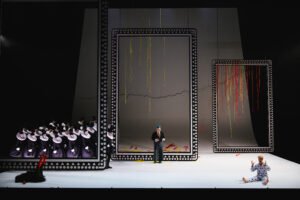
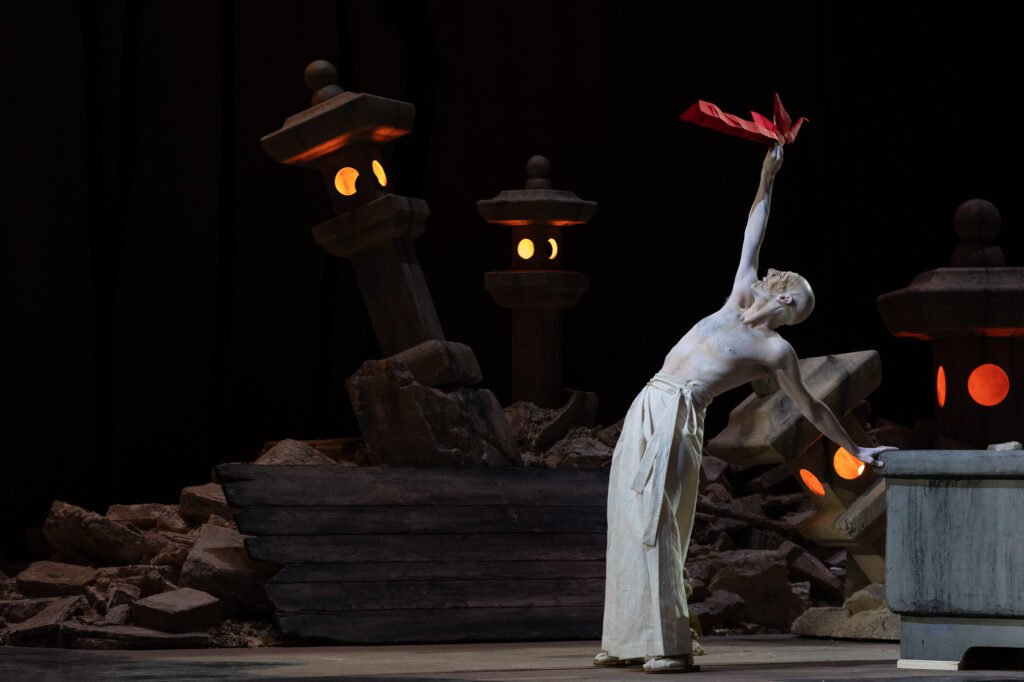
For this new production of the Teatro Regio, Daniele Menghini’s direction avails itself of the dramaturgy by Michele Panella, who strips the opera of its Art Nouveau and decadent atmospheres to immerse it in a post-atomic scenario, punctuated by the trees that survived the bombs of Hiroshima and Nagasaki (hibakujumoku) and have returned to bloom among the rubble. Iris lives together with her father in an oasis of uncontaminated nature, in a corner of the world not yet corrupted and violated, symbolized by a bonsai, where a doll is her emotional refuge and the custodian of her dreams. A large brass gong, a relic of an ancient world, rises among the burnt trees, while the famous “Hymn to the Sun” is heard in the background for the first time. After the kidnapping, Iris is transported to Osaka’s decadent palace, reduced to rubble but still bearing the signs of ancient splendor. The large octopus with its tentacles, painted on the wall as a symbol of lust, materializes on the large double bed during Iris’s famous aria “Un dì, ero piccina”, until it enfolds the protagonist and tears the doll from her arms. Very suggestive and of great scenic impact is the appearance of the Yoshiwara brothel, with the crowd watching Iris exposed high up to the public like prey. In the final act, among the war veterans rummaging through the garbage and the appearance of Kyoto, Osaka, and the father – whose egoisms have destroyed humanity -, the transfiguration of Iris takes place: from her blooms the flower of the purity of nature, sublimated by the protagonist’s sacrifice, while a rain of sunflowers invades the stage from above, like the rays of the Sun of which the chorus sings the hymn on stage. The show results fully convincing in its narration and symbolism, thanks also to the sets by Davide Signorini and the beautiful costumes by Nika Campisi, which blend traditional Japanese visual components and apparatuses with contemporary scenic elements. A synergy capable of giving dramatic power and aesthetic coherence to the story, which oscillates between the uncontaminated purity of Iris and the devastations of post-atomic society, leaving a deep imprint on the mind of the spectator.
Andrea Battistoni finds in this score his repertoire of choice, after the splendid rediscovery of Leoncavallo’s Bohème. His reading manages to hold together all the peculiarities, the timbral contrasts, the evocative suggestions but also the avant-garde intuitions of Mascagni’s score. The exotic stylization (the samisens and the percussions) emerges with astonishing clarity in the puppet show and its oriental manners. In the same way, the melodic vein of the large choral pieces and the solo moments of Iris and Osaka finds in Battistoni an ideal interpreter, capable of unleashing from his baton a tense and vibrant lyrism, yet never yielding to sentimentalism. The third act, thanks to Mascagni’s felicitous instrumental and timbral harmonization (the low registers of the orchestra and female voices), becomes one of the highest moments of most intense dramatic emotion. Here Battistoni brings out the almost expressionistic density of the score, which paints the mud and despair in which Iris lies: a prelude to the final catharsis, where the sonorous magma of chorus and orchestra seems to anticipate by over twenty years the final of Turandot composed by Alfano.
Sobotka’s Revelation and Choral Triumph: Mascagni’s Iris Captivates Turin
In the excellent cast assembled for the occasion, the Iris of Polish soprano Iwona Sobotka is a true revelation, an ideal interpreter for the timbre and emission of the unfortunate maiden. Her beautiful lyric soprano voice bends to all the expressive nuances required by the character, resolved with a truly astonishing technical solidity, particularly in the use of half voices and pianissimos, rising to the acute register even in the most dramatic moments without ever being harsh or forced. In the first act she portrays with candor the innocence and ingenuity of the character; in the second act she faces the expressive difficulties of the “aria della piovra” and its cutting sonorous arches, managing to restore the oneiric atmosphere of the piece up to the dramatic closure on the high A of extraordinary emotional power. Also in the duet with Osaka and in the terrible finale, Sobotka displays an adequate volume without ever forcing the emission. Remarkable is also the stage play and acting, capable of restoring with impressive realism the dramatic loss of innocence of the maiden. Mascagni writes one of the most demanding vocal roles for Osaka, interpreted over the years by tenors of the caliber of Enrico Caruso (1907 at the Met), Beniamino Gigli, Aureliano Pertile, up to the extraordinary Giuseppe Di Stefano (Rome, 1956). Samuele Simoncini has the right lyric-spinto tenor vocal weight, with metallic and cutting high notes, which lend themselves well to interpreting the arrogant and bored young man. The first-act serenata “Apri la tua finestra”, in its terrible post verismo vocal writing, suffers from a certain strain and difficulty in softening in the high register. On the contrary, the second-act duet with Iris is perfectly centered and loaded with drama, where Simoncini can show off excellent phrasing, high notes of dark warmth, and a highly effective stage presence in the shoes of the rich and spoiled seductor.
Manel Esteve Madrid is a Kyoto with a fine, brilliant baritone vocal quality, ironic and sharp in the declamations of the first act, capable of becoming cynical and rough in his ruthlessness as a merchant of human flesh in the second, where the scenic and vocal interpretation fully restores the unpleasantness of the character. The basso Mariano Buccino in the shoes of il Cieco is characterized by a noble but at the same time dark and solemn color, with a low register rich in harmonics that well contrasts with the pure and innocent one of Iris. The high notes launched in his curse are imposing and desperate, standing out with vigor above the orchestra. Excellent, finally, is also the performance of tenor Didier Pieri in the melancholic and mournful song of the cenciaolo that opens the third act, effective in restoring that cadence poised between folklore and Tuscan stornello.
An orchestra in splendid shape and the superlative performance of the chorus led by Gea Garatti Ansinicontributed significantly to the full public success of the show. A happy outcome which, it is hoped, may reopen the doors of the theatres to one of the most precious and interesting operas of the turn of the century.
About the Author