PORGY AND BESS | Opéra de Monte-Carlo
©Marco Borrelli
Catfish Row comes vividly to life on the stage of the Grimaldi Forum as Porgy and Bess makes its historic debut at the Opéra de Monte-Carlo. Framed by Jean-Louis Grinda’s poetic, film-inspired direction, a phenomenal ensemble of specialists and the soulful Cape Town Opera Chorus delivered a moving triumph to open the 2026/2027 season.
When in 1928, in Paris, George Gershwin asked Maurice Ravel to give him lessons in orchestration and composition, the French master refused with a sentence that has gone down in history: “Why become a second-rate Ravel when you are already a first-rate Gershwin?“. It is precisely at that fascinating crossroads between the European classical tradition and the vital energy of the New World that Porgy and Bess was born – an absolute masterpiece that premiered in Boston in 1935, the fruit of the collaboration between brothers George and Ira Gershwin and writers DuBose and Dorothy Heyward. Right from its debut, it was difficult to categorize Porgy and Bess into a well-defined musical genre, and much debate has surrounded its placement within the realm of grand opera rather than its proximity to the Broadway musical. Not even Gershwin’s own words serve to clarify the matter: “Porgy and Bess is a folk-opera! Because it is a folk tale, its characters sing folk music… Having as its subject the life of Black American, elements are introduced into the operatic form that had never appeared in opera before, and I have shaped my compositional criteria to make use of their drama, humor, superstition, religious fervor, dance, and irrepressible high spirits“.
It is a work built according to the architectures of traditional opera: there are arias, choruses, Italian-style love duets such as “Bess, You Is My Woman Now” – probably the most beautiful duet for soprano and baritone ever composed – and even the use of Wagnerian-style Leitmotive. Undeniable too is its debt to the first great American opera, La fanciulla del West, in which, at the beginning of the century, Giacomo Puccini had ingeniously fused traditional melodrama with ragtime, saloon dances, folk songs, and the banjo. In the same way, Gershwin intertwines classical forms with jazz, blues, work songs (such as Jake’s “It Take a Long Pull to Get There”), lullabies (the immortal “Summertime”), and the religious repertoire: from gospel (Bess’s “Leavin’ for the Promise’ Lan'”) to spirituals (Porgy’s “Oh Lawd, I’m on My Way”), up to sung prayers (Serena’s “Oh, Doctor Jesus”). The dual soul of Porgy and Bess is also reflected in its performance history, which has seen the finest voices of opera and jazz alternate in opera houses and recording studios, from Leontyne Price and William Warfield to Ella Fitzgerald and Louis Armstrong. The stipulation set by the Gershwin estate, holders of the copyright, remains unchanged to this day, authorizing productions of the opera only with an all-Black cast, chorus included.
Based on DuBose Heyward’s novel and subsequent stage play – inspired by the true story of the beggar Samuel Smalls and the Gullah community of Charleston, South Carolina – the plot also unfolds along a compelling double track. The tragic and passionate structure of nineteenth-century romantic melodrama comes to life in the raw, visceral microcosm of Catfish Row, a fictional neighbourhood of the city in the 1920s and 1930s, where the local community lives amidst hardship, gambling, violence, and superstition. Within this microcosm unfolds the drama of Bess, a carnal and fragile woman torn between the brutality of her lover Crown, the lures of the drug dealer Sportin’ Life, and the pure, sincere love of the crippled beggar Porgy. A love that offers a temporary refuge in Bess’s life yet is destined to shatter against a cruel and merciless reality: Porgy kills Crown to defend her, but she, yielding to the temptations of “happy dust,” flees once again and leaves for New York with Sportin’ Life. The opera concludes, however, on a note of hope, with Porgy setting off on his cart toward the big city to pursue the only love of his life.
Between Hollywood Dreams and Realism: Grinda’s Direction and the an outstanding leading Cast
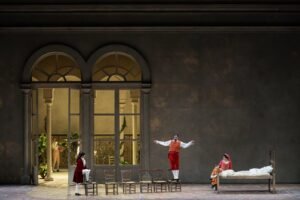
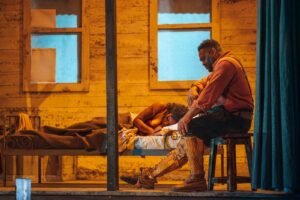
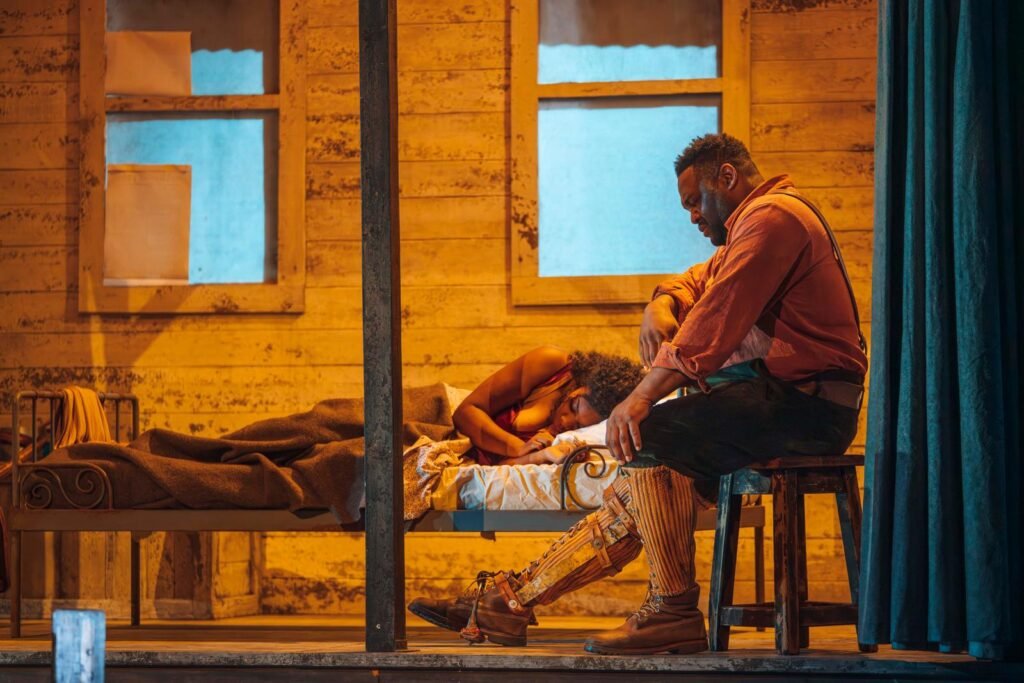
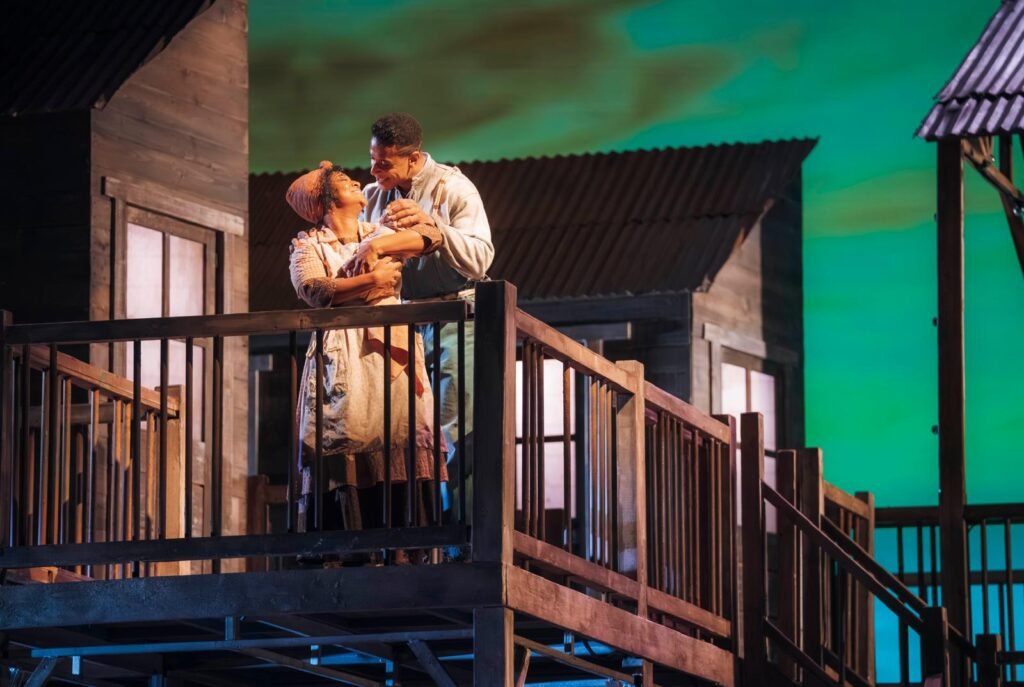
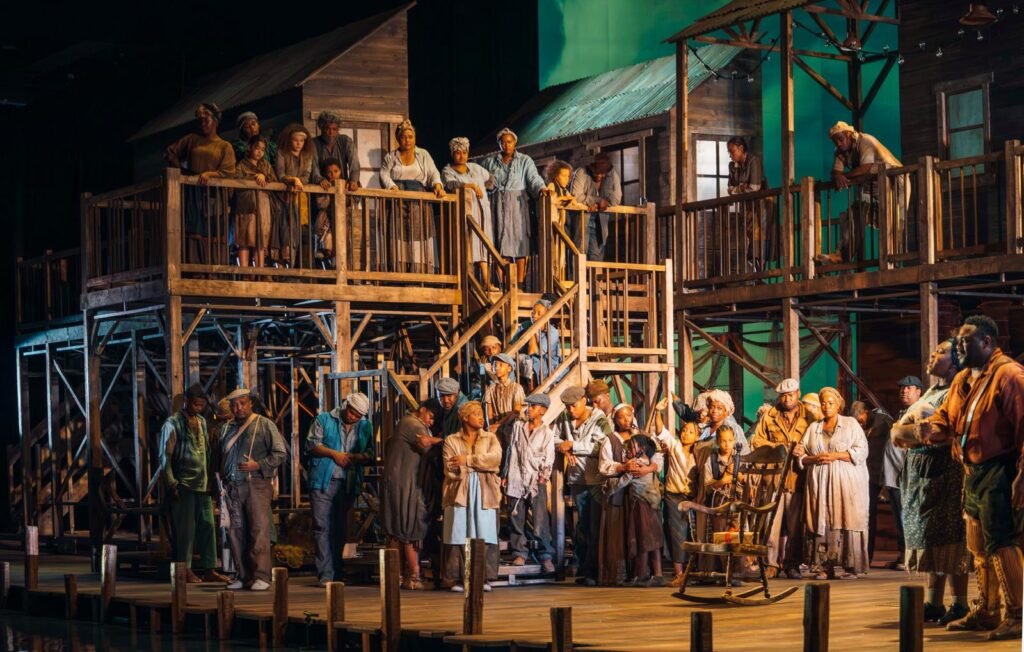
Fully capturing the spirit of the work is Jean-Louis Grinda‘s staging, returning to the Grimaldi Forum after a successful production of La Bohème (2024) in which Puccini’s masterpiece was reimagined as a cinematic fresco set in twentieth-century Paris and the Nouvelle Vague. To tell the story of Catfish Row and its community, the director once again chooses a deliberately cinematic approach, starting with projected captions that mark the passage of time and an extremely realistic reconstruction of the ghetto and its houses – like stilt dwellings – where the impoverished underclass community of the American Great Depression crowds together in close quarters, seen at the beginning through the eyes of a wide-angle lens. Isolated on the right is the destitute shack where the crippled Porgy lives, at first in solitude, mocked by the children, and later the setting for his brief and tormented love story with Bess. Grinda’s camera moves with extraordinary narrative coherence across the different planes of action, alternating with inspired fluidity between the wide shots of the choral scenes – inspired by the vitality and choreography of musicals – and close-ups charged with dramatic and emotional tension. Exceptional is the scenic rendering of the duet “Bess, You Is My Woman Now,” where the stage plunges into darkness except for Porgy’s illuminated hut, transformed by a beam of warm light into an island of intimacy and tenderness in which the two lovers embrace with infinite sweetness, while in the background, high up, a pair of elegant dancers in the style of Ginger Rogers and Fred Astaire perform as if stepping straight out of La La Land: a visual counterpoint of extraordinary poetry, the dream of an unattainable Hollywood happiness clashing with the cruel reality of the ghetto.
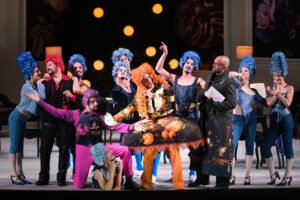
Equally exceptional is the way Grinda orchestrates the movements of the supporting characters and the chorus, where every figure has a distinct physiognomy and a body language far removed from folkloric stereotypes, both in the most tragic moments – such as the murder of Robbins and the famous funeral wake – and in the most joyful ones, such as the picnic on Kittiwah Island, where Sportin’ Life illustrates his revised version of the Bible with unbridled musical-theater moves as well as through projections. The hurricane, with its grand choral scene, takes on the force and visual power of Neorealist cinema and the great socially engaged American classics, thanks to sharp, crepuscular lighting that sculpts bodies and spaces. Moving, finally, is the opera’s ending, where Porgy staggers forward on his crutch toward the skyscrapers and lights of Woody Allen’s Manhattan: a final, poetic frame that illuminates the touching conclusion of hope.
The cast assembled for this production is the finest one could possibly imagine for this title: from the leads down to the smallest supporting role, genuine specialists of the score were engaged, capable of masterfully commanding the technical, vocal, and interpretive demands required by Gershwin, combining operatic singing, jazz, and the religious repertoire of spirituals and gospel with balance and full stylistic awareness. All of this is even more evident in the leading pair, who also stand out for an all-encompassing stage performance, enhanced by Grinda’s direction, which proves capable of delving into the characters’ psychology and bringing out their fragile intimacy against the backdrop of the restless, vital humanity of the Catfish Row community.
A Parade of Vocal Greatness: Opera, Jazz, and Spirituals Come Alive
Michael Sumuel is a virtually ideal Porgy. His bass-baritone timbre, warm and enveloping yet dark and authoritative at the same time, endows the protagonist with a heroic stature in stark contrast to his physical fragility. The American singer thus succeeds in portraying an authentic and deeply moving character: he lightens his voice, making it bright and ironic, in the famous “I Got Plenty o’ Nuttin’” – a true hymn to freedom and the joy of owning nothing, steeped in jazz, ragtime, and folk inflections – while approaching the duets with Bess with an intense, sorrowful lyricism. In the long melodic phrases of “Bess, You Is My Woman Now”, he bends his vocal production to a thousand nuances, intertwining and blending at the octave with the soprano’s voice on the B-flat that closes this heartbreaking love song. Sumuel also demonstrates extraordinary vocal and theatrical presence both in the storm scene, where he leads the chorus in prayer with spiritual and deeply felt accents, and in the high tension physical struggle with Crown, culminating in the exhilarating final exclamation, “Bess, you got a man now”. His performance finally reaches its emotional peak in the last scene, with the departure toward the unknown of the Big Apple sealed by radiant, hope-filled singing.
Equally extraordinary is the Bess of Californian soprano Brittany Olivia Logan, endowed with a truly exceptional vocal instrument in terms of timbral quality and volume, which expands with tremendous ease into the upper register, always luminous and well-projected even in moments of greatest dramatic tension. Her Bess is a contradictory and torn woman, caught at the moment when her beauty is beginning to fade: provocative and brazen at first, capable of sweetness and quiet resignation beside Porgy, yet later overwhelmed by her own emotional fragilities and addiction. This complexity finds full correspondence on the vocal plane, moving from the ecstatic lyricism of “Bess, You Is My Woman Now” – crowned by an enveloping and radiant high B-flat – to the anguish-tinged accents of “I Loves You, Porgy”. On Kittiwah Island, Logan then tackles the confrontation with Crown (“What you want wid Bess?”) with great dramatic intensity, mastering a daunting vocal line made of lightning-fast leaps to the top and plunges into the chest register, and conveying with powerful acting impact a woman who first rebels and then yields to the man’s violence and brutal magnetism.
Chauncey Packer portrays the drug dealer Sportin’ Life with the bright voice of a character tenor, following the finest vocal and performance tradition. Within the bigoted community of Catfish Row, the singer perfectly delineates a cynical yet witty and seductive character. Mastering both traditional operatic technique and jazz, Packer is completely at ease with scat singing and syncopated rhythms, doing full justice to his most iconic numbers. During the picnic on Kittiwah Island, “It Ain’t Necessarily So” becomes a true Broadway musical number: Sportin’ Life delivers his irreverent version of the Bible with razor-sharp diction and impeccable rhythm, ascending to high notes with a ringing tone free of operatic vibrato, and entering the chorus’s responses with spot-on timing, alternating between winking and irreverent accents. In his other famous solo, “There’s a Boat Dat’s Leavin’ Soon for New York”, Packer excels at shifting registers: moving into a more central tessitura, he adopts a whispered, enveloping crooner style to manipulate Bess and convince her to run away with him.
Leveraging the power of his baritone voice, Bongani Justice Kubheka is a brutal and violent Crown who, thanks to his imposing stage presence, depicts Bess’s lover as almost animalistic in his strength and dominance, yet seductive in his magnetic carnality. The singer displays a solid, incisive, and stentorian vocal production in moments of anger, asserting himself arrogantly both in the duet on Kittiwah Island (“What You Want Wid Bess?”) and in his irreverent defiance of the storm (“A Red-Headed Woman”), right up to the dramatic final confrontation with Porgy.
On the opposite side stands the exceptional Serena of Leah Hawkins, who delivers a memorable performance as the wife of Robbins, killed by Crown during a craps game at the beginning of the opera. The American soprano showcases a rich, harmonic, and powerful lyric voice, yet one capable of bending to poignant and emotionally vibrant singing. The singer deeply impressed the audience right from the justly famous “My Man’s Gone Now,” a piece in which grand opera merges with the spiritual: here Hawkins chisels out a desperate and deeply felt vocal line, where high notes turn into cries of pain and downward glissandos transform into an anguished, heartbreaking lament. Equally impactful is the prayer for Bess’s recovery, “Oh, Doctor Jesus,” in which her phrasing becomes hieratic and her velvety, mellow timbre bends into evocative mezza voce passages and accents of genuine faith in God.
Entrusted to Brandie Inez Sutton’s Clara is the most famous page of the opera (which has also become one of the most frequently performed pieces in jazz and twentieth-century music), the lullaby “Summertime”, which the young mother, wife of the fisherman Jake, sings to her infant child. Sutton displays an ideal bright, luminous timbre and supple phrasing; she ascends to the concluding high B-natural with a perhaps overly pronounced upward portamento, yet manages to sustain the note for a long time with a lovely suono filato floating over the orchestra. Equally successful is the reprise in the second act, where her phrasing becomes more anxious and dramatic.
A genuine specialist and iconic interpreter of this repertoire, Tichina Vaughn lends her celebrated mezzo-soprano timbre and charisma to the proud Maria, proprietor of the Catfish Row cookshop. Her dark vocal color and temperament emerge vigorously throughout the opera, particularly in her vehement invectives against Sportin’ Life, whom she condemns for his corrupt ways and for trying to peddle his “happy dust” – an intervention through which Maria stands as the true moral conscience of the community and its mores.
In a choral fresco so complex and varied, it becomes virtually impossible to dwell individually on each of the numerous performers, yet the entire cast operates at a remarkably high level of quality, helping to bring life and credibility to the Catfish Row community even in seemingly minor roles such as Siphesihle Mdena’s evocative Honey Man and Karabo Rabaloi’s suave Strawberry Woman.
Singing from the Soul: The Cape Town Opera Chorus and Monte-Carlo Philharmonic
Fundamental to the masterful success of the production is the contribution of the Cape Town Opera Chorus, an ensemble of absolute excellence superbly conducted by Antoinette Huyssen, which becomes the true collective protagonist of Gershwin’s folk opera. Their sonic compactness, wide dynamic range, and ability to alternate every stylistic register – from the hieratic tone of the prayers to the most festive and lively moments – blend with a profound vocal and psychological assimilation of this score, which seems to spring from the soul even before the vibration of the vocal cords. No less striking is their compelling stage presence, in which every single artist transforms into a living, recognizable member of the Catfish Row community.
British conductor Lee Reynolds, at the helm of the Monte-Carlo Philharmonic Orchestra, provides a solid orchestral fabric for this extraordinary vocal lineup. His musical reading is dazzling and rich in the warm colors of American music, both in the most agitated, overwhelming moments and in the more lyrical, intimate pages, where the baton finds accents and sonorities of strong emotional impact. Reynolds consistently ensures an excellent balance with the stage and a complete rapport with the singers, accompanying the protagonists’ duets with rare sensitivity and engagement. From the pit, the two souls of Porgy and Bess emerge clearly – the European tradition of classical symphonism and the American spirit of jazz and blues – though the latter at times feels less visceral, lacking that deep psychological internalization and that “vibration of the soul” that instead made the performance of the soloists and the chorus unforgettable.
At the end of the performance, with darkness enveloping Porgy and the silhouette of New York illuminated in the background, the Grimaldi Forum audience gave a warm reception to all the musical performers, the stage director, and his creative team, sealing in the best possible way this opening of the Opéra de Monte-Carlo’s 2026/2027 season, signed by the great intelligence, musical expertise, and refined artistic sensitivity of Cecilia Bartoli.
About the Author