WERTHER | Opernhaus Zürich
T+T Fotografie
When Going Back Changes Everything: Werther and the Art of Rediscovery
Some productions make a strong first impression. Others quietly settle in the back of your mind, inviting you to return one day.
I first encountered Tatjana Gürbaca‘s Werther at the Opernhaus Zürich in February 2024. At the time, I knew very little about Massenet‘s opera. I had never seen the production, barely knew the music and arrived with almost no expectations. Benjamin Bernheim‘s elegant and beautifully controlled portrayal of Werther made the evening a wonderful discovery.
So when the production returned two years later, this time with Jonathan Tetelman making both his role and Zürich debut, going back felt like an opportunity too good to miss.
I ended up going twice.
Curiously, neither evening began as planned. On 19 June, a violent summer storm over Zürich postponed the start after several orchestra musicians were delayed. On 4 July, the orchestra began, the singers entered behind the curtain… and the curtain simply refused to rise.
For a few surreal minutes, Werther unfolded without a stage. The performance was eventually interrupted while the mechanism was repaired before restarting after the Prélude. The Opernhaus softened the inconvenience with complimentary Prosecco during the interval. There are certainly worse ways to deal with a technical mishap.
Fortunately, the curtain proved to be the least memorable part of the evening.
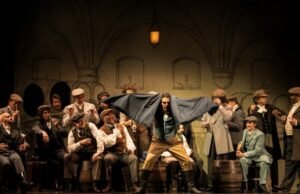
If one word defines Gürbaca’s production, it is intimacy.
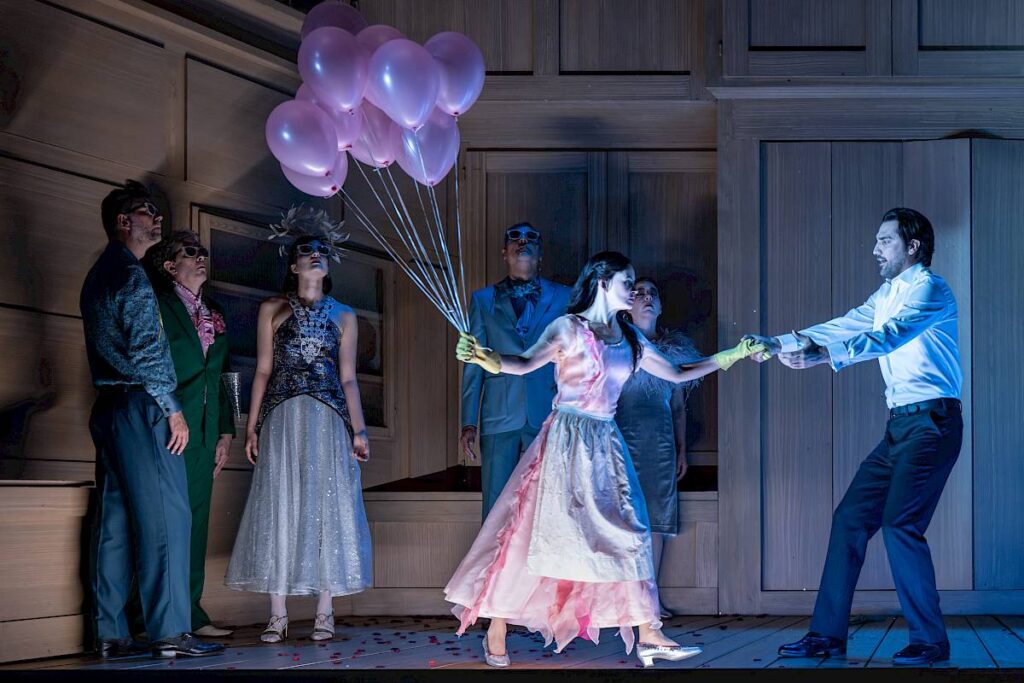
Klaus Grünberg’s set resembles a small wooden house, warm, modest and almost childlike. Christmas decorations, children and simple costumes create the atmosphere of a family portrait. Nothing is extravagant, except for a ballroom scene whose dreamy elegance briefly seems to suspend ordinary life.
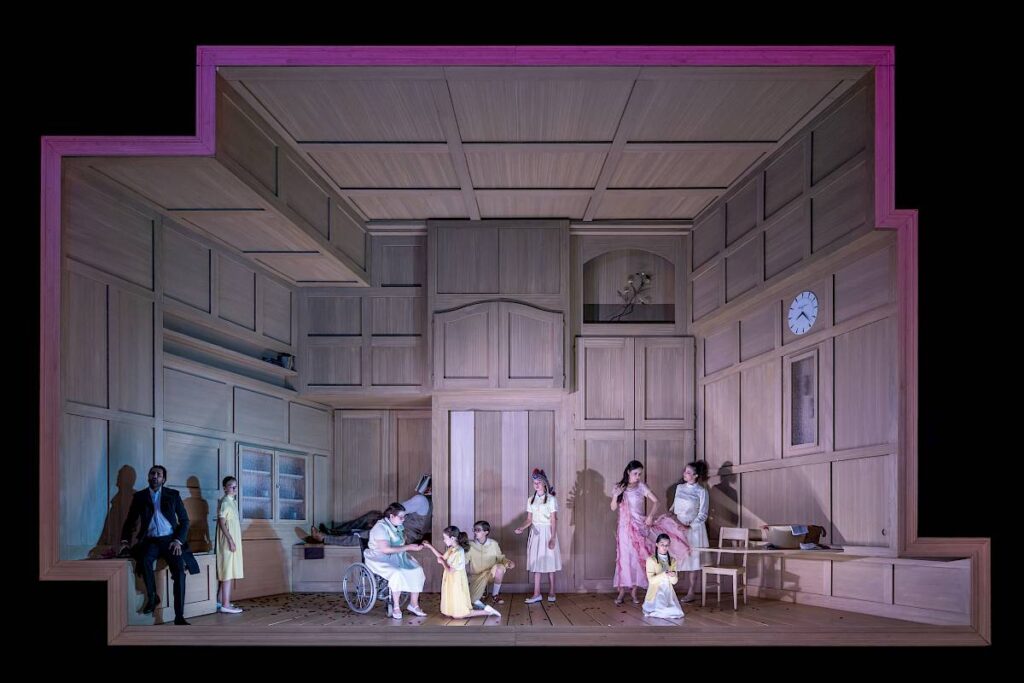
Watching it again, I began to see the wooden box as something closer to a mind: a confined space in which love, duty, regret and endless overthinking collide. The characters seem trapped not only inside the house, but inside their own thoughts.
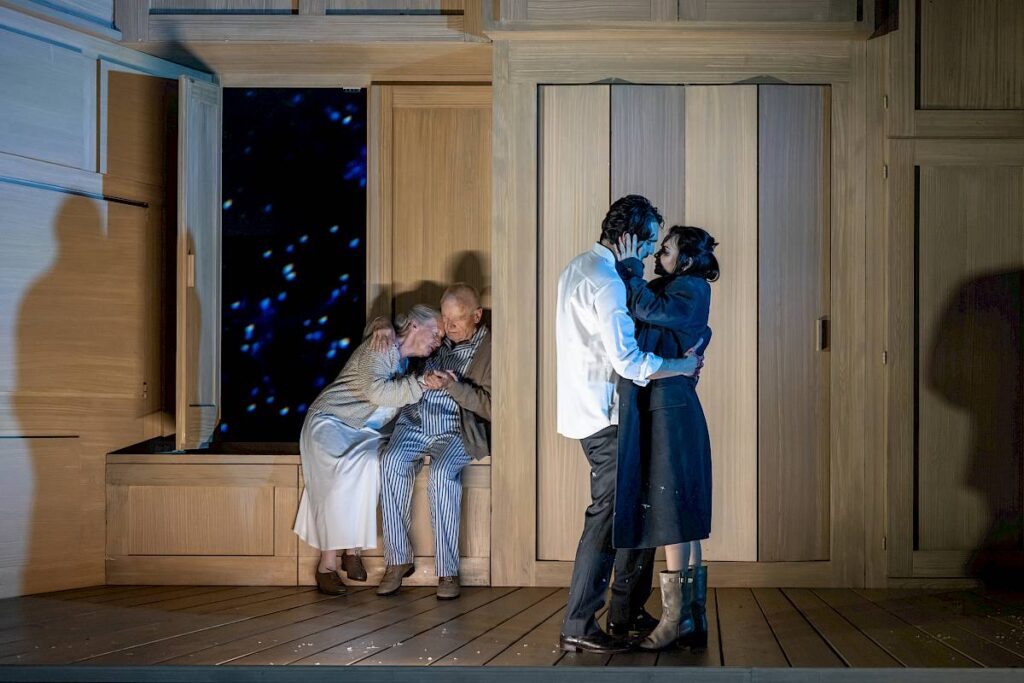
As the evening progresses, wooden panels slowly open onto the outside world. In the final moments, the snowy landscape gives way to the stars themselves. It feels as though Werther’s world is finally opening, revealing every possibility life might have offered him, only when it has become too late to seize any of them.
The production’s most moving image appears when Werther and Charlotte are finally reunited. An elderly couple enters the room wearing costumes that recall those of the younger lovers at the ball. The man echoes Werther, while the woman wears a fairy-tale crown resembling Charlotte’s. For a moment, they seem to represent another version of the story: a parallel life in which Werther and Charlotte chose each other, remained together and grew old side by side.
It is an astonishingly simple image. Yet it says everything.
Throughout the production, we witness the full arc of life, from childhood and family to love, old age and, ultimately, death. In this single scene, the audience is confronted not only with the fate of Werther and Charlotte, but with the life they will never share. It was the moment that moved me most. Their tragedy was no longer simply about impossible love. It became a reminder that life is short, that every decision closes other paths, and that some possible lives remain forever unlived.
Massenet‘s score mirrors that same intimacy. Rather than overwhelming the audience with constant emotional climaxes, it seems to breathe with the characters. Delicate orchestral colours suspend time, allowing silence and hesitation to become just as expressive as the great lyrical outbursts.
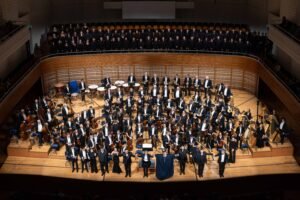
Marco Armiliato understood that balance perfectly. Under his direction, the Philharmonia Zürich never dominated the stage. Instead, the orchestra became another storyteller, supporting the singers while preserving the score’s extraordinary transparency.
Having first experienced the production with Benjamin Bernheim, comparison became inevitable. Bernheim impressed through elegance, refinement and remarkable vocal clarity. Jonathan Tetelman chose a different path.
His Werther was darker, more physical and almost feverishly passionate. His voice moved effortlessly between tenderness and despair, while his commanding stage presence gave the character an intensity that never felt forced. Seeing him twice within just over two weeks also confirmed something equally important: remarkable consistency.
He never seemed to be performing Werther. He was living him.
Anna Goryachova brought undeniable dramatic commitment to Charlotte. Her portrayal possessed tremendous emotional weight, although I occasionally wished for greater contrast and vocal intimacy to complement the sustained dramatic intensity.
Chelsea Zurflüh was one of the evening’s happiest discoveries. Her radiant Sophie brought freshness, warmth and effortless charm to every appearance, while Aksel Daveyan offered a thoughtful and vocally secure Albert, reminding us that this opera contains no real villain, only human beings making impossible choices.
When the wooden walls finally opened onto the stars, the focus shifted from death toward transcendence. Rather than dwelling on Werther’s final moments, the production released him from the world. Earth slowly disappeared beneath him as he floated into darkness, leaving Charlotte and the life they might have shared behind. It completed the circle begun with the children and the family gathering: childhood, love, old age and death, all contained within one small wooden room.
Why return to the same production three times?
Because returning is not about confirming what we already know. It is about discovering what we somehow failed to notice before. A different cast reveals different emotions. Time itself changes the way we listen. Even our own lives quietly reshape the stories we see on stage. When I first discovered Werther in 2024, I admired a beautiful production. Two years later, I realised I was no longer watching exactly the same opera. Not because the staging had changed. Not because the cast was different. But because I was.
Some performances deserve to be experienced once.
The greatest ones invite us back.
Cast & Creatives
Conductor — Marco Armiliato
Director — Tatjana Gürbaca
Sets Designer — Klaus Grünberg
Set Design Collaboration — Anne Kuhn
Costume Designer — Silke Willrett
Costume Design Collaboration — Carl-Christian Andresen
Chorus Master — Alice Lapasin Zorzit
Dramaturgy — Claus Spahn
–
Werther — Jonathan Tetelman
Charlotte — Anna Goryacheva
Sophie — Chelsea Zurflüh
Albert — Aksel Daveyan
Le Bailli— Valeriy Murga
Schmidt — Martin Zysset
Johann — Evan Gray
Brühlmann — Guram Margvelashvili
Käthchen — Thalia Cook-Hansen
About the Author