DER SCHATZGRÄBER | Deutsche Oper Berlin
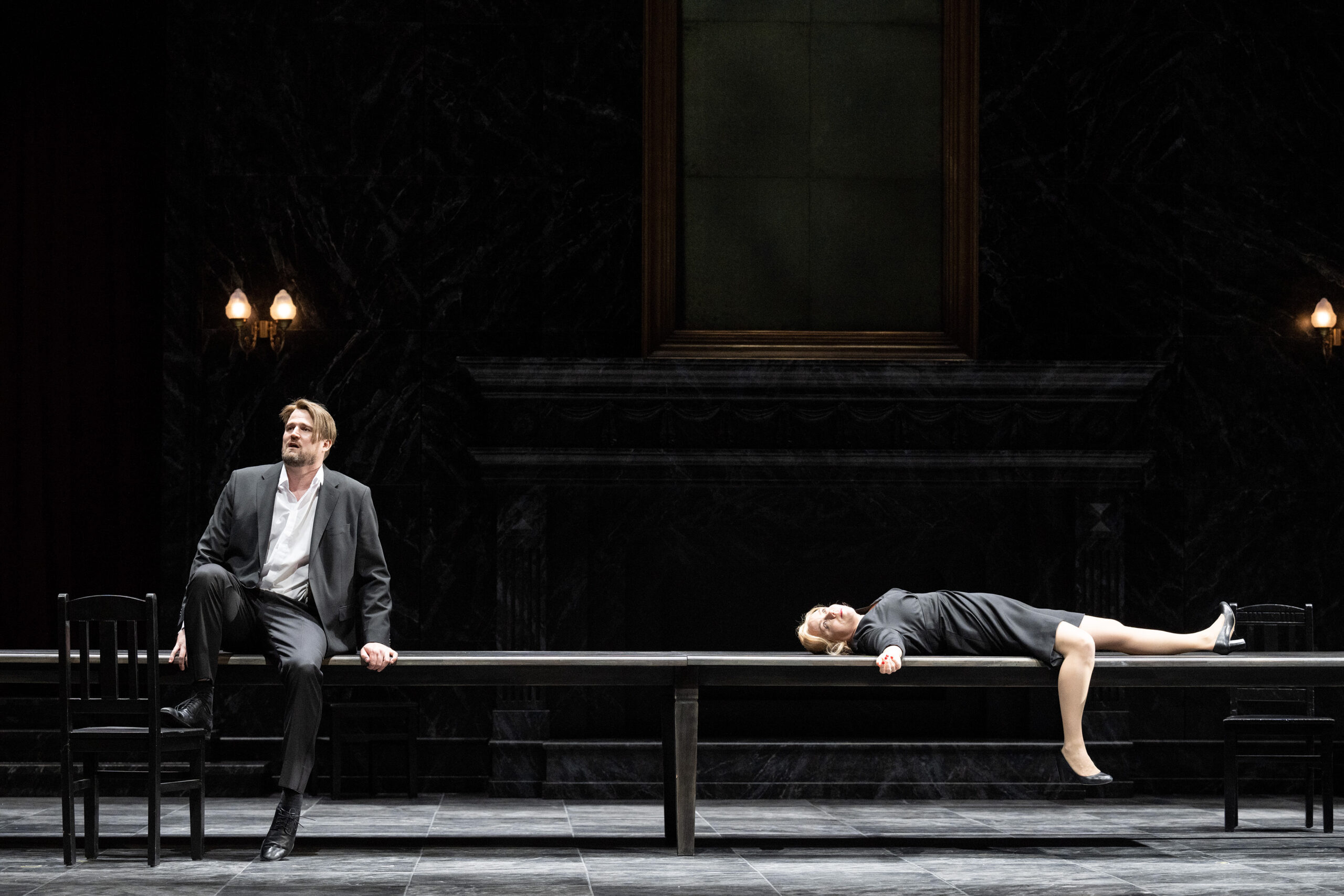
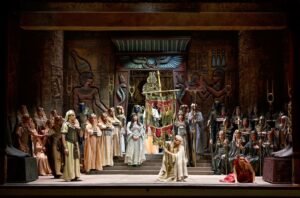
Restraint touched with elegance returns to the stage of the Deutsche Oper in this revival of Der Schatzgräber, in Christof Loy’s staging, long acclaimed wherever it has been seen. In Berlin as in Strasbourg, the most rapturous critical notices greeted a production that has not aged by a single day, whose interpretative force, despite an astonishing economy of means, remains wholly intact. It stands as eloquent proof of the calibre of insight this all-too-rare and exceptional work demands – and, one may hope, as a means of bringing it more fully into the public consciousness. It bears recalling that, following the meteoric success of Der ferne Klang and Die Gezeichneten, Franz Schreker established himself as one of the most celebrated composers of the interwar years: Der Schatzgräber alone was performed no fewer than 350 times during the Roaring Twenties, securing his reputation as the rightful heir to Richard Wagner, poised at the juncture of Romantic tradition and an emergent modernity.
An exceptionally well-wrought musical architecture, whose winding pathways release in turn sensuality, ambition and love. At the crossroads of Debussyan expressionism and post-Wagnerian opulence, it proves at once deeply human and exhilarating, never lapsing into tedium or excess, sustaining the listener’s breathless attention across its four acts, from prologue to epilogue.
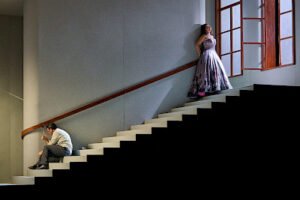
Daniel Johansson delivers a compelling portrayal of Elis, whose integrity of character and sincerity of utterance prove deeply moving. There is about him an unassuming nobility, free of affectation and quietly beguiling, allied to a humility that his gleaming Heldentenor voice conveys with striking aptness. His formidable resources dovetail seamlessly with Schreker’s luxuriant and virtuoso writing, allowing him to ride the orchestra effortlessly even in the score’s most unabashedly Tristanesque moments.
Olesya Golovneva brings to life a touching Els, yearning for a life graced with greater comfort and social recognition. There is no trace of frivolity in her portrayal, but rather the palpable suffering of a woman condemned to an existence ill-suited to her nature: even her flashes of joy are tinged with a melancholy one might deem irredeemable. The voice mirrors the character’s inner tides: richly inflected, generous in the upper register, dispatched with disarming ease, despite the occasional shimmer bordering on over-emphasis.
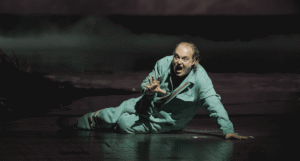
It is through him that we are ushered into this marvellous yet acerbic tale: as the Narr, Thomas Cilluffo lets his prodigious gifts as an actor blaze forth, allied to a timbre of the utmost lyricism and radiance. Theatre and song flourish in a portrayal meticulously calibrated for this pivotal figure, earning what proved to be the evening’s most resounding acclaim.
Panache and poise define the König as sung by the excellent baritone Jared Mac Werlein. His warm, firmly textured voice reflects a character who, beneath layers of nonchalance and self-concealment, is possessed by a despair that only deepens as the drama unfolds. Clemens Bieber’s Chancellor cuts with the incisive edge the role demands, without forgoing a welcome measure of sustaining lyricism. The remainder of the cast, true to the Deutsche Oper Berlin’s tradition, rises fully to the level of the principal roles, carrying the evening to heights of lyric intensity and emotional charge.
Marc Albrecht’s refined conducting proves adept at channelling the orchestral flow, while endowing it with the suppleness required to evolve alongside the narrative, fully realising the score’s highly theatrical Konversationston.
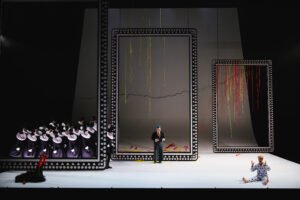
Despite the predominance of anthracite grey in Johannes Leiacker’s sets and the elegant restraint of Barbara Drosihn’s costumes, it is a fabulous array of shifting colours and embodied leitmotifs that are painted musically and vocally: an ideal incarnation of the work, suspended in a spellbinding fusion of beauty and sensuous delight.
******************************
DER SCHATZGRÄBER
Opera in four acts, with a prologue and an epilogue, by Franz Schreker
Libretto by the composer
Première: 21 January 1920 (Oper Frankfurt)
Conductor | Marc Albrecht · Stage direction | Christof Loy · Set design | Johannes Leiacker · Costume design | Barbara Drosihn · Light design | Olaf Winter · Chorus Director | Jeremy Bines · Dramaturge | Dorothea Hartmann
Der König | Jared Werlein · Die Königin | Doke Pauwels · Kanzler | Clemens Bieber · Der Graf/Ein Herold | Philipp Jekal · Der Magister/Der Schultheiss | Joel Allison · Narr | Thomas Cilluffo · Der Vogt | Tómas Tómasson · Junker | Byung Gil Kim · Elis | Daniel Johansson · Schreiber | Michael Dimovski · Wirt | Bart Driessen · Els | Olesya Golovneva · Albi | Patrick Cook · Landknecht | Volodymyr Morozov · Drei Damenstimmen | Kristina Griep, Nicole Drees and Seungeun Oh · Chor der Deutschen Oper Berlin · Orchester der Deutschen Oper Berlin · Credit coverture photo: ©Monika Rittershaus
(For further informations) Link to the Deutsche Oper Berlin website: Der Schatzgräber
About the Author