Somewhere between the 1930s and 1940s, a group of Jewish men and women gathers in a vast and richly stocked library. As in all places where books are handled and consumed, order is elusive; the volumes themselves belong to another age. The contrast with the deep burgundy of the walls only heightens the eye’s attraction to these grey, dust-laden tomes. The evening opens with Narraboth (Joachim Bäckström), veiled hat perched upon his head, launching – lip‑synched – into Nun will die Sonn’ so hell aufgehn’ from Mahler’s Kindertotenlieder. The choice of music and of character to voice it is strikingly apt: is it not he who, albeit under the relentless pressure of the Princess of Judaea, permits Jochanaan to emerge from his cistern? The allusions to the spoliation endured by Jews during the Second World War are unmistakable, embodied by those who seek refuge in this “kingdom” where everything is symbol. For, as the programme rightly reminds us, Salome is a biblical tale, set in Galilee – nothing more logical, then, than to re‑inscribe its unfolding within this context, even if transposed two millennia forward.
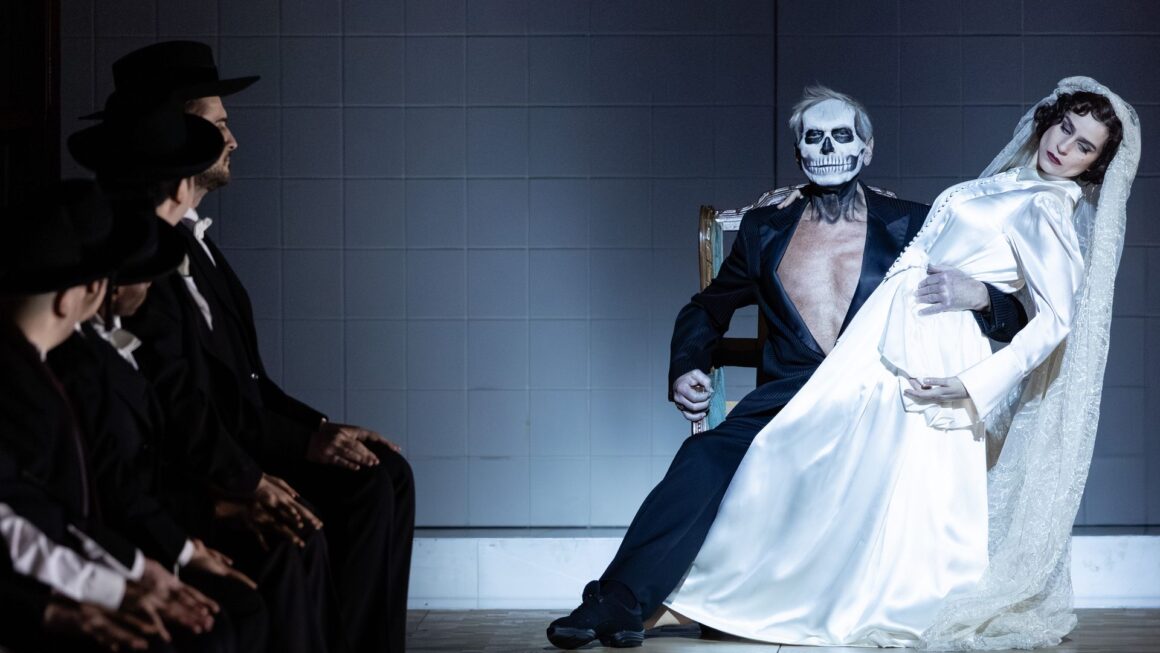
Krzysztof Warlikowski thus approaches Salome through this prism, supported by the superb contributions of Małgorzata Szczęśniak for costumes and sets, Felice Ross for lighting, and Kamil Polak for video design. The profusion of details and references forms a backdrop at once tightly woven and unusually rich for an opera whose stagings, though often pertinent and engaging, tend to remain more straightforward in their interpretative stance. The result is a supple layering of scenic intention and musical ecosystem, leaving a distinct imprint and the gratifying sense of having witnessed something singular and striking in its artistry.
A blazing presence on stage, possessing the role until it becomes an extension of herself, Asmik Grigorian has been showered with the most laudatory epithets for her remarkable performance, praise fully deserved, both from the public and from the specialist press. She inhabits the production’s intentions so completely that they seem to arise from within, shaping an evolution rendered with the delicacy of a glide both controlled and subtle, profoundly dramatic in its essence. It is unmistakably her Salome – and therein lies the source of a few vocal reservations that temper the surrounding fervour. Salome was conceived for a lyric soprano: powerful, certainly, but endowed with incisive youthfulness, a silvery brilliance, agile and seductive, even erotic in its allure. Grigorian’s voice, voluptuous in timbre and instantly recognisable, soars towards the upper register with arrow‑like ease, yet at times seems a touch too developed to allow for the quicksilver modulations and slightly insolent lyricism demanded by many passages. There is heightened expressionism, even tragedy, but little of the glittering, venomous incandescence that so many “Salomes” of the past have accustomed us to. A touch more of that luminous acidity, of that shimmering, voluble phrasing, would no doubt be welcome – but can one reasonably expect this from a (truly great) artist who, in less than five months, will be making her debut as Carmen?
Wolfgang Koch offers a Jochanaan of imposing authority, even if the voice no longer carries quite the same prophetic resonance as in earlier years. This slight erosion lends his portrayal the air of a prophet worn down by struggle yet still unbowed. His finely judged acting, and above all his clarity of diction and command of the text, complete a performance of considerable distinction.
Gerhard Siegel crafts a Herodes capable of the most unavowable greed, endowed with a sense of absurdity and excess that suits the tetrarch to perfection. The tenor resorts to Sprechgesang sparingly, allowing his projection and vocal line to be appreciated in their full measure. What ultimately emerges is the impression of an artist who understands that, for his character truly to live, he must step just beyond what is expected. It is a finely calibrated extravagance, more deranged than dangerous, that never rings false and never overwhelms.
Herodias gains formidable stature in Claudia Mahnke’s portrayal. Fashioned in rounded, resonant imprecations shaped by a striking gift for declamation (acerbic, hysterical, yet never relinquishing a certain poise), she makes it clear from her very first entrance that she is the one who holds her husband in check, despite his incestuous proclivities. It is in this ability to transform a handful of interventions into moments of grandeur and sheer delight that a truly great artist reveals herself.
The luminous timbre and fine poise of Joachim Bäckström make his Narraboth a model of radiance, standing in complete contrast to Gerhard Siegel’s portrayal. Beside him, Avery Amereau offers a beautifully shaped performance as Herodias’s Page: superb projection, a tremulous edge of great charm, and a presence carved with exquisite precision. To these distinguished contributions are added the excellent Jews – ardent, flamboyant, ablaze with character – and the bright‑voiced Nazarenes, vividly brought to life by Ya-Chung Huang, Tansel Akzeybek, Frederick Ballentine, Jinxu Xiahou, Roman Chabaranok, Martin Snell and Lucas van Lierop. A special mention must go to Paweł Horodyski’s Erster Soldat, whose ample, burnished, bronze‑coloured voice proves particularly alluring.
Under Thomas Guggeis’s luxuriant direction, sumptuous from first bar to last, the score unfurls as a true panorama of colours and textures. A distinct tragic impulse courses through his reading, carrying the breath of Strauss’s great symphonic canvases and drawing from the Bayerisches Staatsorchester torrents of sound as vertiginous as they are sublime. The result is an experience in its own right – whirling, intoxicating, and fully worthy of the finest interpretations of this formidable score.
Around a radiant central figure, the production’s boldly innovative theatrical vision, supported by a first‑rate ensemble in the secondary roles and an orchestral direction verging on the prodigious, turns this Salome into a moment of pure jubilation and one of the defining highlights of the 2025/2026 European operatic season.
******************************
SALOME
Musik-Drama in einem Aufzug nach Oscar Wildes gleichnamiger Dichtung (1905)
Musikalische Leitung | Thomas Guggeis · Inszenierung | Krzysztof Warlikowski · Bühne und Kostüme | Małgorzata Szczęśniak · Licht | Felice Ross · Video | Kamil Polak · Choreographie | Claude Bardouil · Dramaturgie | Miron Hakenbeck und Malte Krasting
Herodes | Gerhard Siegel · Herodias | Claudia Mahnke · Salome | Asmik Grigorian · Jochanaan | Wolfgang Koch · Narraboth | Joachim Bäckström · Ein Page der Herodias | Avery Amereau · Erster Jude | Ya-Chung Huang · Zweiter Jude | Tansel Akzeybek · Dritter Jude | Frederick Ballentine · Vierter Jude | Jinxu Xiahou · Fünfter Jude | Roman Chabaranok · Erster Nazarener | Martin Snell · Zweiter Nazarener | Lucas van Lierop · Erster Soldat | Paweł Horodyski · Zweiter Soldat | Bálint Szabó · Ein Cappadocier | Armand Rabot · Eine Sklavin | Iana Aivazian · Frau des Cappadociers | Paula Duarte Romero · Der Tod | Peter Jolesch · Bayerisches Staatsorchester
(For further informations) Link to the Bayerische Staatsoper website: Salome