After the triumph of Elektra and the less conclusive venture of Ödipus und die Sphinx, Hofmannsthal felt the need to step back from tragedy and attempt a genre more accessible and less overtly unsettling for audiences. Since Strauss had declined Cristinas Heimreise (“Christine’s Return“), inspired by Casanova, the playwright devised a “comedy” written expressly “for music”. To the mobile triangle (often familial) that underpins most tragedies, including Elektra (Elektra/Klytämnestra/Aegisth), he now substitutes a quadrilateral (Marschallin/Ochs/Octavian/Sophie), in which shifting affinities, withdrawals and exchanges work towards a new equilibrium. The chosen path is a blend of earthy, good‑natured comedy and genuine drama, without ever lapsing into sentimentality.
An unfailingly modern Komödie für Musik, the title itself hints at the work’s difficulty: honouring yesterday’s humour while appealing to today’s audience, without sacrificing the gravity of themes essential to its coherence – most notably the onset of ageing and the gradual retreat that can follow an ascent, provided it is undertaken with clarity and grace. The task is made harder by a dialect unfamiliar to most listeners (even Viennese, increasingly), and by a sometimes breathless pace requiring vigilant attention to grasp what is said, how it interlocks with the fabric of the work, and how the text, so finely chiselled by Hofmannsthal, balances the comic and the serious.
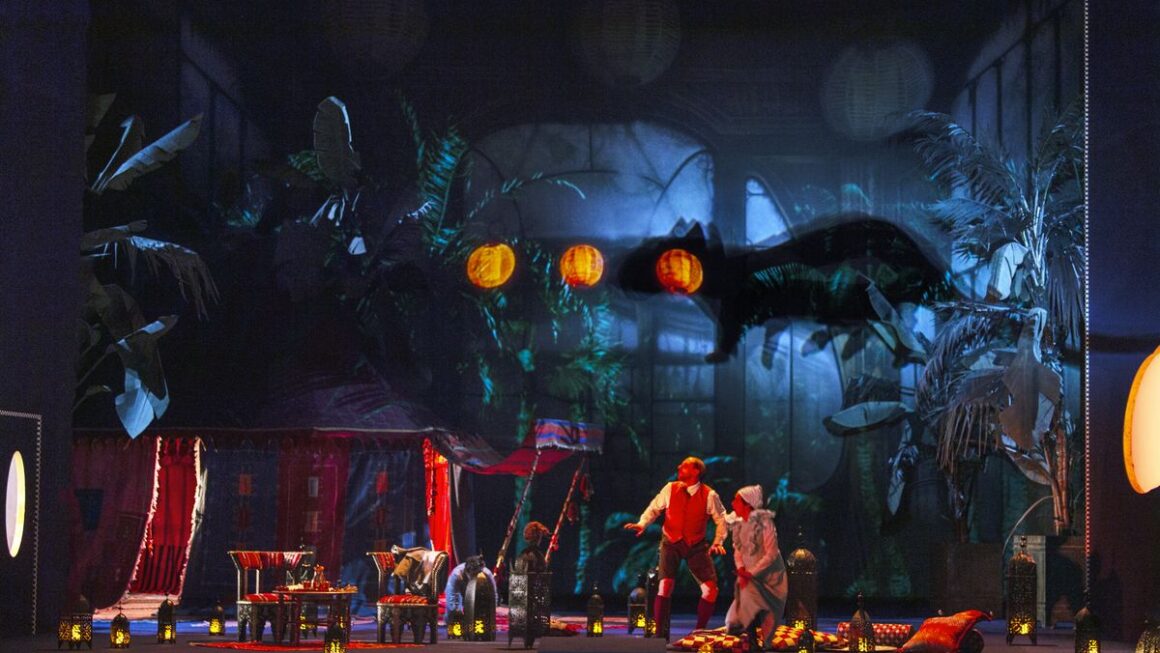
For this reason, the staging must adhere as closely as possible to the indications in the text and be tightly constructed, lest a void open between what is heard and what is seen. André Heller’s production (revived by Katharina Lang) at the Staatsoper Berlin meets these demands: every setting described in the libretto is clearly recognisable, characters are well delineated – at times verging on caricature, like Roman Trekel’s high‑strung Faninal, offset by Julia Kleiter’s exquisitely restrained presence. Instead of recreating the Theresianische Epoche, the action is transposed to Secession‑era Vienna, with all its Jugendstil and belle‑époque refinement (floral motifs in the Marschallin’s room, oriental screens, a touch of Maghrebi influence). The aim is unmistakable: to infuse the work with fin‑de‑siècle nostalgia (elevated by the period’s elegant decadence, so fitting for the story) and to evoke the exoticism that so captivated German‑speaking cultures in the early twentieth century, itself rooted in the aristocratic taste inherited from the seventeenth century.
At the season’s final performance at the Staatsoper Berlin, the role of the comedy’s fulcrum fell to Peter Rose. From his first entrance, the British bass inhabited one of his signature parts. His broad, earthy timbre retains its power, if with less suppleness than before. He adopts a near‑buffo approach to the role, relishing its parodic edge; his spoken lines are crystal‑clear, prosody impeccably judged throughout. The comedy remains light‑footed rather than heavy‑handed, and the charm is urbane rather than rustic.
Julia Kleiter unfurled her warm, ample tone while maintaining the long legato lines demanded of the finest soprano role Strauss ever wrote. Her Marschallin is finely nuanced, moving between tenderness, melancholy and authority with the assurance taught by long experience in Mozart. Now taking on the role more regularly, she offers an interpretation that feels both timely and welcome in her career, without implying any artistic decline. The time for the great dramatic parts has come. Eschewing all excess, she established herself before the audience as the prima donna her Marschallin so clearly heralds.
With elegant virility and youthful colouring that lend full credibility to the noble adolescent, Patricia Nolz combines fervour in passionate outbursts with a notably steady middle register. Her stamina is as vigorous as it is impressive, and she never neglects rhythmic precision. As Mariandel, she leans into caricature, even allowing a slightly strident top, eliciting frequent, genuine laughter.
Far from being merely light, Nikola Hillebrand doesn’t so much portray Sophie as embody her. Nobility and freshness throughout inevitably invite comparison with the poised, infinitely delicate, unmistakably distinguished presence of Lisa Della Casa. Ideal intonation, translucent line, gestures executed with unforced grace, and naturally expressive high notes: this is as flawless as it is promising. Have we not, in the past, seen model Sophies become legendary Marschallins?
The agile, incisive articulation of Karl‑Michael Ebner (in a performance more restrained than some, but just as sparkling), paired with the dark timbre and stage appeal of Christa Mayer, produced an excellent Valzacchi/Annina duo. Andrés Moreno García contributed a bright‑toned, virtuoso pastiche as the Sänger.
German to the fingertips (which is not always an advantage in this repertory), Christian Thielemann succeeds effortlessly in preserving clarity without heaviness, despite Strauss’s voluptuous orchestral writing. True to the principle that “more is less”, he achieves a careful balance with a Staatskapelle Berlin ideally suited to the work, combining sensuality, transparency and light, dancing buoyancy, without relinquishing the necessary irony. Yes, the orchestral amplitude is there, but it breathes; it never overwhelms the singers, the stage or the audience (even in Ochs’s boisterous scenes), nor does it compromise the finesse of the elegiac passages.
In the end, this Rosenkavalier revealed a rare harmony of insight and style, where a finely judged staging, distinguished singing, and Thielemann’s lucid orchestral sweep allowed Strauss’s blend of humour, nostalgia and tenderness to emerge with effortless grace.
******************************
DER ROSENKAVALIER (op. 59)
Comedy for Music in three Acts by Hugo von Hofmannsthal · Music by Richard Strauss
World première: 26 January 1911 (Königliches Opernhaus Dresden)
Berlin première: 14 November 1991 (Königliche Hofoper Unter den Linden)
Première of this production: 9 February 2020 (Staatsoper Unter den Linden)
Musical Director | Christian Thielemann · Director | André Heller · Revival director, assistant director | Katharina Lang · Set Design | Xenia Hausner · Costumes | Arthur Arbesser · Light | Olaf Freese · Video | Günter Jäckle and Philip Hillers · Chorus Master | Gerhard Polifka
Feldmarschallin Fürstin Werdenberg | Julia Kleiter · Baron Ochs auf Lerchenau | Peter Rose · Octavian, genannt Quinquin, ein junger Herr aus grossem Haus | Patricia Nolz · Herr von Faninal, ein reicher Neugeadelter | Roman Trekel · Sophie, seine Tochter | Nikola Hillebrand · Jungfer Marianne Leitmetzerin, die Duenna | Daniela Köhler · Valzacchi, ein Intrigant | Karl-Michael Ebner · Annina, seine Begleiterin | Christa Mayer · Ein Polizeikommissar | Friedrich Hamel · Haushofmeister bei der Marschallin | Florian Hoffmann · Haushofmeister bei Faninal | Stephan Rügamer · Ein Notar | Jaka Mihelač · Ein Wirt | Stephan Rügamer · Ein Sänger | Andrés Moreno García · Eine Modistin | Sonja Herranen · Staatsopernchor · Kinderchor der Staatsoper · Staatskapelle Berlin · Credit for the cover photo: ©Ruth Walz
(For further informations) Link to the Staatsoper Berlin: Der Rosenkavalier