TRISTAN UND ISOLDE | Gran Teatre del Liceu
A glittering evening, as beguiling as it was enchanting. The première of a superb production in which the avowed minimalism, guided by a stagecraft as incisive as it was assured, only heightened the impact of such vocal and orchestral splendour.
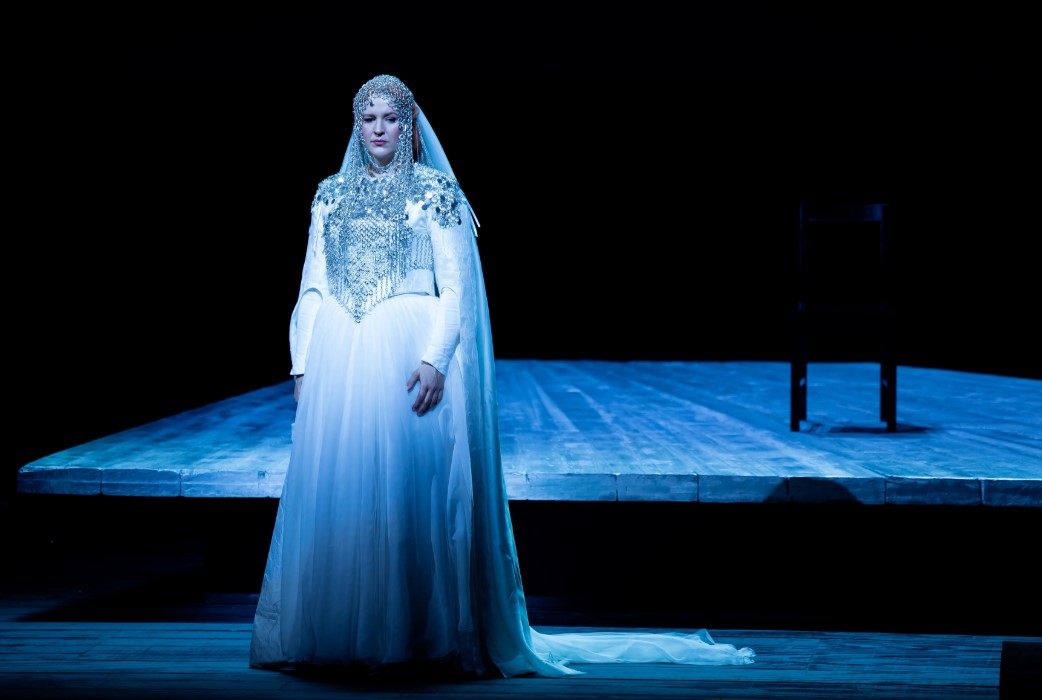
A matter for women? Indeed, in many respects. In taking charge of the staging, Bárbara Lluch displayed the acuity to evoke realities that are perfectly conceivable (though almost never acknowledged) in a world where love may secure one’s survival as readily as it may hasten one’s demise. Hence the (mercifully understated) scene of Brangäne’s assault by the sailors in Act I; Isolde’s vindictive fury driving her to threaten Kurwenal with a knife; the summoning of Isolde’s parents around the table as the curtain rises – one figure in particular, the mother, source of both the love and death potions; and the tender exchanges between the title roles in a second act of ethereal beauty, set beneath a canopy of stars… The audience’s awkward, faintly prudish reaction to all this was, to say the least, disproportionate. Introducing such a resolutely modern perspective, while adhering to the principle that less can indeed be more and preserving the essential markers of character and circumstance, reveals just how fully Bárbara Lluch has made the work her own, all the while maintaining the necessary distance to shape this production into her production.
Susanna Mälkki breathes, with sumptuous delicacy, the impulses that allow the excellent Orquestra Simfònica del Gran Teatre del Liceu to unfurl orchestral waves of elusive beauty and power rendered with striking elegance. Analytical in her reading, certainly, yet only to the degree required to shape the musical landscapes upon which the voices may then rise, offering the audience an experience that borders on the physical, as music and song carry them away. One senses her meticulous care in drawing from pit and stage alike the precise note, intention, and expressive inflection demanded by the score and by the dramatic vision she seeks to reveal. To this end, she permits herself to handle the musical material with impeccable discernment: stretching and quickening tempos, breaking apart and layering textures, weaving and distancing instrumental strata… all delivered with a disarming simplicity. Beneath such finesse, beneath such apparent ease of approach, the conductor’s benevolent authority is unmistakable, and only a temperament combining flawless command with generosity could allow such assurance in steering this vast lyrical vessel safely to its destination.
In her long‑awaited role debut, Lise Davidson embodies an Isolde of such breadth of nuance and colour that she surpasses both expectation and convention. That she should accomplish feats worthy of the greatest Wagnerians was never in doubt; that she should pour forth an arsenal of lyricism and poetry, infusing each word with a fragrance that renders it at once timely and indispensable, reveals not only that her prodigious talent stands at the very summit of its powers, but also that a painstaking, long‑matured labour of refinement – of seeking accuracy, adjusting intention, calibrating inspiration – has preceded this performance. Any comparison with those who came before her would be, at the very least, inappropriate: this is a creation of exceptional musical quality, of unprecedented sophistication in articulation and prosody, a level of excellence seldom attained, born no doubt of a wide palette of influences, yet one that forbids us from setting her against any other interpreter. Vocal performance and theatrical embodiment were here perfectly allied, spanning the vengeful princess and the young woman undone by love: an incandescent love, like her Liebestod.
For an exceptional Isolde, one must expect an equally superlative Brangäne. Ekaterina Gubanova knows the role to her very fingertips; her interpretation dispenses with commentary and theatrical artifice alike, allowing the character to live exactly as she must. Simplicity and effectiveness are united from her first entrance to her final utterance. A consummate artist, she can adjust her vocal intentions to any scenic framework without losing the clarity of her portrayal (wherever she stands, it is Brangäne whom one sees and hears), nor any measure of interpretative authority. To ensure the coherence of the drama and the force of its narrative impact, only a Brangäne capable of bracing herself against Isolde’s formidable tempest will suffice. Through her immense talent and her almost inalienable intimacy with both work and role, she not only fulfils this demand but, at moments, surpasses it.
A formidable task fell to Clay Hilley, entrusted with embodying the Tristan of this production. His robust vocal resources possess a disconcerting natural ease, the instrument showing scarcely a trace of fatigue even by the close of the punishing third act, which he delivers without the slightest restraint. He throws himself into the role with utter abandon, allowing no hesitation, so assured is he of what must be done – and of his ability to do it well – astonishing by the sheer force and fervour he unleashes. A Heldentenor in the most unequivocal sense, he treats those soaring high notes as his playground, triumphs over the orchestra, and in so doing secures both the audience’s admiration and its wholehearted allegiance, even if the timbre shows the faintest signs of thinning in the softer passages. No matter: he presses on, commits himself, hurls himself forward – and dazzles us.
The remaining roles were delivered with as much commitment as artistry. With the stature and bearing befitting a dignified Kurwenal, Tomasz Konieczny unfurled his handsome, bronzed, enveloping voice in his role debut as Tristan’s loyal companion. The instrument may now be a touch less pliant than in earlier years – several Wotans have left their mark – but the accuracy of tone and the wholehearted embodiment of the character more than compensate for the challenges encountered on stage. Brindley Sherratt’s sonorous depth, in a moving portrayal of King Mark, offered a moment of stillness in the second act, where the nostalgia of a ruler overtaken by events was conveyed with great nobility. And all the aversion that Melot is capable of provoking was rendered with flair by tenor Roger Padullés.
Centred on a long‑awaited role debut, the Liceu has succeeded in presenting a fully fledged spectacle, honouring a work which – performed here, and under such conditions – once again, and surely not for the last time, attains the stature of a historic moment.
********************
TRISTAN UND ISOLDE
Musical drama in three acts
Libretto by Richard Wagner based on Tristan (ca. 1210) by Gottfried von Straßburg
World première: 10 June 1865 at the Königliches Hoftheater und Nationaltheater (Munich)
Conductor | Susanna Mälkki · Choir director | Pablo Assante · Stage direction | Bárbara Lluch · Dramaturgy | Yvonne Gebauer · Costumes | Clara Peluffo · Set designer and lighting design | Urs Schönebaum
Tristan | Clay Hilley · Isolde | Lise Davidsen · Brangäne | Ekaterina Gubanova · Kurwenal | Tomasz Konieczny · König Marke | Brindley Sherratt · Melot | Roger Padullés · Ein Steuermann | Milan Perišic · Ein junger Seemann | Albert Casals · Orquestra Simfònica del Gran Teatre del Liceu · Cor del Gran Teatre del Liceu
(For further informations) Link to the Gran Teatre del Liceu website: Tristan und Isolde
About the Author