VIOLANTA | Deutsche Oper Berlin
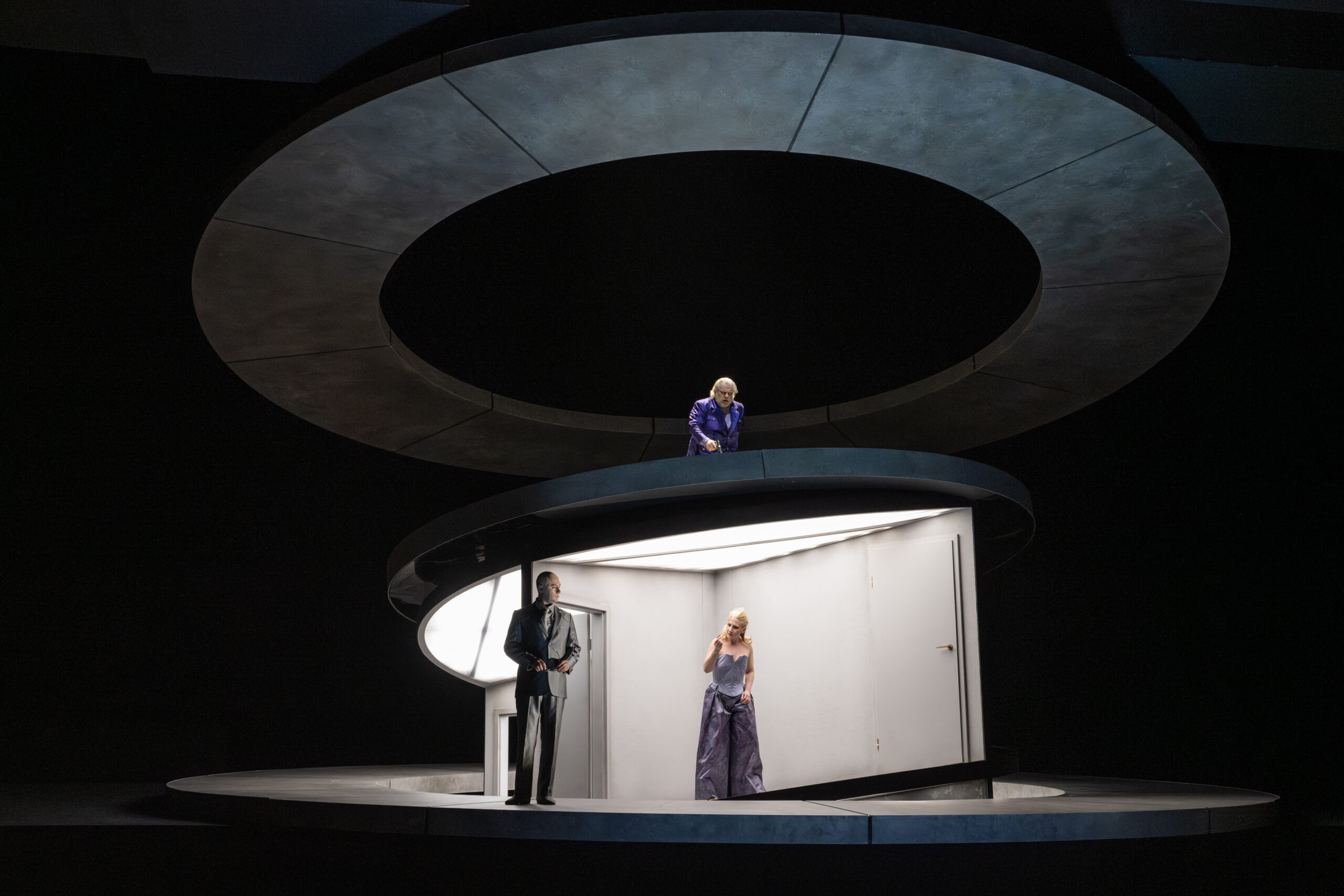
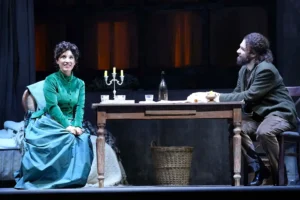
Ort: Deutsches Oper, Berlin. Titel: Violanta. Musik: Erich Wolfgang Korngold. Libretto: Hans Mueller-Einigen. Musikal. Leitung: Sir Donald Runnicles. Insz.: David Hermann. Buehne: Jo Schramm. Kostueme: Sybille Wallum. Premiere: 25.01.26 Darst.: Ólafur Sigurdarson (Simone Trovai), Laura Wilde (Violanta), Mihails Culpajevs (Alfonso). Copyright: Marcus Lieberenz/bildbuehne.de (Veroeffentlichung nur gegen Honorar und Belegexemplar!)
The work is as rare as it is concise (barely eighty minutes) yet sufficiently incandescent to leave upon its listeners an imprint commensurate with the ardour of its passions and the opulence of its orchestration. Erich Wolfgang Korngold’s second opera, composed in the wake of Der Ring des Polykrates, Violanta astonishes both in subject – vengeance transfigured into suicidal love – and in its unfolding, suffused with such harmonic sensuality from a composer of… eighteen. To fashion a score of such stratified richness (where psychological depth and an almost preternatural capacity for emotional restitution coexist) would in itself be remarkable; that it should emanate from so youthful a hand justifies the epithet so often attached to Korngold at the time: prodigy. The influence of Richard Strauss and Franz Schreker remains palpable; yet, as aptly observed in the booklet accompanying the recording conducted by Marek Janowski (CBS Records, with Eva Marton in the title role, Siegfried Jerusalem as Alfonso and Walter Berry as Simone Trovai), the final result exceeds the sum of its components: vocal brilliance, a keen instinct for melodrama, orchestral mastery: qualities as striking as they are unmistakable.
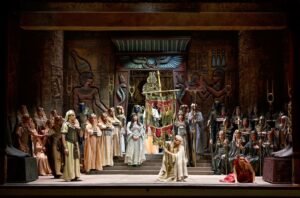
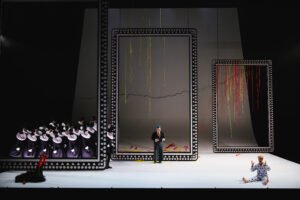
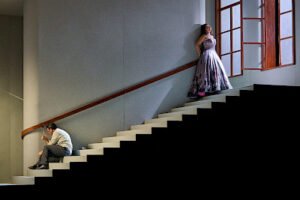
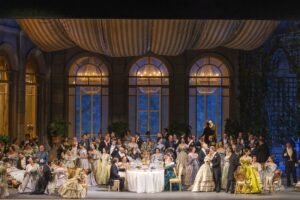
David Hermann situates the drama somewhere in space – where precisely, one would be hard pressed to say. The action initially unfolds upon a tilted disc whose shifting central surface gradually reveals, as the narrative progresses, the successive psychological chambers of Violanta’s inner world. Not incidentally, it allows for a literal rendering of the libretto’s indication that Simone waits above the level where Violanta and Alfonso conduct their protracted exchange, culminating in martyrdom by suicide. It is Alfonso who guides Violanta through these hitherto inviolate “rooms”, succeeding one another in the motion of an infinite screw, recalling, inevitably, Judit’s descent in Bluebeard’s Castle by Béla Bartók. The faintly Freudian inflection, contemporary with the opera’s genesis, is self-evident and entirely apposite. Visually, the effect is ravishing. One may quibble at the costumes or scenic décor; yet the conceptual ingenuity of the director’s vision commands admiration. It ensures a narrative dynamism more compelling for its symbolic interplay: the disillusioned women undone by Alfonso’s seductions (among them Nerina, Violanta’s sister), and the heroine’s own buried longings, for integrity, for inviolate purity.
For Laura Wilde’s Violanta appears less preoccupied with preserving her chastity than with safeguarding the primal integrity of her intention. A flicker of egoism glints within her portrayal. At least such is the impression left by her evolution: from a woman steeped in grief and bitterness to one mesmerised by Alfonso’s song (Mihails Culpajevs). The impulse feels elemental, deeply rooted in her psyche, impelling an ultimate act more suicidal than amorous. Vocally, the American soprano commits herself fearlessly, seeking to trace the myriad tonal shadings suggested by this descent into darkness; the result is a performance of genuine interest, even if the tensile writing occasionally presses her resources to their limits. Culpajevs’ Alfonso is sheer bravura, cleaving through the harmonic torrents from the pit – at times at the expense of lyric suavity. Charm is his weapon; yet the purpose it serves is domination. Such an approach accords with the production’s reading of the character, darker and more glacial than the libretto might initially imply, intent upon enchantment; indeed, possession.
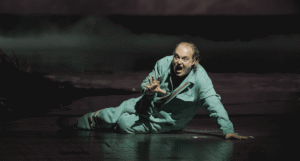
Ólafur Sigurdarson demonstrates unflagging stamina as Simone Trovai, his burnished timbre carrying effortlessly, finely attuned to the surging emotions that ultimately betray the character’s status as spectator within a reality he had presumed his own. Perhaps the evening’s most finely poised assumption, alongside that of Stephanie Wake-Edwards as Barbara, a mezzo for whom ambiguity and androgyny seem instinctive terrain: lucid serenity, disciplined ardour, and the discernment to apprehend that Violanta’s tragedy will be consummated in shadow. The luminous voice of Kangyoon Shine Lee fits Giovanni Bracca like a glove, matched by the mercurial agility of Hye-Young Moon as Bice, with Lilit Davtyan assuming the stage action. One regret only: that the Chor der Deutschen Oper Berlin remains unseen, confined to the wings. Even unheard in full view, the choral sound radiates power and precision from behind the curtain.
The intrepid, at times unleashed, direction of Donald Runnicles prefigures a constant borne out throughout the evening: one believes one has grasped the intention, deciphered the feeling: only to discover, moments later, that one has strayed. It is within these intimate oscillations, where certainties dissolve and bitter self-recognition dawns, that such musical vigour, such incisive reading, finds its true fulfilment, offering the listener an unsparing portrait of the characters’ condition.
******************************
VIOLANTA
Oper in einem Akt
Nach einem Libretto von Hans Müller-Einigen
Uraufführung am 28. März 1916 am Hoftheater München
Conductor | Sir Donald Runnicles · Director | David Hermann · Stage design and video | Jo Schramm · Costume design | Sybille Wallum · Light design | Ulrich Niepel · Dramaturgy | Jörg Königsdorf · Chorus master | Jeremy Bines
Simone Trovai | Ólafur Sigurdarson · Violanta | Laura Wilde · Alfonso | Mihails Culpajevs · Giovanni Bracca | Kangyoon Shine Lee · Bice | Lilit Davtyan (playing) and Hye-Young Moon (singing) · Barbara | Stephanie Wake-Edwards · Matteo | Andrei Danilov · First maid | Maria Vasilevskaya · Second maid | Lucy Baker · First soldier | Michael Dimovski · Second soldier |
Paul Minhyung Roh · Lute | Pedro Alcàcer · Chor der Deutschen Oper Berlin · Orchester der Deutschen Oper Berlin · Opernballett der Deutschen Oper Berlin · Credit coverture photo: ©Marcus Lieberenz
(For further informations) Link to the Deutsche Oper Berlin website: Violanta
About the Author