FAUST | Opéra de Tours

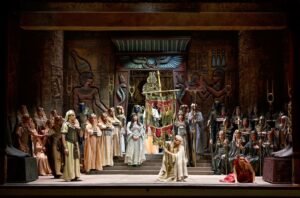
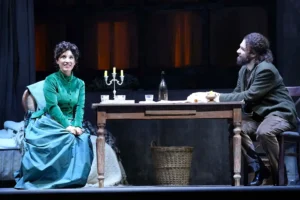
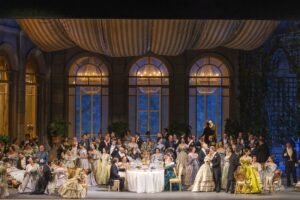
Co-produced with the Opéra Royal de Versailles, this new production of Faust by Charles Gounod, staged by Jean‑Claude Berutti, offers a largely traditional transposition. Painted sets and medieval style costumes coexist with stagehands who execute scene changes in full view of the audience. Yet the production never slips into kitsch, the formula works, thanks in particular to a straightforward but effective approach to stage direction. The Baroque Dance Academy of the Opéra Royal de Versailles shines in the ballet sequences, which are beautifully choreographed.
At the podium of the Orchestre Symphonique Région Centre‑Val de Loire/Tours, Laurent Campellone proves thoroughly inspired this evening. His conducting brings a fiery momentum throughout the work and ensures cohesion among all the forces involved in this dense score.
Dense above all in its choral writing, the choruses of the Opéra de Tours, reinforced by those of Versailles, deliver several robust and impressive passages, though a few moments of slight misalignment can be heard.
The entire cast distinguishes itself with impeccable French diction, making surtitles almost unnecessary.
Jean‑Gabriel Saint‑Martin is an excellent Wagner, whose performance only makes one regret how brief the role is.
The Marthe of Julie Pasturaud brings welcome a to the evening through her duets with Méphisto.
Eléonore Pancrazi offers a spirited and impassioned Siébel. Her finely controlled “Faites-lui mes aveux” rightly earns warm applause from the audience.
One of the evening’s greatest satisfactions is the Valentin of Anas Séguin. Recently heard as Wagner at the Opéra Comique, the baritone makes a striking impression from his very first aria, “Ô sainte médaille.” The timbre is handsome, the lower register resounds splendidly, and his ease in the upper range is equally evident. He is a singer one hopes to see very soon in major roles on our stages.
Casting a bass such as Luigi De Donato as Méphisto might at first seem surprising, given how closely we associate him with Baroque repertoire or Rossinian comic roles. Yet it soon becomes clear that the gamble pays off handsomely. Here, Méphisto’s manipulative and sly side emerges more than his terrifying aspect. His “Ronde du veau d’or” sweeps the chorus into a scene reminiscent of the dancing plague of Strasbourg. His “Vous qui faites l’endormie” is subtle and mischievous. A genuine success.
There is little need to introduce once again the Marguerite of Vannina Santoni, who had already won us over at the Opéra Comique. This evening the pleasure is renewed, her vocal and interpretative qualities remain intact, perhaps even more striking, particularly in her heart rending “Il ne revient pas.” “Il était un roi de Thulé” stands as one of the most beautiful moments of the night. Santoni confirms her status as one of today’s finest interpreters of Marguerite.
Finally, in the title role, Thomas Bettinger emerges with full honours. His Faust is full of panache, and the tenor’s voice noticeably richer in recent years, suits the role perfectly. With superb diction, he meets the part’s challenges with intelligence and control. A very fine interpretation.
The audience, spanning all generations, responds with fervent applause to this handsome production, a reminder that classicism need not mean dullness, especially when the cast proves so consistently accomplished.
Opéra en 5 actes – Livret de Jules Barbier et Michel Carré -Créé au Théâtre Lyrique le 19 mars 1859
Faust | Thomas Bettinger
Marguerite | Vannina Santoni
Siébel | Éléonore PancraziMarthe | Julie Pasturaud
Méphisto | Luigi De Donato
Valentin | Anas Seguin
Wagner| Jean-Gabriel Saint-Martin
Chœur de l’Opéra de Tours
Chœur de l’Opéra Royal de Versailles
Orchestre Symphonique Région Centre-Val de Loire/Tours
Académie de danse baroque de l’Opéra Royal
Direction musicale | Laurent Campellone
Mise en scène | Jean-Claude Berutti
Chorégraphie et assistant mise en scène | Reveriano Camil
Création costumes | Françoise Raybaud
Création décors | Rudy Sabounghi
Création lumières | Christophe Forey
Chef de Chant | Martin Surot
Chef de Chœur | David Jackson
About the Author