BILLY BUDD | Opéra National de Lyon
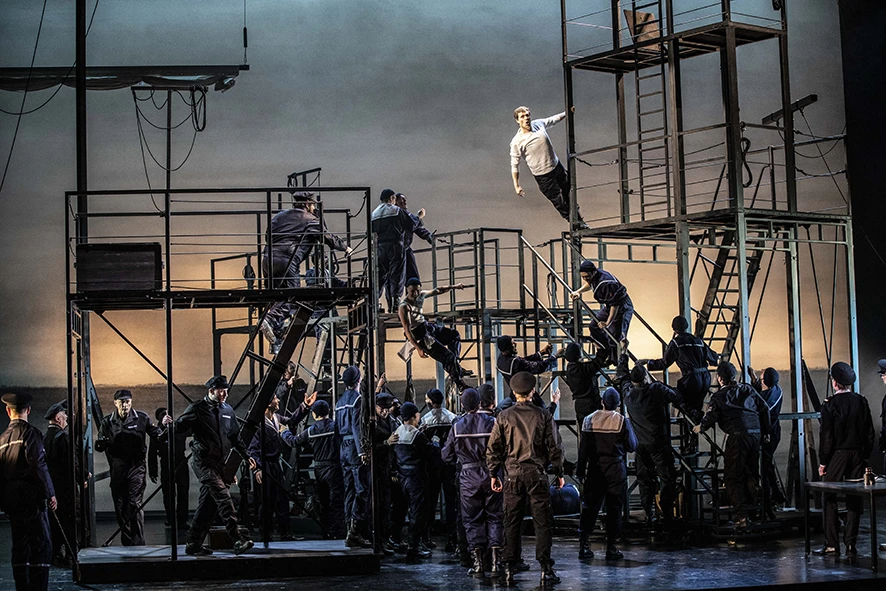
Presented for the first time in its history at the Opéra de Lyon, Billy Budd by Benjamin Britten is staged by the company’s director, Richard Brunel.
It is no small undertaking. Britten’s music is not always the most immediately accessible, and the opera itself grapples with a range of complex themes that are challenging to bring to the stage, particularly for a house like Lyon, which takes pride in attracting new audiences and younger spectators.
Yet the gamble has clearly paid off.
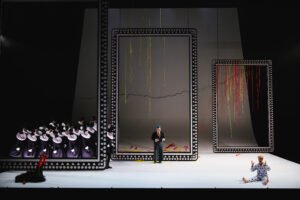
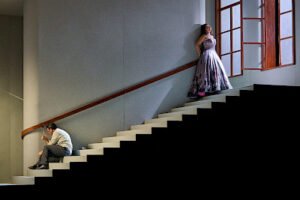
Following last season’s acclaimed Peter Grimes, Brunel delivers here a genuine lesson in theatre. Stephan Zimmerli’s set is built primarily from staircases and movable scaffolding structures that slide, combine, and separate in a fluid choreography executed by both chorus and stage crew. These constructions evoke not only the physical ship but also the mental prisons in which the characters are confined.
Equally remarkable is the lighting design by Laurent Castaingt, which creates a rich palette of atmospheres and emotional states, constantly reshaping the audience’s perception of the drama.
Brunel’s interpretation is deeply compelling. As in Peter Grimes, he explores the cruelty of society toward the individual, as well as themes of oppression, authority, and injustice. In this exclusively male opera, homosexuality is addressed with notable subtlety, never forced or overstated, yet clearly present.
This restraint serves to heighten the central contrast of the work: the almost virginal beauty of Billy Budd set against the moral ugliness of the world around him.
In sum, this is a major theatrical success, confirming Richard Brunel as one of the most exciting stage directors working today.
Musically, the Orchestre de l’Opéra de Lyon seems to relish exploring a repertoire beyond the standard canon. Under the baton of Finnegan Downie Dear, the performance is highly expressive, adding a further layer of drama to Britten’s already powerful score.
The vocal cast is of outstanding quality and impressively well-balanced. The central trio : Paul Appleby as Captain Vere, Sean Michael Plumb in the title role, and Derek Welton as John Claggart, sustain dramatic tension throughout the evening.
Appleby’s Vere is nuanced and ambiguous, far from a one-dimensional figure, and fully convincing as a commanding officer torn by moral conflict.
Plumb offers an innocent and pure Billy Budd, as radiant outwardly as he is inwardly.
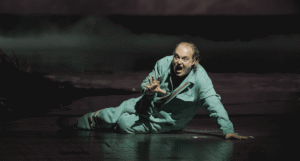
Welton’s Claggart is dark and menacing, yet also reveals an inner torment that prevents the character from becoming a simplistic villain.
This exceptional trio is supported by an equally strong ensemble of secondary roles, all performed with precision and commitment. Particularly noteworthy are Alexander de Jong as Redburn and Scott Wilde as the Dansker.
Ultimately, this Lyon production is a resounding success on every level, further confirming the Opéra de Lyon as one of the most compelling and innovative opera houses in Europe today.
————————————————————————-
- Un opéra de
- Benjamin Britten
- Direction musicale
- Direction musicale (le 4 avril)
- Mise en scène
- Scénographie
- Costumes
- Lumières
- Dramaturgie
- Chef des chœurs
- Capitaine Vere
- Billy Budd
- John Claggart
- Redburn
- Flint
- Ratcliffe
- Red Whiskers
- Donald
- Dansker
- Le Novice
- L’Ami du novice
- Squeak
- Le Maître d’équipage
- Le Second Maître
- Antoine Saint-Espes
- Orchestre, Chœurs et Maîtrise de l’Opéra de Lyon
About the Author