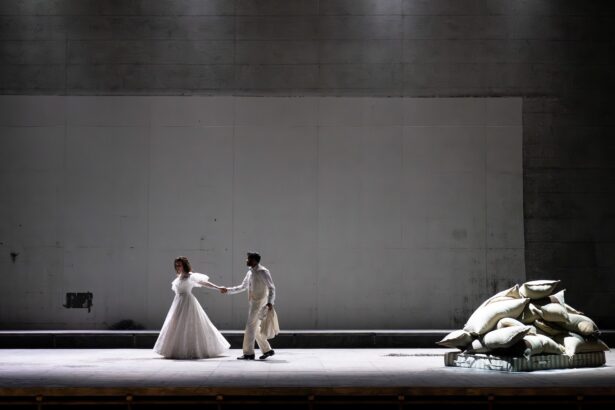
The aesthetic violence matches the musical intensity. Remembering that, for its composer, this opera was a “satirical tragedy”, where “satirical” means an indictment of the cynicism and contempt of Russia’s wealthy merchants, it is above all the satirical, laced with caustic verve, that lingers. The result is a faint dizziness as one steps out of the theatre.
Apart from the heroine’s splendid wedding dress and kokoshnik in Act III, there is no trace of visual beauty, nor even of an attempt at it. Set in a contemporary reality, the new Lady Macbeth of Mtsensk at the Komische Oper Berlin unsettles – perhaps its greatest strength, though this approach is shared by other major European productions (cf. Warlikowski’s blood soaked, even more erotic staging in Paris, April 2019). The difference here lies in the unbridled nature of Barrie Kosky’s intentions and their execution: feral brutality (Askinia’s rape on a wheelbarrow, rendered with searing shrieks and cries by Mirka Wagner; the necrophilic scene in a warehouse between the shabby Simpleton and the inert body of Zinovy Ismailov, sung with a plaintive, somewhat strident lyricism by Elmar Gilbertsson), a realism at the edge of the bearable (Boris Timofeyevich’s vomiting fits on the dining table as he dies), eruptions of eroticism (the countless explicit sexual references), as impetuous as they are destructive… Elements which, strung together, fit the production’s dramaturgical thread, yet can quickly create a sense of saturation. Kosky saves the whole by his sharply chiselled direction of actors (one of his trademarks) and by a whirlwind pacing that moves easily from one situation to the next, aided by Shostakovich’s nine tableau structure. The shock is not constant, but intermittent.
One thus seeks refuge in the voices. The impression is of a cast as solid as the score is demanding, with ample projection and stamina. First, Ambur Braid’s steel bladed Katerina: well measured lyricism, sometimes underplayed (her Act I lament conveys less existential malaise than simmering, angry boredom), yet never absent. It is in exposing the character’s wounds, through a syncopated vocal line sustained by a remarkable breath, that she ignites the art of a true dramatic soprano. Diction is not always ideal, but one forgives it easily: with so many quasi spoken passages, the challenge for a non Russian speaker to maintain clarity is obvious. More femme fatale than housewife, steering events with calculated coldness, her Katerina stands out for chesty, authoritative low notes, coloured by erotic passion and an impulsiveness far removed from the expected femme du peuple.
Sean Panikkar devours the sex driven Sergej. Heroic from start to finish, with a brutal, rhythmic vocal expression, monumental projection and unflagging endurance, shifting between light and dark as deftly as his partner, he reveals the character’s complexity. His performance is as astonishing as his previous ventures into roles of similar difficulty (notably Alexei in Prokofiev’s The Gambler in Salzburg, 2024).
Caspar Krieger delivers a performance both spectacular and shocking as the shabby Schäbige. A consummate actor with a radiant voice, effortlessly riding the orchestral waves, he embraces the staging’s uncompromising ideas (excessive lust, constant drunkenness) with disarming ease. It is great artistry to elevate a secondary character to a central narrative force.
Dmitry Ulyanov’s Boris Ismailow remains more ridiculous than morally grand or libidinously perverse. A rough edged bass, yet capable of surprising, not unpleasant lyricism, he renders the character less repellent and, like his colleagues, commands respect through sheer theatrical commitment – even in moments that threaten his vocal comfort (the vomiting scene already mentioned).
Around Dimitry Ivashchenko’s vodka clutching Pope, Marcell Bakonyi’s knitting Polizeichef, and the Komische Oper’s Chorsolisten deliberately caricaturing idle bureaucrats, the fourth tableau of Act II and the seventh of Act III offer scathing satire that Shostakovich would surely have relished.
Despite a perhaps overly muscular approach, producing an almost explosive sound for the Schillertheater’s size, James Gaffigan seizes the opportunity to forge a strong connective tissue – a blend of rage, structure and clarity – across the score’s cinematic episodes. His attention to execution, in both interludes and tableaux, earns the audience’s admiration and shows in his careful balance between orchestral volume and singers’ projection, never compromised by his vehemence. Embracing and amplifying the staging’s descent into darkness, the American conductor summons Straussian colours, warmly welcomed and deftly executed by the Orchester der Komischen Oper Berlin.
**********
LADY MACBETH OF MTSENSK
Opera in four acts (1934) by Dmitri Schostakowitsch based on a novella by Nikolai Leskov
Libretto by Alexander Preis
Musikalische Leitung | James Gaffigan · Inszenierung | Barrie Kosky · Bühnenbild | Rufus Didwiszus · Kostüme | Victoria Behr · Dramaturgie | Daniel Andrés Eberhard · Chöre | David Cavelius · Licht | Olaf Freese
Boris Timofejewitsch Ismailow | Dmitry Ulyanov · Sinowi Borissowitsch Ismailow | Elmar Gilbertsson · Katerina Lwowna Ismailowa | Ambur Braid · Sergej | Sean Panikkar · Aksinja | Mirka Wagner · Der Schäbige | Caspar Krieger · Pope | Dimitry Ivashchenko · Polizeichef | Marcell Bakonyi · Sonjetka | Susan Zarrabi · Alter Zwangsarbeiter | Stephen Bronk · Hausknecht | Junoh Lee · Zwangsarbeiterin | Elisa Maayeshi · Lehrer | Thoma Jaron-Wutz · 1.Vorarbeiter/Kutscher | Volker Herden and Yauci Yanes Ortega · 2.Vorarbeiter | Matthias Spenke and Taiki Miyashita · 3. Vorarbeiter | Philipp Schreyer and Carsten Lau · Verwalter/Wächter | Ezra Jung and Simon Wallfisch · Polizist | Philipp Schreyer and Carsten Lau · Bote | Philipp Schreyer and Simon Wallfisch · Chorsolisten der Komischen Oper Berlin · Orchester der Komischen Oper Berlin · Credit photo coverture : ©Monika Rittershaus
(For further informations) Link to the Deutsche Oper Berlin: Lady Macbeth of Mtsensk