DON CARLO | Deutsche Oper Berlin
(C)B.Aumueller/www.szenenfoto.de
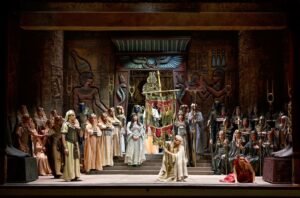
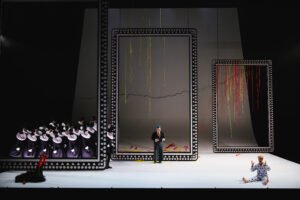
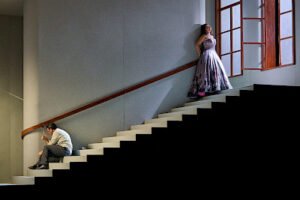
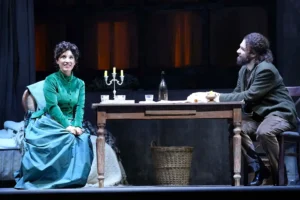
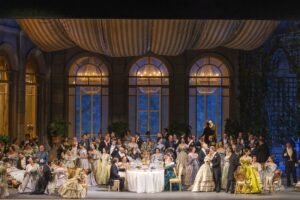
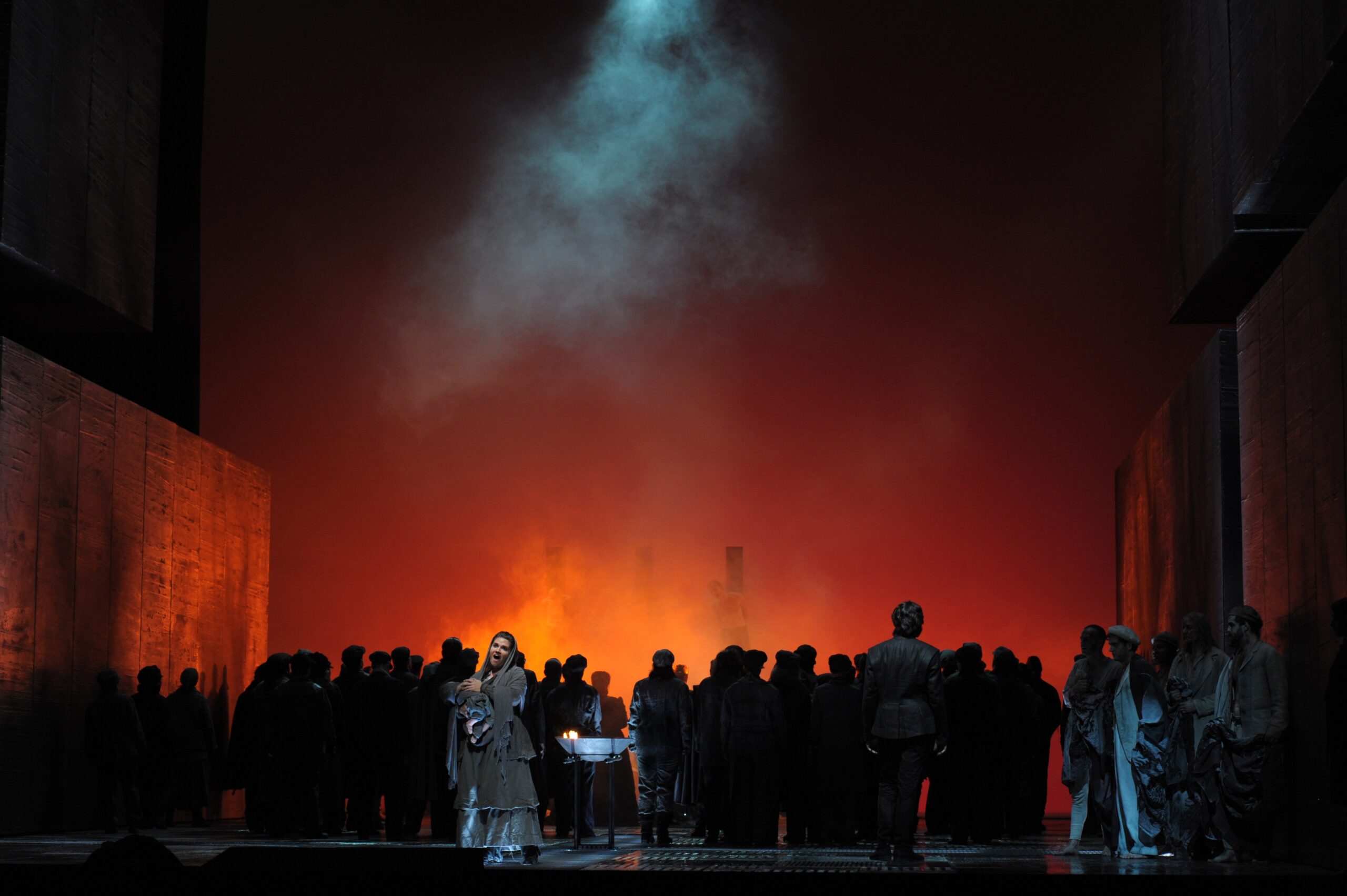
Long acclaimed for its merits, the current Don Carlo at the Deutsche Oper nonetheless proves a revelation to those approaching it anew. The eye is first caught by Marco Arturo Marelli’s exquisitely conceived staging. With remarkable fluidity, the Queen’s gardens metamorphose into the cloister of San Yuste, the Fontainebleau forest, or Philip II’s private chamber, a sophisticated rotational device continually returning the gaze to the emblematic form of the cross – an element that is certainly dispensable, given the countless references to religion, but one that serves as a reminder that the political plot is heavily influenced by the clergy’s position within the sphere of power at the time. By simply rearranging the decorative elements to recreate the various settings required by the score, the Italian director eliminates any risk of boredom.
The ear, in turn, is disarmed by the unfailing finesse Friedrich Praetorius elicits from the Orchester der Deutschen Oper Berlin. He sidesteps all brusqueness and forswears any mannered pursuit of style that might lapse into the pastiche of inherited habits. Instead, he offers a pared‑back reading of the score – one that, by its very restraint, allows the music to bloom with heightened eloquence. The wisdom of this approach, which is not entirely without risk, is particularly evident at those moments when an overly fierce attack might undermine the lyricism of the text.
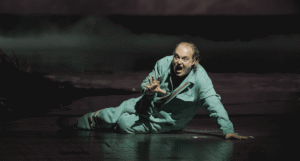
Vocally, the surprise is more discreet, though scarcely less rewarding. The cast delivers performances of striking cohesion, wholly aligned with what discerning audiences seek: Verdian singing that is both sincerely felt and impeccably realised. Monumental in presence, Roberto Tagliavini elevates Filippo II to his rightful stature: a monarch, certainly, but above all a man racked by a murderous solitude, his human frailties laid bare with painful clarity. Valentyn Dytiuk’s fresh‑toned timbre and impetuous surges of phrasing restore to his Carlo the very blend of youthful ardour and boldness that the role demands. Geon Kim astonishes with singing of striking beauty and the vocal stamina indispensable to a portrayal of the marchese di Posa that is as compelling as it is impeccably controlled. Magnanimous in bearing, rich‑hued in timbre and wonderfully supple, Maria Motolygina’s Elisabetta di Valois exudes both nobility and power (perhaps even a little too powerful, given the character’s age and the suffering she is going through?), providing a perfect counterbalance to Karis Tucker’s Eboli: charming, seductive, and possessed of a formidable vocal presence. From the depths, Huanhong Li commands attention with a Grande Inquisitore whose chess match with Filippo II proves as thrilling as it is chilling. These distinguished performances are framed by those, equally delectable, of the deputati fiamminghi embodied by Volodymyr Morozov, Benjamin Dickerson, Padraic Rowan, Paul Minhyung Roh, Byung Gil Kim and Navasard Hakobyan.
The only criticism we feel we can make here is this: why was Eboli’s Canzone del velo cut in half in Act II? One of the few moments of joyful fugue in the work certainly did not deserve to be omitted from the performance, especially with a performer whose skills were equal to the challenge.
With a vocal cast as appealing as it is exemplary, a deftly crafted staging, and a musically refined direction perfectly attuned to the work’s grandeur and gravity, the current production of Don Carlo at the Deutsche Oper Berlin offers its audience that interlacing of emotions which makes this opera one of the towering masterpieces of the repertoire.
**********
DON CARLO
Oper in vier Akten von Giuseppe Verdi
Libretto von Joseph Méry und Camille du Locle nach Friedrich Schillers Tragödie
Uraufführung der italienischen Fassung von Achille de Lauzières am 10. Januar 1884 in Mailand
Musikalische Leitung | Friedrich Praetorius · Inszenierung, Bühne, Licht | Marco Arturo Marelli · Kostüme | Dagmar Niefind · Chöre | Jeremy Bines
Philipp II | Roberto Tagliavini · Don Carlo | Valentyn Dytiuk · Rodrigo, Marquis von Posa | Geon Kim · Graf von Lerma/Herold | Michael Dimovski · Der Großinquisitor | Huanhong Li · Ein Mönch | Jared Werlein · Elisabeth von Valois | Maria Motolygina · Prinzessin Eboli | Karis Tucker · Tebaldo | Maria Vasilevskaya · Stimme von oben | Hye-Young Moon · 1. Flandrischer Deputierter | Volodymyr Morozov · 2. Flandrischer Deputierter | Benjamin Dickerson · 3. Flandrischer Deputierter | Padraic Rowan · 4. Flandrischer Deputierter | Paul Minhyung Roh · 5. Flandrischer Deputierter | Byung Gil Kim · 6. Flandrischer Deputierter | Navasard Hakobyan · Orchester der Deutschen Oper Berlin · Chor der Deutschen Oper Berlin · Credit coverture photo: ©Bettina Stöss
(For further informations) Link to the Deutsche Oper Berlin: Don Carlo
About the Author