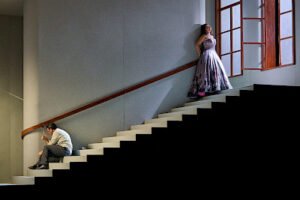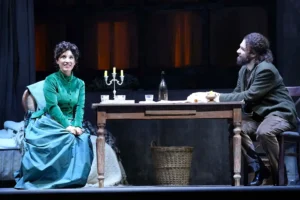
LE NOZZE DI FIGARO | Dutch National Opera
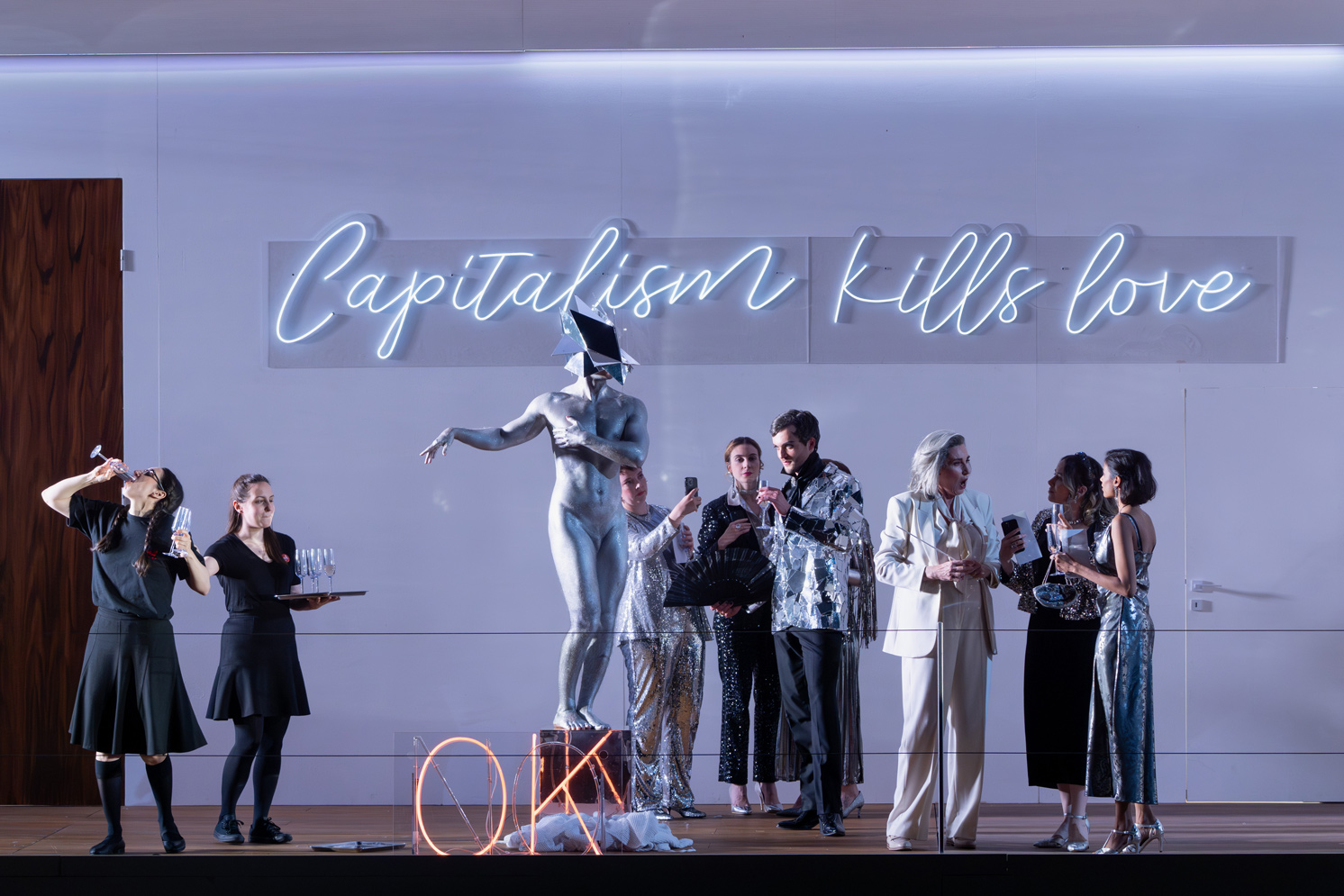
Two scars across an otherwise glowing evening. Dutch National Opera‘s new Nozze di Figaro gives us Mozart at the level the work deserves on almost every front — a Netherlands Chamber Orchestra playing with a heat, a transparency, a coloured Mozartian breath that belongs to the very top tier of pit work this season; a cast that ranges from very fine to outright revelatory; and on stage a continuous theatrical flow that, whatever one thinks of its larger choices, never tips into cacophony. And yet the two figures most responsible for shaping the whole — the man in the pit and the man behind the staging — each insist, in their own way, on getting in Mozart‘s path. Best to clear those reservations first.

Francesco Corti makes his Dutch National Opera debut at the head of the Netherlands Chamber Orchestra, and there is much to admire in his colour: woodwinds singing, basses articulate, the period sensibility worn lightly. But the tempi are hazardous in a way that is, finally, anti-Mozartian. Rubato is borrowed everywhere — within phrases, across cadences, even in passages whose entire comic mechanism depends on rhythmic implacability. There is a hard truth about Mozart that some conductors still resist: with this composer, the full charge of tension, the full ferment of invention, only releases itself inside a strict rhythmic frame. You cannot stretch the bar lines and expect the genius to remain intact. Worse, every elastic ritenuto in the pit pulls the rug from under the singers, who lose the seat from which they fence and flirt. The cast survives it; one wishes they had not had to.
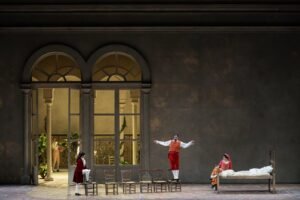
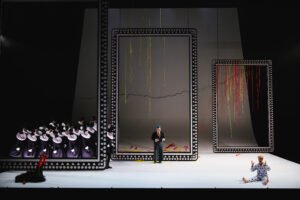
The case of Kirill Serebrennikov is harder, because credit is owed and should be paid in full. The actors trained through his Moscow academy — silently present in this Cherubino, in the Count’s henchmen, in the household’s spectral young man and old woman — are exceptional, and they push the theatrical voltage of the evening to a level no conventional opera-house Regie ever reaches. Credit, too, for a mise-en-scène that, even when it sacrifices a great deal of the work’s philosophical dimension (and it does — the social-criticism gloss is too easy a substitute for what Da Ponte and Mozart actually negotiate), keeps the stage in continuous, legible motion without ever collapsing into noise. One smiles at the small mischief — Bartolo’s vengeance aria displaced from Act I to between the Count’s Act III aria and the sextet (pointless, gratuitous, but harmless); the Countess and Barbarina merged into a single character, especially diverting when Olga Kulchynska is the one singing both; the harpsichord continuo ringing every so often like a mobile phone. Soave sia il vento dropped into the opening of Act III to underscore the Count–Countess–Susanna triangle is unnecessary — Mozart was not asking for help — but tolerable.

What is not tolerable is the cut at the end. Between the great fourth-act tumult — that vertiginous swarm of voices and intrigue — and the Contessa perdono, the moment for which the entire opera has been preparing itself since the first bars of the overture, Serebrennikov inserts a Mozart string quartet, scored across the full orchestra, while the Count wanders the stage. The point, evidently, is to prolong the moment. The effect is the opposite. That second of silence between the sextet’s last beat and the Countess’s pardon is itself the dramaturgy. It is in that silence that everything Mozart has built — the social comedy, the erotic feinting, the constant near-cruelty — is gathered up and offered for absolution (one could write pages, fascinating pages, on the strange double nature of that absolution: a pardon entirely sincere that also rings false, because life will resume its old course the next morning, and that very ambiguity is what makes the piece a masterpiece — complex, fine, subtle. But that is not the point here). Filling the silence empties it. And to come back into Contessa perdono after that long quartet interpolation only exposes how impossibly simple and exposed the music is, how much it depends on its preparation to land at all. Played in its proper place, the phrase is a miracle of harmonic plainness encoding the entire emotional weight of the evening — what Salieri in Forman‘s Amadeus (a film, incidentally, that Dutch National Opera is programming alongside this run at LAB111) is made to describe with such accuracy: the absurd economy by which Mozart turns the plainest material into something no one else can write.
That is the deeper Mozart truth this edit violates. More than with any other composer, the slightest comma in his line is unmovable — not because the harmonies are fragile (they are robust) but because the spacing, the breath, the silence is structural. To displace any of it is to break something. To displace this particular second — arguably top-three in all of Mozart, top-ten in the entire operatic repertoire — is at once inexact, ungenerous to the score, and disrespectful to the audience. Not in the abstract way one might invoke in defending a masterwork on principle (a posture I would rather avoid), but in a far more concrete sense: it is the audience that loses here, above all the part of the audience that does not yet know Nozze inside out and is served a diminished version without being told. Mozart has already done the impossible part — left this absolute masterpiece in our keeping; what was required of the production was, with the right humility, simply to play it. One knows what “simply” is doing in that sentence, but the point holds. The gesture reads, finally, as transgression for transgression’s sake, which is the least artistic of all directorial impulses, and it is all the more depressing coming from a director who elsewhere proves his real intelligence. Sad, frankly.

That said — and this is what makes the evening, finally, more than the sum of its quarrels — the singing and the acting carry the night.
Björn Bürger‘s Count is a model of what the role can be when a baritone trusts his middle: round, warm, magnificently extended through his aria, with the noble irritation of a man who can no longer impose himself on his own house and is beginning to suspect why. Michael Nagl, in his house debut, establishes himself as the young Mozart bass-baritone of reference — as powerful as he is easy, as warm as he is articulate, with the kind of comic timing that never has to ask for the laugh. Across from him, Emily Pogorelc‘s Susanna is his exact female counterpart, and another major arrival: so young, so musically complete, so artistically integral that one wants to track this evolution as closely as one anticipates it. Olga Kulchynska, taking her first Countess, is sublime — and what an actress, the dignified ache of Dove sono lifting itself out of a stage situation she has been asked to share with more roles than she should. Cecilia Molinari‘s Cherubina is exactly right for the bifurcated concept, all longing taken at a tempo entirely her own. Véronique Gens is a luxury Marcellina, and one is grateful to get her rare Act III aria, which suits her line and her stagecraft to perfection. The Bartolo of Anthony Robin Schneider, the Basilio of Steven van der Linden, the Antonio of Frederik Bergman, and the silent Cherubino of Georgy Kudrenko all hold the household’s seams together with character and precision.
A very fine evening, on balance — undermined at two specific seams. One can only hope that Corti comes to find the discipline this score requires, and that Serebrennikov — capable, when he wants to be, of genuine theatrical genius — comes to understand that the bravest gesture available to a director of Mozart, at certain rare moments, is to do nothing at all.

***
CAST
- Il Conte Almaviva — Björn Bürger
- La Contessa Almaviva — Olga Kulchynska
- Susanna — Emily Pogorelc
- Figaro — Michael Nagl
- Cherubina — Cecilia Molinari
- Marcellina — Véronique Gens
- Bartolo — Anthony Robin Schneider
- Basilio — Steven van der Linden
- Antonio — Frederik Bergman
- Cherubino — Georgy Kudrenko
- The Count’s Henchman — Nikita Kukushkin / Nikita Elenev
- The Young Man — Nikita Elenev / Rowan Kievits
- The Old Woman — Marieke Reuten
PRODUCTION
- Musical direction — Francesco Corti
- Stage direction, set & costume design — Kirill Serebrennikov
- Revival director, choreography — Evgeny Kulagin
- Associate set design — Olga Pavlyuk
- Associate costume design — Tatiana Dolmatovskaya
- Lighting design — Sergey Kucher
- Video design — Ilya Shagalov
- Dramaturgy — Daniil Orlov
- Cembalo continuo — Pedro Beriso
- Orchestra — Netherlands Chamber Orchestra
Photos: Ben van Duin / Dutch National Opera
About the Author