TRISTAN UND ISOLDE | Oper Frankfurt
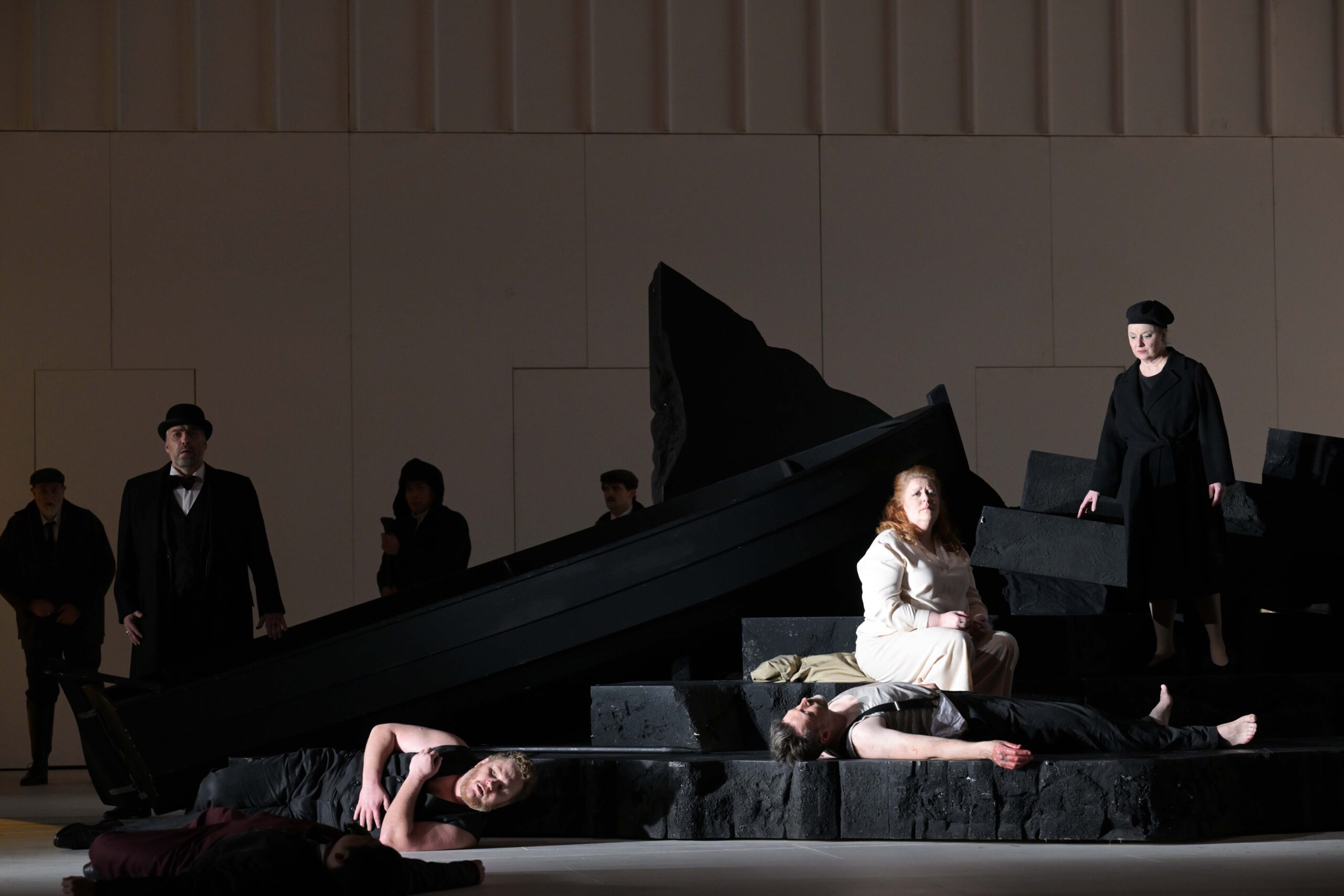
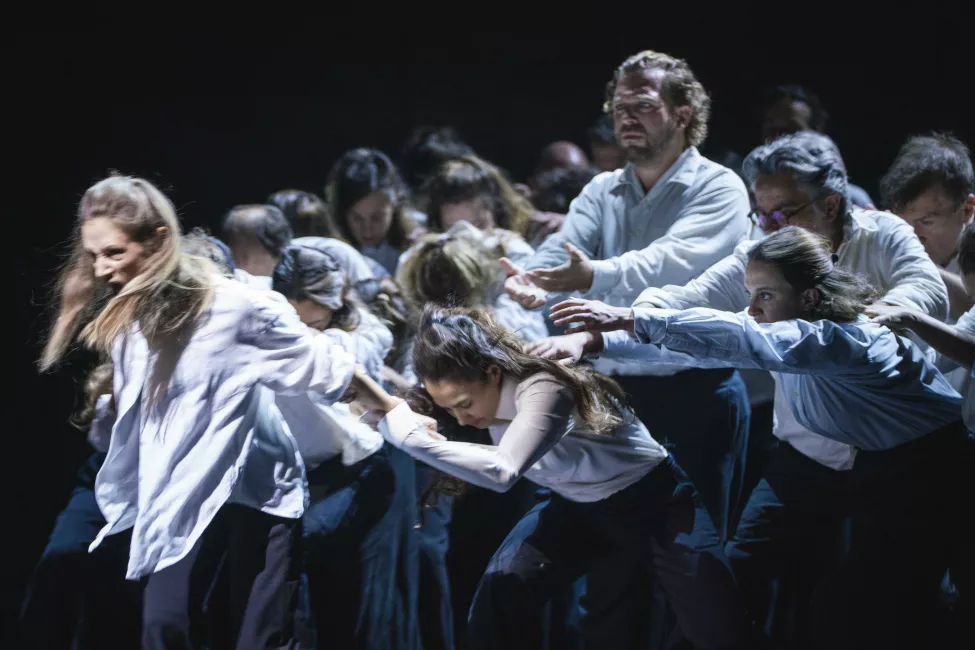
Oper Frankfurt opens the early spring season with a revival of Katharina Thoma’s 2020 production. The staging is marked by Johannes Leiacker’s pared‑back set design, the same throughout all three acts: three vast white walls punctuated by numerous doors that ease the performers’ entrances and exits while reducing the depth of the stage; a row of neon lights set side by side halfway up the walls, switched on and off at pivotal moments (Isolde’s awakening in Act I, or the entrance of Marke, followed by Melot and his guards, in Act II); and, finally, a large black plank symbolising the unfolding of the mythical lovers’ passion.
Olaf Winter’s lighting choices create spaces and atmospheres that closely reflect the narrative’s descriptions (particularly in Act II) and in doing so prove more decisive than the set itself. The costumes by Irina Bartels, however, make it difficult to determine the precise period in which the action is placed: while those worn by Tristan, Isolde and Kurwenal are contemporary, Brangäne’s and König Marke’s appear to belong to another era (perhaps the early twentieth century?). Taken as a whole, the production’s aesthetic approach convinces, without necessarily captivating.
In the end, despite an almost monastic scenic clarity that ought to demand a firmly defined direction of actors, the German director’s vision offers the audience neither the means to anticipate the situations nor to connect them with what unfolds on stage.
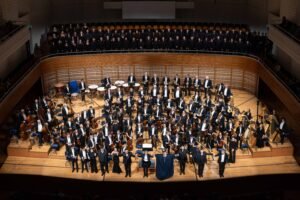
Thomas Guggeis’s musical direction is shaped to sustain a genuinely symphonic breath, received with poise by the Frankfurter Opernorchester. The Bavarian conductor adjusts the tempi so as to maintain a driving momentum that holds the audience’s attention while preserving an unbroken musical flow. One detects little, if any, roughness between the sections, allowing the orchestral atmosphere to remain both enveloping and sensuous. Attentive to a balance that is both vivid and supple, he ensures that the brilliance of the brass is radiant yet sufficiently rounded to avoid any harshness; the expansions of the harmonic climaxes are crafted with discernment; and the voices, supported particularly by the strings, are immediately woven into the orchestral fabric.
Marco Jentzsch offers a valiant vocal portrayal of Tristan. Although his performance during the first two acts is marked by a certain immobility, the third is a true triumph of talent and commitment. At times his voice is less clearly heard in the tutti passages (his timbre is dense though not baritonal), yet the projection remains consistently well‑shaped, the breath perfectly controlled to meet the demands of Wagner’s long phrases, the text intelligible (clear but never percussive consonants, faithful respect for the prosodic rhythm), and the balance between coverage and brightness exemplary – allowing him to sustain the great vocal arches without any rupture.
At his side, Miina‑Liisa Värelä deploys a broad, powerful voice, without ever abandoning a finely judged management of dynamics. Her legato is highly expressive and firm – less sculpted in the line than that of certain celebrated Isoldes, yet projected and sustained with an impressive command entirely in keeping with the amplitude of her instrument. The lower register poses no difficulty – quite the opposite (on rare occasions it may sound a touch “mezzo‑like” for the role, though the impression is misleading) – while the high notes are gracefully spun, enabling her nonetheless to produce pianissimi of disarming beauty. Within the vast musical cathedral erected by Guggeis, her ability to place her voice within this grandiose architecture is instantaneous. The Finnish soprano embraces the production’s theatrical conception. Her diction is not as precise as her partner’s, yet thanks to her strong engagement with the staging, she succeeds magnificently, delivering an irresistible interpretation of the character.
Claudia Mahnke and Andreas Bauer Kanabas are the only cast members returning from the 2020 production, and their familiarity with the staging is evident. The mezzo, with her warm, enveloping timbre and exemplary legato, offers upper notes that are both frequent and luminous. Her emission is smooth and seemingly effortless, carrying her voice through the space without a trace of hardness. What emotion she conveys in Einsam wachend in der Nacht, a moment both profound and deeply moving!
Andreas Bauer Kanabas embodies royal grandeur in a man all too human. A noble bass, with a sovereign legato, impeccable expressive declamation, a voice both supple and profound, dark yet lyrical, he ennobles a character often considered less compelling by making him a decisive force in the unfolding of Act II. We may readily acknowledge that this performance ranks among the finest of recent years, as the audience’s reception confirmed.
A perfect dramatic baritone, with a robust timbre supporting Tristan’s tragedy without faltering, Nicholas Brownlee delivers a convincing Kurwenal, marked by the fidelity and loyalty integral to the role. Finally, credit must be given to the clear and expressive performance of Taehan Kim as Melot, and to Aurélien Laizé’s beautiful playing on the cor anglais onstage: melancholic, plaintive, yet never forsaking the elegance so fitting to the introspective melodies associated with Tristan.
With its polished conducting and solid vocal performances, this production distinguishes itself through a consistency of quality that is as unusual as it is noteworthy, reinforcing Oper Frankfurt’s standing among Germany’s leading opera houses.
******************************
TRISTAN UND ISOLDE
Handlung in drei Aufzügen von Richard Wagner
Text vom Komponisten
nach dem Versroman Tristan (um 1210) von Gottfried von Straßburg
Musikalische Leitung | Thomas Guggeis · Inszenierung | Katharina Thoma · Szenische Leitung der Wiederaufnahme | Orest Tichonov · Bühnenbild | Johannes Leiacker · Kostüme | Irina Bartels · Licht | Olaf Winter · Chor | Álvaro Corral Matute · Dramaturgie | Mareike Wink
Tristan | Marco Jentzsch · Isolde | Miina-Liisa Värelä · König Marke | Andreas Bauer Kanabas · Brangäne | Claudia Mahnke · Kurwenal | Nicholas Brownlee · Melot | Taehan Kim · Hirte/Ein junger Seemann | Theo Lebow · Steuermann | Pete Thanapat · Herrenchor der Oper Frankfurt · Frankfurter Opern- und Museumsorchester | Credit photo coverture: ©Barbara Aumüller
(For further informations) Link to the Oper Frankfurt: Tristan & Isolde
About the Author