INTERMEZZO | Semperoper
Depending on your point of departure, Dresden may not be the most accessible destination in Germany. For those living in Paris, as the author of these lines does, the least taxing route is to travel to Berlin and then take one of the IC trains linking Rostock to the capital of Saxony. It will take you around two hours, crossing a landscape that is not without charm, though fairly uniform, from Brandenburg to the “Florence on the Elbe”. Once at the central station, a short ten-minute tram ride will bring you to the opera house – magnificent, one of the finest in Germany, if not the finest – to see the work under discussion here: Intermezzo, by Richard Strauss (both libretto and music).
At this point, you might well ask: why travel so “far” to see an opera that has come close to falling into oblivion? Especially when the plot is disarmingly simple: the everyday life of the composer, here named Robert Storch, with his wife Christine (whose real name was Pauline), until a misunderstanding leads her to believe that her husband is unfaithful during his frequent and distant travels. Still not convinced? There are no arias, no monologues, no set numbers: above all, an unbroken musical conversation, something the traditional operatic repertoire has hardly accustomed us to. Six years were devoted to writing the libretto and composing this work, whose initial reception was mixed (owing, according to Hofmannsthal, to the lack of genuine dramatic momentum in the libretto), a lyrical counterpart to a subject Strauss had already explored in his Sinfonia Domestica (1904), a symphonic portrayal of his family in which each member is represented by an instrument.
So why expend so much effort to see it?
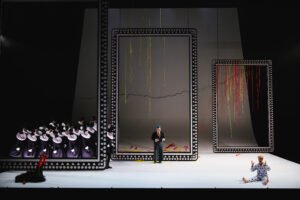
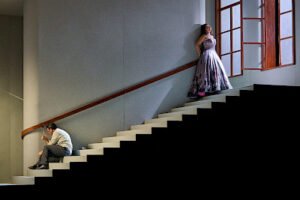
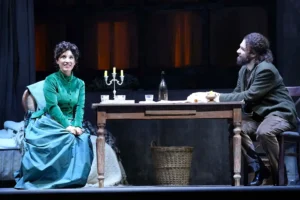
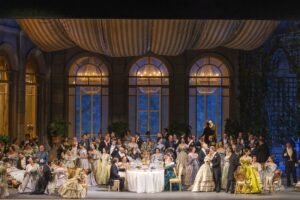
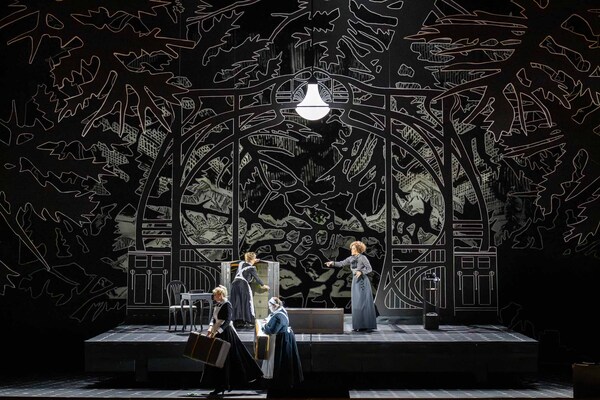
First of all, because this venue is to Strauss enthusiasts what the Vatican is to Catholics: a place of reference, where no fewer than nine of the Bavarian composer’s operas were premiered: Feuersnot (1901), Salome (1905), Elektra (1909), Der Rosenkavalier (1911), Die ägyptische Helena (1928), Arabella (1933), and, of course, Intermezzo (1924). Going to Dresden is a pilgrimage as natural as it is essential, especially given the thread adopted by Axel Ranisch’s staging to tell this story. His approach is playful without ever being patronising, displaying a creative ingenuity of striking simplicity in solving the many scene changes. Working in black and white throughout (even the costumes are chromatically restrained), it is the patterns (rich in Belle Époque influences and of exquisite finesse) that anchor the action firmly in the early twentieth century. Up to this point, the production recalls the “classic” stagings by John Cox (Glyndebourne Festival, 1974 and 1983) and, even more so, Kurt Wilhelm (Bavarian State Opera, 1988), in its exemplary economy of means. The main innovation lies in the insertion of videos (by Falko Herold), which follow the Strauss couple (played by Katharina Pittelkow and Erik Brünner) on the evening of the premiere of Intermezzo in this very house. Much like the New Year’s Concert showcases the Musikverein, these sequences highlight the beauty of the Semperoper. Additional comic-strip-style videos recount the genesis and key elements of the works premiered in Dresden that resonate within Intermezzo. These “stories within the story” appear during the interludes, serving either as markers during the orchestral passages or as previews of what is about to unfold on stage.
Secondly, precisely because it is so rarely performed, this opera ought to arouse curiosity. And not just mild curiosity: it poses a genuine challenge in terms of casting, requiring singers who are entirely at ease in the demanding art of alternating spoken dialogue and singing of remarkable lyricism, all while maintaining a rapid, speech-like rhythmic flow. The logistical demands are equally significant: fourteen scenes, each with a distinct set, spread across two acts and separated by lively, exquisitely crafted orchestral interludes that invariably echo material heard elsewhere – in Salome, Elektra, and Der Rosenkavalier. In such conditions, the risk of boredom is low, provided that singers, orchestra and conductor rise to the occasion.
In her role début as Christine, Clara Nadeshdin does not disappoint. The immediate warmth and rapport established by Felicity Lott or Lucia Popp (with Wolfgang Sawallisch in 1980) may be less evident here; there is a greater, perhaps deliberate, distance, with the German soprano sometimes leaning too heavily on a capricious, almost girlish characterisation that does not always feel entirely natural. But the voice… what a voice! Apart from slight signs of fatigue towards the end (unsurprising, given the sheer weight of the role), her performance is remarkably accomplished for such a young singer. Breath control, prosodic agility, stamina, and diction are all exemplary, supported by a well-focused vibrato that ensures textual clarity. It would be difficult to identify any strictly technical shortcomings.
Alongside her, Christoph Pohl offers a lyrical and assured Robert, noble and elegant, entirely at ease in a role he has already performed, notably opposite Maria Bergston’s warmly received Christine in 2024. One might almost think the role was written for him. The American tenor James Ley brings a welcome touch of self-mockery to his Baron Lummer, without sacrificing the character’s lyrical charm, and delivers with confidence several striking high notes that are rarely encountered in this work. The remainder of the cast, though appearing more briefly, proves essential in sustaining the dramatic fabric and offers performances of consistently high quality – if all too short.
Thirdly, the orchestral interludes. Here Strauss refines the musical fabric with watchmaker-like precision, weaving in quotations and pastiches. These moments, almost as important as the scenes themselves (if not more so) form a network of references that call for a flexible yet firmly shaped conducting style. In keeping with the unforced, conversational parlando of the singers, the music demands clarity and control without undue force that might result in an unnecessarily aggressive momentum. Patrick Hahn meets these demands with assurance. His approach leans distinctly towards a more symphonic reading (in the tradition of Sawallisch), favouring broad phrasing and an imposing architectural vision over a more overtly theatrical or psychologically analytical one, all animated by a visibly joyful engagement throughout the performance.
With so many elements converging towards what feels less like a simple operatic performance and more like a richly coloured and admirably executed homage to Strauss’s entire output, one must conclude that travelling to Dresden to see Intermezzo was far from incidental (as the somewhat prosaic opening of this article suggests): it was self-evident.
******************************
INTERMEZZO (op. 72)
Eine bürgerliche Komödie mit sinfonischen Zwischenspielen in zwei Aufzügen
Libretto vom Komponisten
Musikalische Leitung | Patrick Hahn · Inszenierung | Axel Ranisch · Bühne | Saskia Wunsch · Kostüme | Alfred Mayerhofer · Licht | Fabio Antoci · Video | Falko Herold · Choreografie | Michael Tucker · Dramaturgie | Jörg Rieker
Christine | Clara Nadeshdin · Hofkapellmeister Robert Storch | Christoph Pohl · Anna | Ute Selbig · Baron Lummer | James Ley · Der Notar | Bernhard Hansky · Die Frau des Notars | Nadine Secunde · Ein Kapellmeister | Jürgen Müller · Ein Kommerzienrat | Anton Beliaev · Ein Justizrat | Martin-Jan Nijhof · Ein Kammersänger | Tilmann Rönnebeck · Resi | Sofia Savenko · Pauline | Katharina Pittelkow · Richard | Erik Brünner · Sächsische Staatskapelle Dresden · Credit for the cover photo: ©Semperoper Dresden/Monika Rittershaus
(For further informations) Link to the Semperoper: Intermezzo
About the Author