DAS RHEINGOLD | Bayreuther Festspiele
Between Myth and the Algorithm
Bayreuth is a place of pilgrimage, a codified rite, and an immutable liturgy. Its theater is a temple built according to Wagner’s exact vision and design, opening for just one month a year to exclusively perform the works of the great German composer. Attending a performance in the great hall on the Green Hill remains a unique, deeply absorbing experience: the invisible orchestra, the hall plunged into total darkness, the unrivalled acoustics that flawlessly elevate both instrumental and vocal performances, the unforgiving wooden seats, the lack of air conditioning, and the complete absence of the surtitles now ubiquitous worldwide. Yet, upon leaving, one cannot wait to return and re-immerse themselves in a soundscape that seems to rise from the bowels of the earth, enveloping the listener with a sonic perfection far superior to any high-definition recording.
An unmissable milestone for all Wagnerians is this 150th Anniversary Ring, celebrating the masterpiece that premiered in this very theater on August 13, 1876. For the occasion, the production has been conceptualized as RING 10010110 “From Mythos to Code,” with the central, provocative idea of entrusting the staging to artificial intelligence.
The theatrical interpretation of one of the most complex works of art in Western culture—composed over 26 years from 1848 to 1874—is itself an integral part of the history of this absolute masterpiece. The Ringfunctions as a Gesamtkunstwerk, a theatrical laboratory where myth, tragedy, philosophy, power struggles, generational conflicts, revolution, and institutional crises intertwine. Across 150 years of performance history, initially shaped by Wagner himself and later by his heirs, we have witnessed epoch-making productions. Think of Patrice Chéreau’s 1976 Centennial Ring, which set the tetralogy during the 19th-century Industrial Revolution, transforming Das Rheingold into a critique of capitalism and the gods of Valhalla into the upper-middle class of the era. Though met with fierce protests at its debut, it quickly became a benchmark, culminating in 80 minutes of uninterrupted applause when the curtain fell on Götterdämmerung in 1980. Over the past decade, however, new productions of the Tetralogy have struggled to achieve similarly revolutionary or even appreciable results, often vacillating between Netflix and Game of Thrones aesthetics—as seen in recent stagings in Milan (directed by David McVicar), London (directed by Barrie Kosky), and Paris (directed by Calixto Bieito).
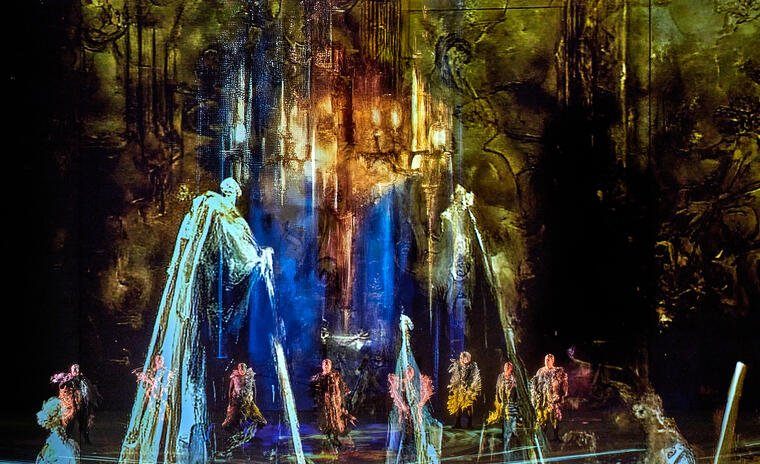
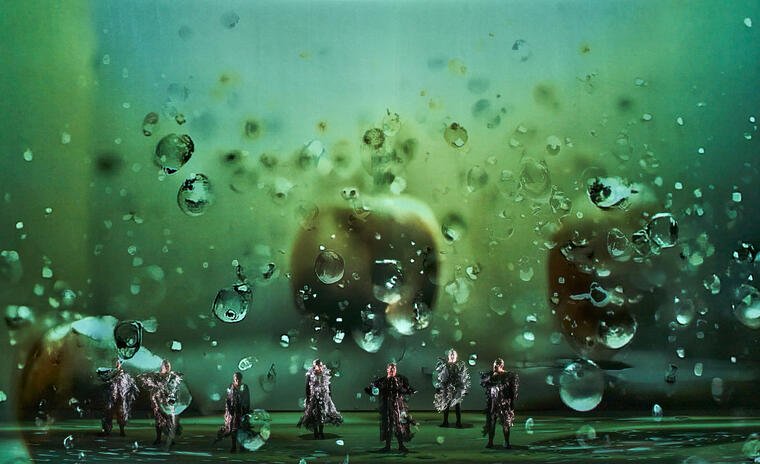
The choice to forgo a traditional stage director in favor of a creation powered by artificial intelligence certainly has its intellectual appeal, but also an intrinsic weakness. Wagner was an artist remarkably open to technological innovation, as his own custom-built festival hall demonstrates. In a sense, AI is a modern-day Rhinegold: whoever fully harnesses it can aspire to global dominance. On the other hand, surrendering the stage to an algorithm means short-circuiting the very human creativity and genius inherent to the art form. According to the local press, this visual project, heavily reliant on video projections, was born partly out of a reduction in the Festival’s budget, which also led to the cancellation of several productions originally planned for this anniversary. Tellingly, the production does not credit a director, but rather a “Kurator” in the person of Marcus Lobbes, Intendant of the Academy for Theater and Digitality Dortmund. The AI system absorbed set designs spanning from 1876 to 2026, alongside historical references, aesthetic spaces, political events, and atmospheric textures, alongside the complete musical score. Furthermore, singers were fitted with trackers to map their stage positions and feed data back into the system. Another much-touted feature is that no performance or rehearsal is identical, meaning the visual landscape alters slightly every evening.
In practice, these video projections are cast between two walls positioned at the front and back of the stage. The singers move within this narrow space in an almost semi-staged format, severely limiting the dramatic movement and physical interactions needed to drive the plot. Compounding this, the uninspired, nearly identical costumes make it difficult to identify individual characters as they enter and exit. Following the prelude, the opera opens with a black-and-white archival image of the Rhinemaidens from the original 1876 production. What follows, however, is a succession of disjointed images: archival clips from past stagings give way to twentieth-century historical figures, interspersed with vibrant visuals somewhere between high art and kitsch, bearing no discernible connection to the libretto or the stage action. While there are a few striking motifs—such as Freia’s garden or the rainbow bridge accompanying the gods into Valhalla—the overall result is a sequence of random projections lacking any apparent logic, disorienting the listener in a sort of sterile“Wort-Ton-ohne-Drama”.
Thielemann’s Sonic Triumph
Yet, if the visual component disappoints, the musical execution lands at the absolute pinnacle of Wagnerian interpretation. Christian Thielemann confirms his status as one of the greatest Wagner conductors of our era. Nobody understands the formidable acoustics and technical idiosyncrasies of the Bayreuth pit better than Thielemann, who has conducted here over 180 times. Consequently, this 150th Anniversary Ring was highly anticipated by the demanding audience of aficionados packing the house. It is difficult to review Das Rheingold in isolation, as Thielemann’s extraordinary reading is designed to unfold across the entire cycle. Every measure of the prologue and the subsequent three days serves as a building block for a vast, continuous narrative; the dramatic tension rises without interruption until reaching its emotional and dramatic climax in Götterdämmerung.
Thielemann’s signature style lies in the sheer beauty and transparency of the orchestral texture, maintaining a flawless balance between the hidden pit and the stage. The Bayreuth Festival Orchestra offers an unparalleled dynamic range and astonishing clarity across all sections, marked by crystalline string playing, impeccable brass intonation, and a perfectly blended ensemble. Thielemann’s reading clearly takes Herbert von Karajan as its spiritual model—evident in the meticulous attention to orchestral color and a predominantly lyrical interpretation that becomes sumptuous during symphonic interludes, deeply capturing the passions and torments of the characters. Right from the inception of the work, Thielemann is phenomenal at sustaining the absolute stillness of the single E-flat major chord, held steady and unchanging for 136 bars. Similarly, the staggering power of the brass section during the rainbow bridge motif lands as a triumphant yet deeply threatening fortissimo. If one minor criticism can be leveled, the conductor occasionally struggles to sustain that same white-hot intensity across the entire two-and-a-half-hour span, appearing slightly detached during the more conversational, recitative-like passages. Even the famous descent into Nibelheim, despite its sonic splendor, lacked a sharper dramatic bite. Nevertheless, this is an interpretive reading built for the long haul across four operas, and it promises to stand as the definitive musical benchmark for this second quarter of the 21st century.
The Cast: Lyrical Depth and Dramatic Cohesion
The ensemble assembled for this production is equally outstanding and perfectly aligned with Thielemann’s musical vision. The cast features predominantly lyrical voices that blend beautifully in timbre, showcasing immense musicality, commanding stage presence, and total fidelity to the expressive nuances of the score. While monumental Wagnerian voices have been scarce for decades—the likes of Birgit Nilsson and Wolfgang Windgassen are now a rarity of a bygone era—this cast stands out for its exceptional homogeneity, crystal-clear diction, theatrical execution, and seamless rapport with the conductor.
- Michael Volle (Wotan): Volle remains a definitive interpreter of Wotan, a role he debuts at Bayreuth at the age of 66 after performing it across the world’s major opera houses. His dark, characteristically Germanic bass-baritone voice is defined by both its velvety smoothness and effortless emission. His upper register is powerful and secure, ringing out confidently even in full-voiced high Fs. Volle’s dramatic delivery is practically flawless, elevated by immaculate diction and a profound psychological grip on the character. In Das Rheingold, he masterfully exposes Wotan’s authoritarian, power-hungry, and manipulative nature, reaching a ferocious peak during his clash with Alberich for possession of the ring. It is a monumental performance, laying the groundwork for a painful and tragic evolution across the remaining operas.
- Alexander Grassauer (Donner) & Siyabonga Maqungo (Froh): Grassauer lends his sonorous baritone to the thunder god, deploying a virile, fiery accent; his call to the mists (“Heda! Heda, Hedo! Zu mir, du Duft!”) is delivered with excellent technique, secure high notes, and vigorous vocal power. Maqungo portrays the spring god Froh with a gorgeous lyric tenor voice, characterized by a fluid vocal line and a blossoming upper register. His hymn to the rainbow bridge (“Zur Burg führt die Brücke”) is sung with exquisite legato and the ideal expressive intensity.
- Klaus Florian Vogt (Loge): A celebrated tenor specializing in the Wagnerian repertoire, Vogt achieves the epic feat in this Ring cycle of singing three roles with completely contrasting vocal demands: Loge, Siegmund, and Siegfried. In Das Rheingold, Vogt embodies the cunning, calculating fire god to perfection. The role demands a brilliant tenore di carattere capable of mimicking the unpredictable flickering of flames. Vogt’s strength lies in his razor-sharp, sculpted diction. His delivery is scathing and ironic with Mime and Alberich, yet agile and chromatic when dealing with the giants. Concurrently, his extensive experience as a Lieder singer emerges beautifully during Loge’s famous narration (“Immer ist Undank Loges Lohn”), rendered with a soft, lyrical intimacy.
- Anna Kissjudit (Fricka): Kissjudit delivers an impressive performance as Wotan’s stern wife. Gifted with a powerful dramatic mezzo-contralto voice, she boasts remarkably resonant low notes and formidable dramatic weight. Her high notes project effortlessly over the massive orchestra, yet she easily resolves into a delicate piano wherever the score demands it. Interpretively, Kissjudit portrays a strong-willed, noble character rather than a merely petulant wife, clashing with her husband with immense dignity as both spouse and sister of Freia.
- Evelin Novak (Freia): Novak infuses Freia, the guardian of youth, with a youthful, luminous soprano timbre that contrasts beautifully with her sister and the giants. She ascends easily into the upper register, maintaining a steady, brilliant tone through the numerous A’s and B’s of the part, making her desperate cries for help genuinely piercing.
- Christa Mayer (Erda): Mayer portrays Erda, Mother Earth, with a dark, solemn, and hieratic tone, notably avoiding any over-emphasis on the chest register. Her declamation is clear, navigating the difficult intervals and register shifts with smooth legato.
- Jochen Schmeckenbecher (Alberich): Schmeckenbecher’s formidable Alberich serves as the true dramatic engine of the entire Tetralogy. Vocally, the baritone masterfully navigates the arduous tessitura, anchoring the subterranean nature of the Nibelung with solid low notes while piercing the texture with sharp, biting high notes. The crowning achievement of his performance is his incisive phrasing, capturing the complex psychological layers of a character to whom Schmeckenbecher grants a profound dimension of human suffering born of pain and humiliation. Consequently, the famous curse on the ring is not delivered as a mere display of vocal power, but as a chilling outburst of impotent rage and heartbreak.
- Gerhard Siegel (Mime): Siegel portrays Alberich’s brother with a perfectly judged character tenor. His timbre is penetrating and incisive without lapsing into excessive caricature. His clear delivery and precise diction capture all the distinctive vocalizations required by the role—wails, sardonic chuckles, and terrified screams—all while remaining strictly musical and avoiding the grotesque.
- Mika Kares (Fasolt) & Peter Rose (Fafner): The two giants are expertly cast. Notably, Kares takes on three distinct roles across this Ring cycle: Fasolt, Hunding, and Hagen. Without ever forcing their voices, both basses successfully outline the contrasting personalities of the brothers. Kares highlights the surprisingly amorous, gentler side of Fasolt without losing his imposing stature, while Rose delivers a Fafner entirely consumed by cold greed and a lust for power.
- The Rhinemaidens: Opening and closing the opera, the trio provides a brilliant blend of timbres, musically synchronized with Thielemann’s magical orchestral landscape. Katharina Konradi’s Woglinde boasts a splendid timbre, ascending effortlessly to luminous high C’s that mimic the sparkle of the gold. Natalia Skrycka’s Wellgunde offers a velvety, seductive tone tinged with irony grounded by a rich, beautifully controlled middle register that bridges the gap between her sister nymphs. Marie Henriette Reinhold’s Floßhilde grounds the trio with a darker, voluptuous timbre perfectly suited to the wiser sister, blending seamlessly into the vocal arabesques of the three nymphs.
Conclusion and Audience Reception
When the curtain fell at the premiere on July 27th, boisterous protests erupted from an audience clearly displeased with the artificial intelligence-driven staging. In stark contrast, the musical forces received enthusiastic applause, with peaks of ovation reserved for Michael Volle and Jochen Schmeckenbecher. Interestingly, while conductor Christian Thielemann received a lion’s share of applause, a few unexpected boos emerged from the crowd—a testament to the fiercely demanding nature of the Bayreuth audience.
About the Author