L’OCCASIONE FA IL LADRO | Rossini Opera Festival
A Timeless Suitcase: Ponnelle’s Legendary L’occasione fa il ladro at the Rossini Opera Festival
L’occasione fa il ladro, ossia il cambio della valigia belongs to the group of five farse written by a very young Gioachino Rossini for the Teatro San Moisè in Venice, where it premiered on November 24, 1812. As was common at the time, the composer was given barely a dozen days to complete this “burletta in musica” based on a libretto by Luigi Previdali, who adapted Eugène Scribe’s French vaudeville Le prétendu par hasard, ou L’occasion fait le larron.
The plot thrives on misunderstandings and mistaken identities: Don Parmenione and Count Alberto accidentally swap suitcases at an inn, while Berenice, wishing to test her betrothed, exchanges clothes with her maid Ernestina. This sets the stage for a delightful comedy blending solo numbers and ensembles, interspersed with recitativi secchi.
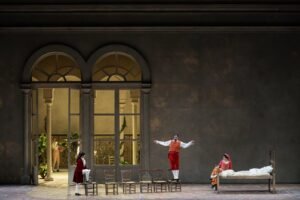
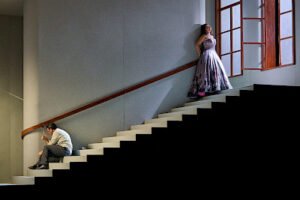
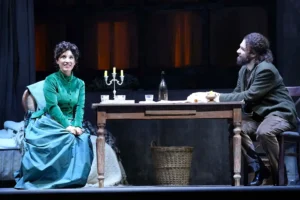
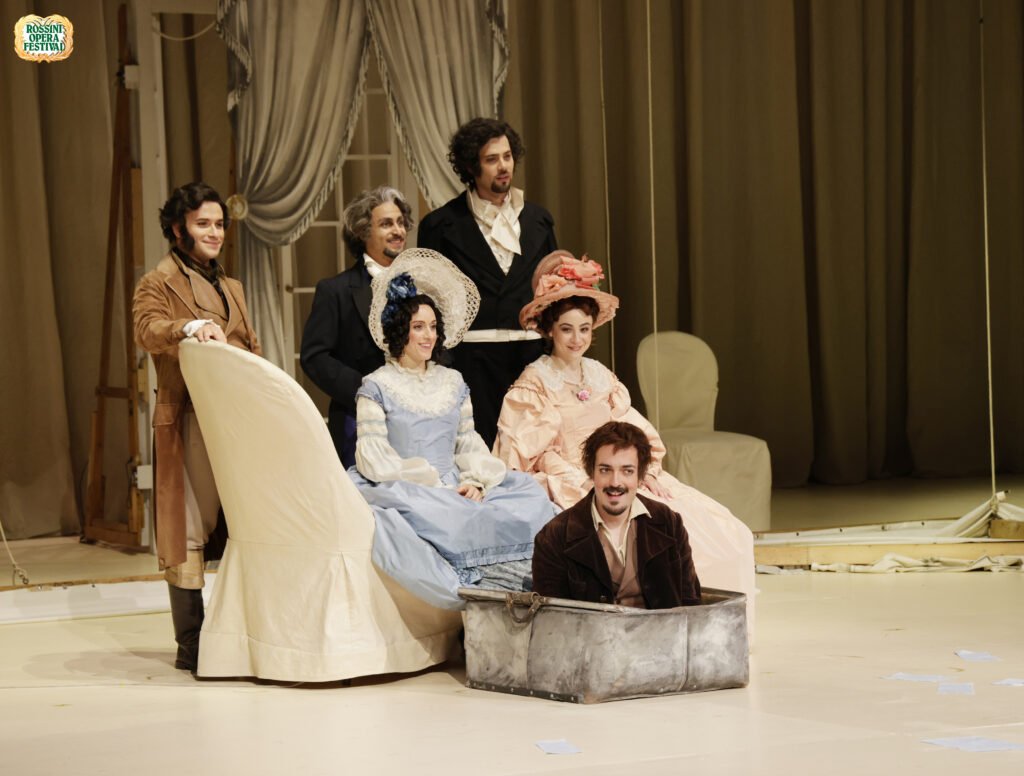
For its 47th edition, the Rossini Opera Festival chose to revive a legendary 1987 production featuring direction, sets, and costumes by Jean-Pierre Ponnelle. His Rossini stagings, regularly revived by major opera houses worldwide, have become legendary milestones in operatic history. Sonja Frisell successfully remounts this historic ROF production, originally created just a year before the director’s untimely passing. Its formidable metatheatre remains intact: the entire set and the characters emerge from a single suitcase during the overture, and the scenery is assembled in full view of the audience. The production maintains a light and elegant touch throughout, enhanced by beautiful costumes, the composer’s trademark crescendos that accelerate the onstage movement, and painted cardboard backdrops that beautifully mimic 19th-century prints.
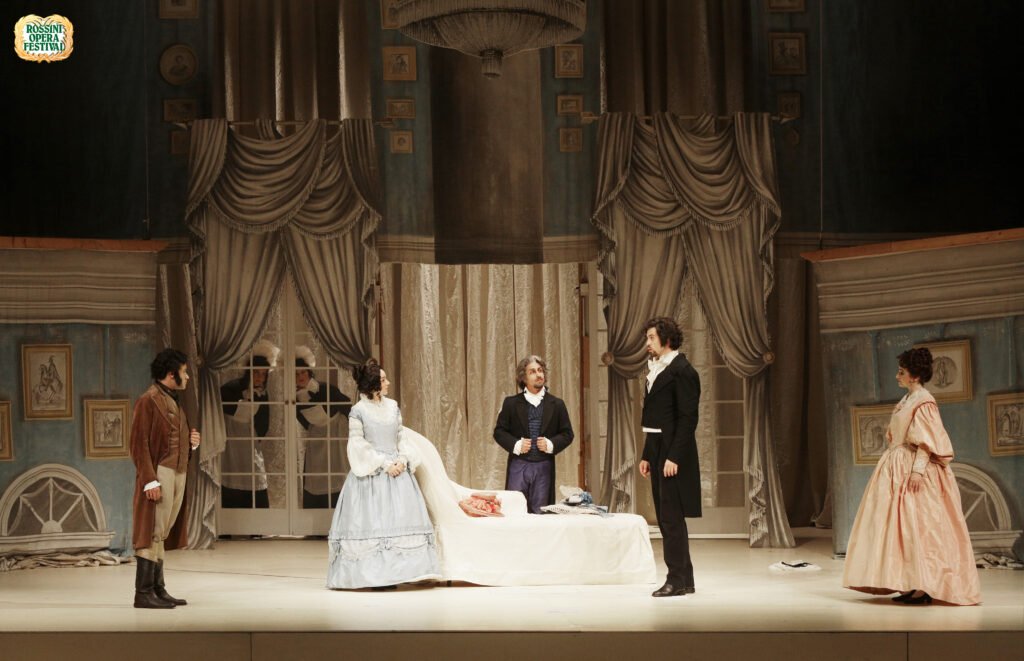
This revival featured a cast of young singers, mostly drawn from the “Alberto Zedda” Rossini Academy, which has operated within the Festival since 1989 to train a new generation of performers capable of mastering the style and technique of the Pesaro composer.
The cast proved meticulously faithful to the highly detailed stage directions, showing strong musicality in the male roles but falling somewhat short in the female ones. Count Alberto was sung with great musicality by Dave Monaco, a rising Rossini tenor who also performed a solo recital and the closing Stabat Mater at this year’s festival. Boasting a true bel canto voice, his stylistic elegance and flawless technical control take precedence over raw vocal power. In the aria “D’ogni più sacro impegno”, Monaco easily reached the high notes, showcasing excellent legato and a superb technical execution of fiorituras and coloratura passages.
Matteo Mancini proved to be an excellent Don Parmenione, offering a crisp baritone voice and a brilliant stage presence. He navigated the rapid sillabato and agile coloratura with taste and technique, delivering a witty and ironic phrasing that never devolved into caricature. Fresh out of the Academy, Giuseppe Toia stood out as Martino, the true engine of the plot, who playfully delivers the score to the conductor and orchestra before the opera begins. Toia effectively fleshed out the buffo role with a bright tone, seamless registration, and an excellent rendition of his “portrait” aria, where he ironically describes his master’s eccentricities and flaws. In the role of the tutor Don Eusebio, tenor Manuel Amati offered secure vocal control and an amusing portrayal of the grumpy, eccentric old man.
On the other hand, Damiana Mizzi’s Berenice was vocally unconvincing. While her timbre is pleasing and well-suited to the protagonist, her upper register sounded dry and sharp. Her coloratura, though precise, lacked the incisiveness and bravura that Rossini’s music demands. Consequently, her performance of the famous “Voi la sposa pretendete” lacked elegance and sparkle, with high notes that tended to weigh down the vocal line. Martiniana Antonie’s Ernestina was also notably unfocused; despite the role’s central tessitura, she lacked the precision and legato required for this repertoire.
In stark contrast, Alessandro Bonato delivered a thoroughly Rossinian reading at the helm of the Filarmonica Gioachino Rossini. His interpretation stood out for its instrumental clarity—evoking Mozart and Cimarosa—rhythmic precision, brisk tempos, and a sparkling, lively drive that lent a magnetic theatricality to the performance.
The packed house at the Teatro Rossini enthusiastically rewarded the revival of this opera, captivated by Ponnelle’s stage magic, the vivacity of the conducting, and the energetic young cast.
CAST
Don Eusebio MANUEL AMATI
Berenice DAMIANA MIZZI
Conte Alberto DAVE MONACO
Don Parmenione MATTEO MANCINI
Ernestina MARTINIANA ANTONIE
Martino GIUSEPPE TOIA
–
Conductor ALESSANDRO BONATO
Director, settings and costumes JEAN-PIERRE PONNELLE
Restaged by SONJA FRISELL
Lighting designer FABIO ROSSI
ORCHESTRA SINFONICA G. ROSSINI
About the Author