DIALOGUES DES CARMÉLITES | Opéra de Marseille
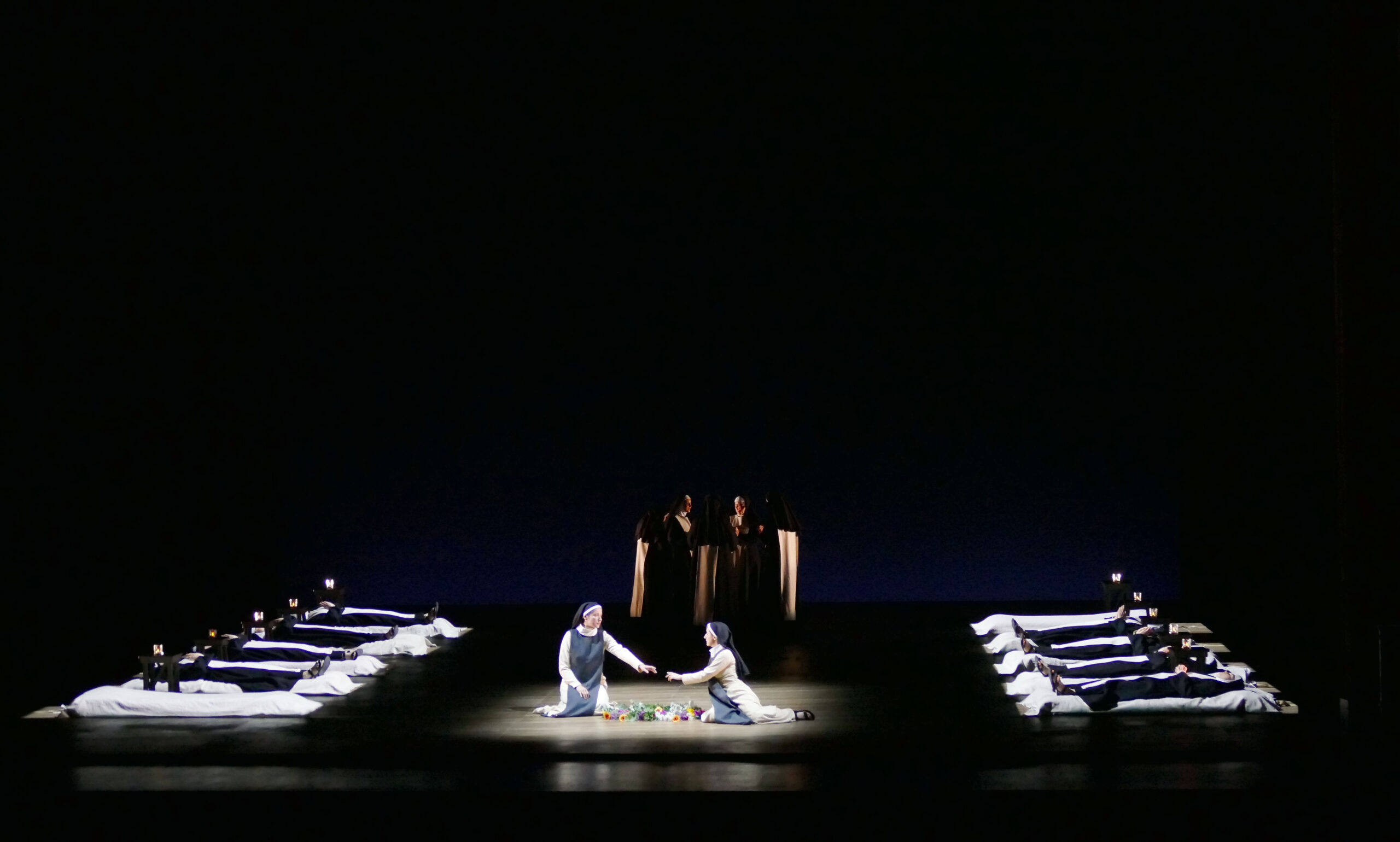
A new production of Dialogues des Carmélites always raises the same fundamental question: how to reconcile the work’s metaphysical density with the radical simplicity it demands on stage. In Marseille, Louis Désiré opts for a deliberately pared-down aesthetic, structured around a series of clean, carefully composed tableaux. The visual language is restrained, often effective, and supported by a fluid management of scenic elements that allows the drama to unfold without unnecessary obstruction.
This approach proves largely convincing—until the final scene. Here, the production falls short of the work’s inherent violence and transcendence. Whether through the presence of a guillotine or a more sharply defined symbolic embodiment, the climax requires a form of theatrical incision that is ultimately lacking. The image of the sisters drifting in the background, while aesthetically coherent with the overall concept, does not fully deliver the brutal finality inscribed in Poulenc’s score. The result is a conclusion that feels visually underdetermined, where one expects a decisive theatrical gesture.
In the pit, Debora Waldman asserts herself with authority and intelligence. Her reading is both structured and alive, attentive to the constant interplay between speech and lyricism that defines the work. The orchestral textures remain clear, the pacing controlled without rigidity, and the singers are consistently supported with care. There is, above all, a strong sense of theatrical breathing—phrases expand and contract naturally, allowing the text to retain its primacy without sacrificing musical line. A convincing and, at times, deeply engaging interpretation.
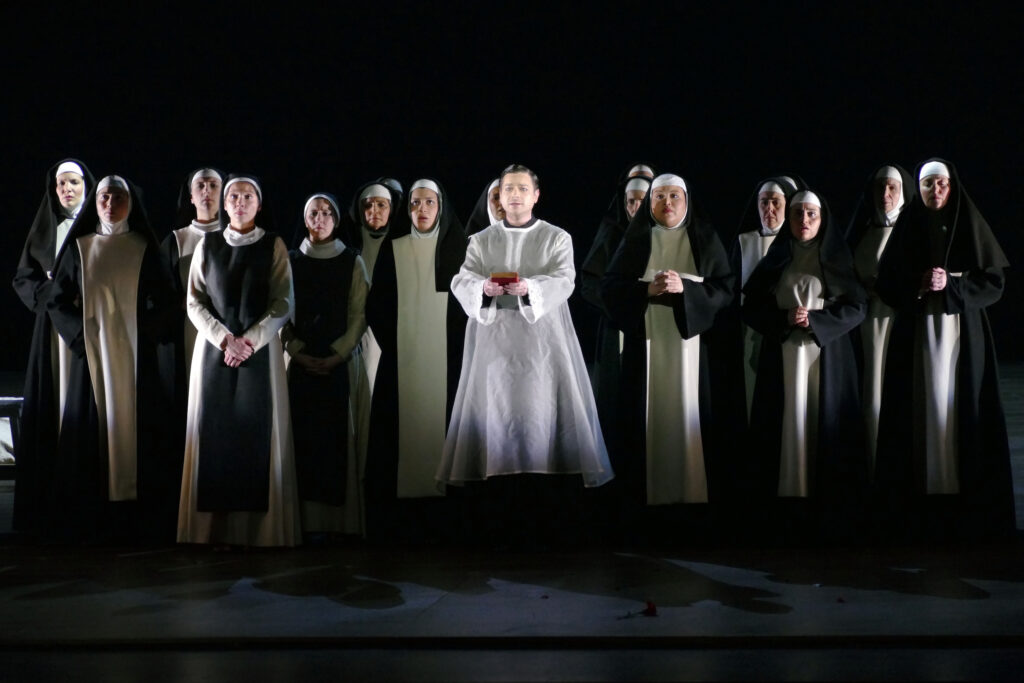
Hélène Carpentier takes on the formidable role of Blanche de la Force with notable assurance. The character’s psychological instability—its oscillation between fear, grace, and transcendence—is handled with coherence and authority. Vocally, the line remains focused, the timbre clear, and the projection sufficient to carry the role’s many introspective moments. She meets the challenge head-on and sustains it throughout the evening.
Opposite her, Léo Vermot-Desroches offers a Chevalier de la Force of genuine presence. His Act II dialogue with Blanche stands out as one of the evening’s most successful moments: the fraternal tension, both intimate and urgent, finds a natural musical and dramatic expression. The voice carries well, and the phrasing reflects a clear engagement with the text.
Among the Carmelites, the ensemble achieves a high and consistent level. Lucie Roche’s Madame de Croissy anchors the opening with the necessary gravitas, her death scene shaped with intensity and vocal commitment. Angélique Boudeville brings dignity and warmth to Madame Lidoine, particularly in her final intervention before the execution, where the line unfolds with calm authority. Ana Escudero’s Soeur Constance provides a welcome contrast, her lighter timbre and direct delivery illuminating moments such as her reflections on death with sincerity and clarity.
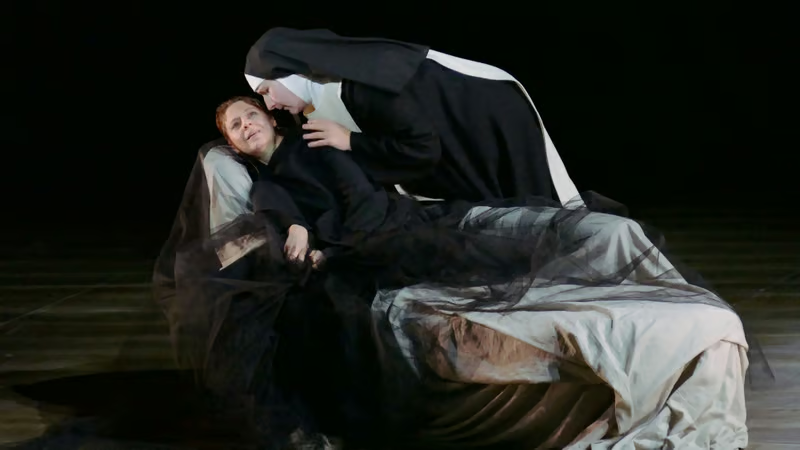
Eugénie Joneau’s Mère Marie maintains a firm dramatic line throughout, notably in her confrontations and moments of moral tension, while Laurence Janot (Mère Jeanne) and Esma Mehdaoui (Soeur Mathilde) contribute effectively to the collective presence of the convent. Each intervention feels integrated within a coherent ensemble rather than isolated contributions.
On the male side, Marc Barrard lends the Marquis de la Force a dignified authority, while Kaëlig Boché’s Aumônier stands out for the serenity of his interventions, particularly in the prison scene. Gilen Goicoechea (Le Geôlier), Yan Bua and Frédéric Cornille (the Commissioners and Officer), as well as Thomas Dear (Thierry) and Raphaël Brémard (Javelinot), all fulfill their roles with precision, ensuring the dramatic continuity of the work’s many transitions.
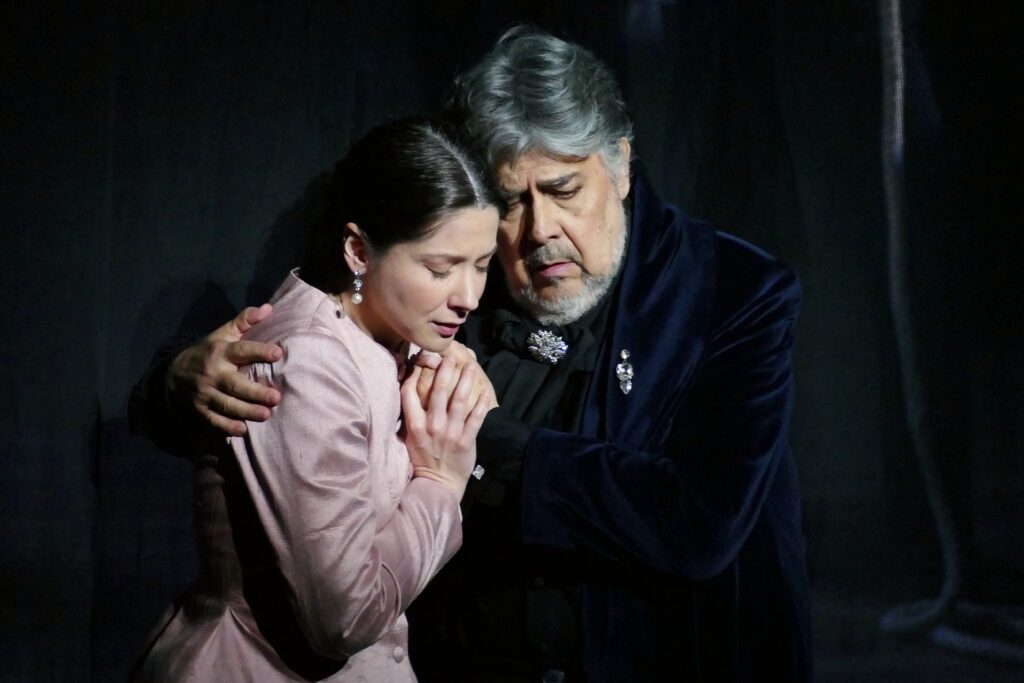
The Orchestre and Chœur de l’Opéra de Marseille respond effectively to Waldman’s direction, providing a solid and cohesive foundation. If not every moment reaches the same level of intensity, the overall impression remains one of balance and commitment.
Beyond the performance itself, one cannot ignore the particular charm of the Opéra de Marseille: its human scale, its acoustic intimacy, and the palpable warmth of its audience. In such a setting, a work like Dialogues des Carmélites finds a natural resonance. Despite a final scene that does not fully meet its dramatic potential, this new production succeeds in capturing much of the opera’s essence—through musical intelligence, a strong ensemble, and a genuine sense of theatrical sincerity.
CAST
Blanche de la Force
Hélène Carpentier
Le Chevalier de la Force
Léo Vermot-Desroches
Madame de Croissy
Lucie Roche
Madame Lidoine
Angélique Boudeville
Mère Marie de l’Incarnation
Eugénie Joneau
Soeur Constance
Ana Escudero
Mère Jeanne
Laurence Janot
Soeur Mathilde
Esma Mehdaoui
Le Marquis de la Force
Marc Barrard
L’Aumônier
Kaëlig Boché
Le Geôlier
Gilen Goicoechea
Le 1er Commissaire
Yan Bua
Le 2ème Commissaire / L’Officier
Frédéric Cornille
Thierry
Thomas Dear
Monsieur Javelinot
Raphaël Brémard
———
Musical Team
Conductor
Debora Waldman
———
Production Team
Director
Louis Désiré
Set & Costume Design
Diego Méndez-Casariego
Lighting Design
Patrick Mééüs
Orchestra & Chorus
Orchestre et Chœur de l’Opéra de Marseille
About the Author