IL TROVATORE | Bayerische Staatsoper
© Geoffroy Schied / Bayerische Staatsoper
Caruso is supposed to have said that all Il trovatore requires is “the four greatest singers in the world” — a line that has been gently mocked for a century, both because it is probably apocryphal and because Verdi’s most contradictory score has always been defended by the wrong arguments. Trovatore is, on paper, the most lurid muddle in the canon: a libretto by Salvadore Cammarano so compressed, so anti-narrative, that even sympathetic readers cannot reliably explain the plot. And it is also, on the stage, the great operatic miracle of mid-century Verdi — a sequence of vocal numbers so saturated with dramatic intensity that the absurdity of the spoken events becomes irrelevant. The paradox is the work itself; and Olivier Py’s 2013 production, back at the Nationaltheater for another revival, does not pretend to solve it. It treats the libretto’s broken logic as a nightmare given, and lets the music do everything else.
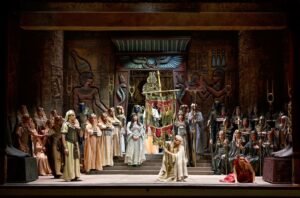
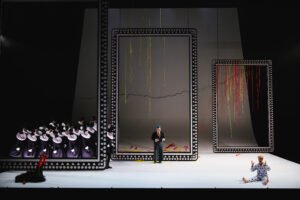
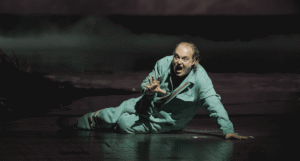
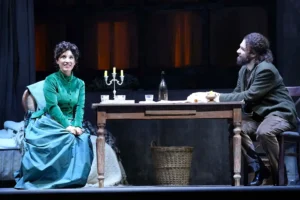
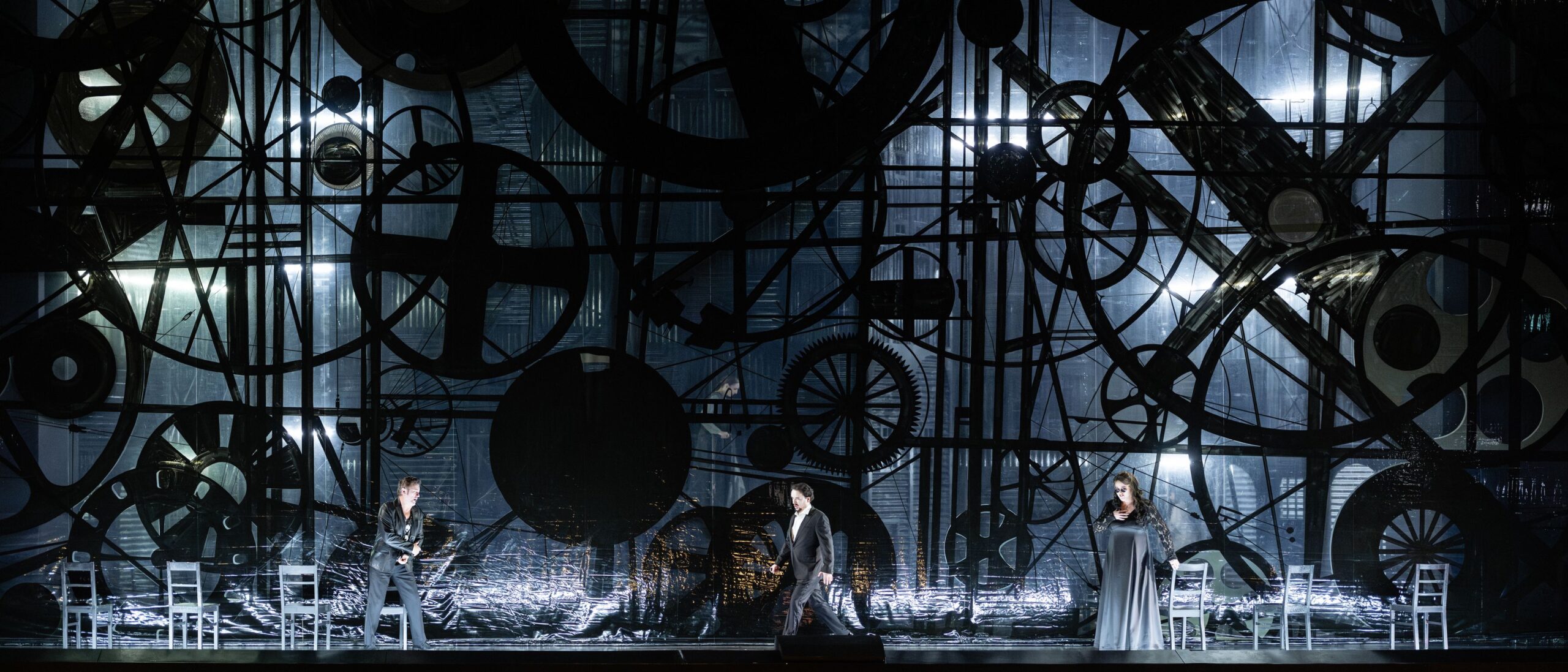
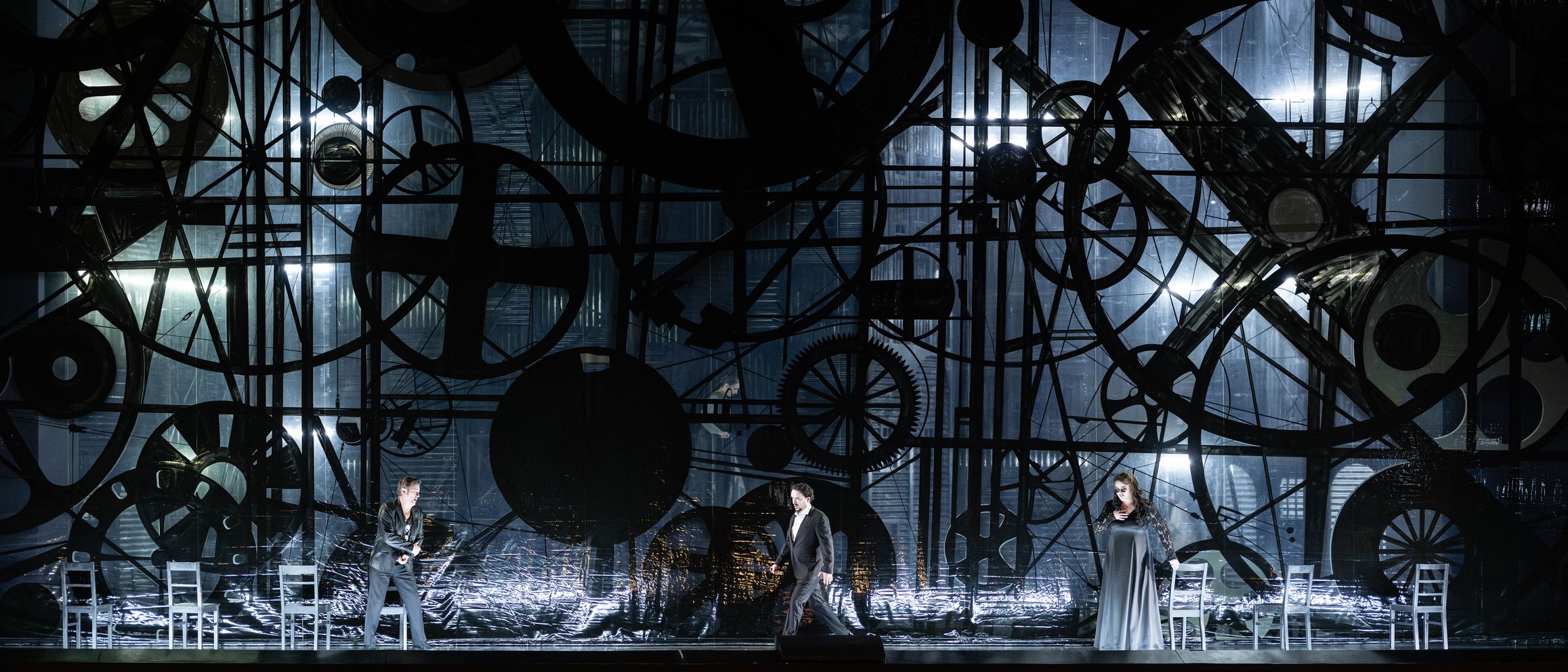
That settled compact is what made the evening cohere. Py’s staging, with Pierre-André Weitz’s by-now-familiar industrial scaffolding and metallic-black surfaces, has been criticised in earlier revivals for over-active stagehand traffic and a literal reading of every shadow in the libretto; on this hearing, more than a decade after the Festspiel premiere, it has settled into the kind of dark machine that no longer asks to be liked. The naked figure of Azucena’s burning mother haunts the sidelines as before; the soldiers’ chorus is rendered as war tableau; the final tower room narrows toward the back of the stage with a claustrophobic rightness that the closing scena absolutely requires. What the production does, and what few stagings of this work do, is take the libretto’s unhinged sequence seriously as an unhinged sequence, rather than trying to rationalise it into psychological theatre. The paradox between Cammarano’s incoherence and Verdi’s lyrical mastery is not papered over. It is dramatised.
It then fell to four singers to vindicate the second half of that paradox, and this they did. Rachel Willis-Sørensen’s Leonora was the anchor of the evening: a dramatic-lyric instrument deployed with full command at every register, paired with the kind of stage authority that simply takes possession of the role. “Tacea la notte placida” opened the part on a long, even cantilena, with a top that bloomed without forcing; the fourth-act “D’amor sull’ali rosee” and the Miserere sequence were sung with the inwardness that the aria needs and the projected line that the orchestral surroundings demand. She owned the part, vocally and theatrically, from the first phrase to the death scene.
Artur Ruciński’s Conte di Luna was a textbook reminder of why a true Italianate lyric baritone matters in this music. The voice — Polish, elegant, evenly produced from bottom to top — found exactly the right curve in “Il balen del suo sorriso”, that long, treacherous Act II cantilena which exposes any baritone whose legato is anything less than schooled. Ruciński sang it as a bel canto aria, as it ought to be sung: not barked, not shoved, but spun on a long breath, with messa di voce on the cadential phrases and a top F that floated rather than stuck. A sublime moment, and one of those reminders that the di Luna is, before he is anything else, a lyric baritone role.
Piotr Beczała’s Manrico described a curious arc. The opening “Deserto sulla terra” and the Pira-bound third act were carefully drawn rather than incandescent; from the “Ah! sì, ben mio” onward, however, what one heard was a complete artist working at full intelligence and full voice — phrases shaped, line sustained, squillo unforced, every word weighted. The fourth-act “Ah! che la morte ognora” in the prison scene, sung with Willis-Sørensen at her most communicative, was the sort of duet this piece is often promised and rarely receives. Beczała remains one of the few tenors alive who can deliver Trovatore without sounding either stretched or compromised, and the second half was the demonstration. What an artist.
Judit Kutasi’s Azucena gave both of her great moments the weight they ask for. “Stride la vampa” was sung with the slightly acid Hungarian middle one wants for the haunted gypsy, and the long narration “Condotta ell’era in ceppi” was managed in a single dramatic span, with the chest extension under control and the registers blended rather than welded. There was no hectoring, no ugly mezzo forte shouting — only a performance of the role as Verdi wrote it, with both arias landing as the structural pillars they are meant to be.
The supporting cast acquitted itself with the expected Munich professionalism, but the night’s real news was below the line. With Granit Musliu indisposed, Samuel Stopford stepped into Ruiz from a music stand at the side of the proscenium — an unrehearsed role debut prepared, by all accounts, that very afternoon. The music is short, but it sits exposed; that the company’s emergency cover sang it in tune, in tempo, and in style at zero notice was the kind of in-house craft for which one keeps applauding repertoire houses long after the festival hype has moved on.
And in the pit, Andrea Battistoni. The young Italian is fast becoming what one suspects he was always destined to be: one of the great Verdi conductors of his generation. The fire of his earliest years is increasingly governed, the dynamic and timbral imagination ever more fully released, and every scene of the evening arrived with a colour and an idea of its own. The Anvil Chorus, held just on the right side of theatricality; the Miserere bell-strokes placed with absolute precision; the orchestral introduction to “Il balen del suo sorriso” shaped to give Ruciński the cradle his cantilena required: each was a small interpretative argument in itself. The fourth act was the demonstration. Trovatore in this conductor’s hands does not merely accelerate toward the prison scene; it thinks its way there, gathering colour and dread, and by the time Beczała and Willis-Sørensen arrived at “Ai nostri monti” it had become genuinely difficult to stay still in one’s seat. The Bayerisches Staatsorchester played for him with the focused commitment of an ensemble that knows when something matters. What love of this music. What talent.
One does not “solve” Trovatore. One either has the singers for it, or one does not. On this evening, in Munich, four of the greatest singers in the world were present — and the conductor was very nearly one of them.
***
DISTRIBUTION
- Manrico — Piotr Beczała
- Leonora — Rachel Willis-Sørensen
- Conte di Luna — Artur Ruciński
- Azucena — Judit Kutasi
- Ferrando — Alexander Köpeczi
- Ines — Elene Gvritishvili
- Ruiz — Samuel Stopford (replacing the indisposed Granit Musliu, from a music stand at the side of the stage)
PRODUCTION
- Conductor — Andrea Battistoni
- Director — Olivier Py
- Sets and costumes — Pierre-André Weitz
- Orchestra — Bayerisches Staatsorchester
- Chorus — Chor der Bayerischen Staatsoper
About the Author