MACBETH | Teatro Carlo Felice di Genova
The first of three operas written by Giuseppe Verdi, based on Shakespeare’s plays, returns to Genoa, in a musically successful and scenically more contradictory production. The opera was composed in 1847 for Florence and extensively revised in 1865 for Paris to adapt it to French tastes, with the addition of dance numbers, a grand aria for the Lady, and a triumphant orchestral finale in place of Macbeth’s sung death; this Paris variant is most of times performed in theaters.
The Carlo Felice also chooses this 1865 version in a new critical edition by David Lawton, (University of Chicago Press and Ricordi), including the dance number of the Ondines and Sylphs in Act III. Beyond the philological aspects, the main innovation in the Paris version is that the opera’s protagonist is no longer Macbeth but the Lady, driven as in Shakespeare by unbridled ambition and a thirst for power. Verdi creates one of his most psychologically complex and vocally challenging characters. He famously wrote a letter to Salvatore Cammarano, advising against hiring the singer Eugenia Tadolini: “Tadolini has a wonderful voice, clear, limpid, powerful; and I would like a harsh, suffocated, dark voice in Lady.” A role made legendary also and above all by legendary interpretations in the second half of the twentieth century by singers such as Maria Callas, Leyla Gencer, Shirley Verrett who outlined a vocal and scenic interpretation that is a point of reference for all lovers of Italian melodrama.
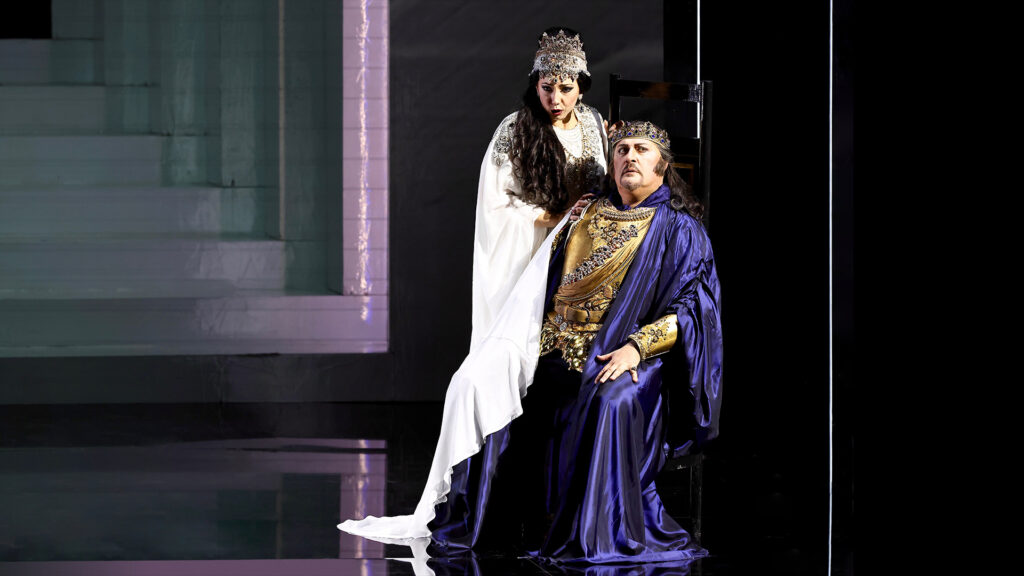
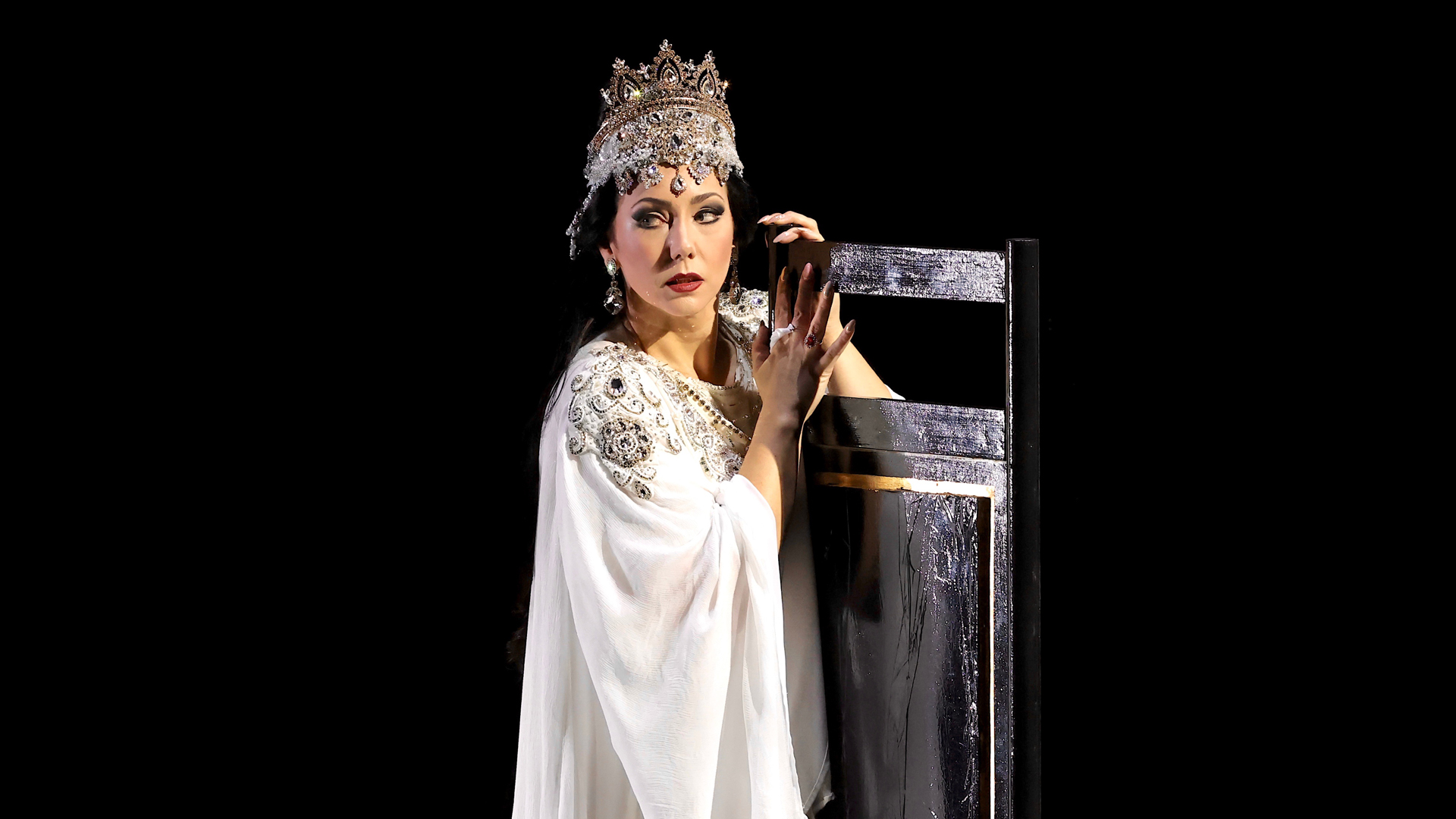
Soprano Jennifer Rowley, whom we had already appreciated as Minnie at the Teatro Regio in Turin, delivers a remarkable performance as Lady Macbeth, thanks to a harsh and penetrating timbre, a solid and sharp upper register, and a first-rate vocal technique, which comes directly from her teacher, the great and unforgettable Martina Arroyo. From the opening scene and cavatina “vieni! t’affretta,” Rowley stands out with her accent and phrasing, portraying a woman both power-hungry and demonic. The soprano’s ability to master the enormous technical difficulties of the allegro maestoso “or tutti sorgete” deserves full praise, with the ease and bel canto precision with which she masters the formidable sixteenth-note quatrains and the numerous high Bs. The aria “la luce langue” was also very good, but it would require a darker color and a more powerful low register, even if Rowley must be given credit for not artificially inflating and darkening the low sounds. Even the most awaited sleepwalking scene, sung with dark, hallucinatory phrasing and concluding with a confident and perfectly tuned high D flat, does not disappoint expectations.
Georgian baritone George Gagnidze is a veteran of the role of Macbeth, a character he has performed at the most important theaters; his voice is always authoritative and full-bodied, ideal for Verdi’s characters; his Macbeth is tormented from the very beginning, dominated by his wife’s ambition, which Gagnidze characterizes not with bel canto but with restless, broken phrasing. The famous aria from Act IV, “Pietà, rispetto, amore,” is sung with great participation, respecting the many dynamics prescribed by Verdi, and full, expressive high Fs, in keeping with the finest performing tradition.
Abramo Rosalen is a formidable Banco, with enormous sonic power and a true basso profondo voice; his timbre contrast and his interaction with Macbeth in the witches’ scene are very effective, and his vocal and stage performance in the great scene “Come dal ciel precipita” is excellent.
Vasyl Solodkyy offers a gorgeous lyric tenor voice to the character of Macduff, and delivers a fine performance of the splendid famous aria “Ah, la paterna mano,” elegantly phrased, with the A-flat and B-flat resolved with ease and excellent technique.
Leonardo Cortellazzi‘s Malcolm is a true luxury, phrasing beautifully in the Birnam Wood scene and emerging with brilliance and vigor in the opera’s grand concertati and in the final victory scene.
Sesto Quatrini‘s conducting stands out for its orchestral clarity and respect for dramatic timing, with a striking use of strettos at the end of the Lady’s cabaletta and the concertati. The balance with the stage is consistently maintained, both in the most dramatic moments and in the intimate, almost spectral moments of the protagonists. The solo interventions of the clarinet and cor anglais in the sleepwalking scene are exemplary in this regard. It’s noteworthy how Quatrini confidently and perfectly managed Rowley’s failed attack in “La Luce Langue.” The Carlo Felice orchestra continues to be in splendid form, and the Chorus appears markedly improved, especially the women’s sections. The performance of “Patria Oppressa” was particularly evocative for its dynamics and perfect “tinta Verdiana” and received the warmest applause of the evening.
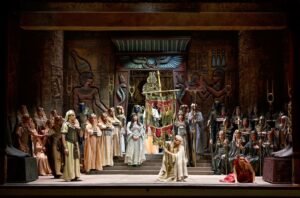
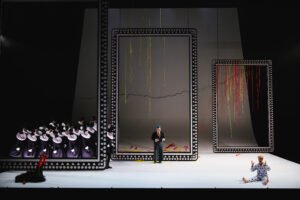
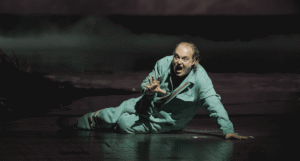
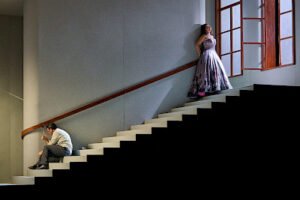
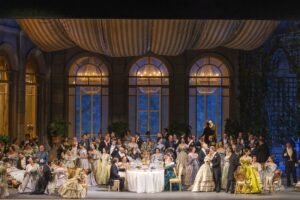
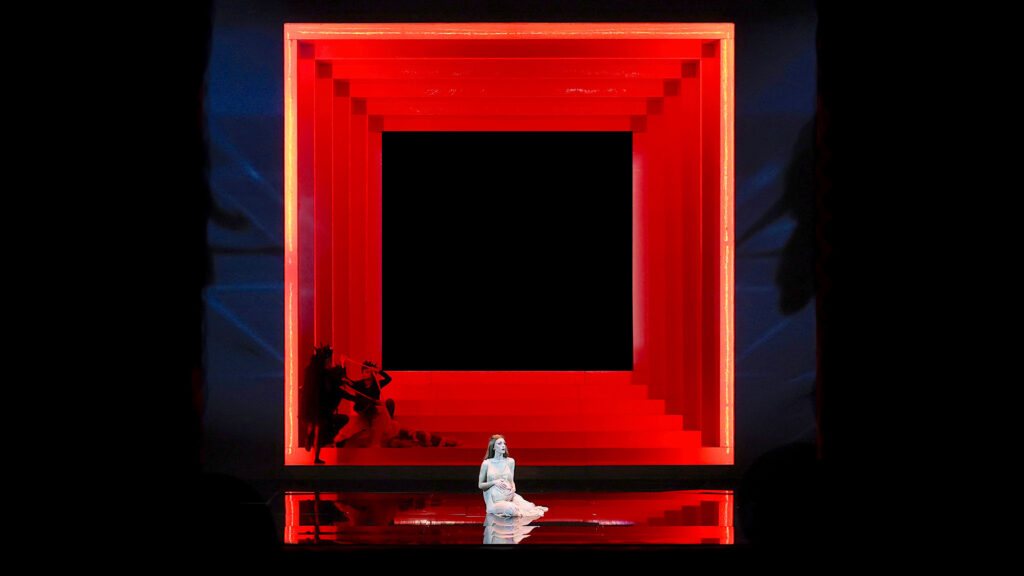
Fabio Cerasa‘s staging began with good intentions, but the show never quite took off, focusing much more on its underlying “fil rouge” than on Verdi’s musical and dramatic intentions. Cerasa interprets Macbeth as a Greek tragedy, a conflict between free will and the inevitability of fate. Hence the witches, like the Parcae, weaving the thread of fate, which then becomes the same red thread that binds all the crimes and imprisons the protagonists. Two scenic spaces, the human one at the forefront and the superhuman one at the back, with prophecies and ghostly apparitions, that are connected only by rectangular frames. Some moments are successful, such as Banquo’s death, others are less so, such as when Lady Macbeth throws coins from her chalice to the crowd during the brindisi. Despite the excellent stage presence of the protagonists and the beautiful, brightly colored costumes, the show suffers from the prevalence of intellectual concept over music, while still respecting Shakespeare’s dramaturgy, with the exception of the finale in which Macbeth kills himself with Macduff’s drawn sword.
The audience, not very large on a hot Sunday in May, enthusiastically applauded all the protagonists.
***********************************************
CAST
Macbeth: George Gagnidze
Banco: Abramo Rosalen
Lady Macbeth: Jennifer Rowley
Lady Macbeth’s Maid: Kamelia Kader
Macduff: Vasyl Solodkvy
Malcolm: Leonardo Cortellazzi
Doctor/Assassin: Luciano Leoni
Domestico di Macbeth: Tiziano Tassi
Herald: Loris Purpura
–
Conductor: Sesto Quatrini
Director: Fabio Ceresa
Scenes: Tiziano Santi
Costumes: Giuseppe Palella
Lighting: Cristian Zucaro
Choreographer and assistant director: Mattia Agatiello
Choir Director: Claudio Marino Moretti
Children’s Choir Director: Gino Tanasini
Stage assistant: Mariam Zamiri
Costume assistant: Elisa Cobello
About the Author