GÖTTERDÄMMERUNG | Bayreuther Festspiele
Between the uprisings of 1849 and the apotheosis of 1875 lies the genesis of the Tetralogy. Wagner did not conceive music and text simultaneously: he first composed the poem, proceeding through preliminary sketches, as though crafting a drama intended to be performed without music. He then began the musical score and finished with the orchestration. This tripartite technique is curiously compartmentalised in a man who was, ultimately, the sole architect of the whole. It is further complicated by the fact that, in the Tetralogy, the dramas were conceived in reverse order. Beginning with The Death of Siegfried, he felt compelled to trace the youth of his hero, then to move backwards through the chain of events that had created this hero for his mission. Reaching, step by step, the origins of the Wälsungen, Siegfried’s lineage, recounting how he was conceived and how his parents loved one another, Wagner retreats all the way to Wotan and to the beginning of the entire story: the theft of the gold, the conflicts of power and love. The third and final day of The Ring of the Nibelung, Götterdämmerung, premiered on 17 August 1876, closes a Tetralogy whose gestation spans more than a quarter of a century (poem completed in 1852, score in 1874) and therefore bears the imprint of this backwards genesis: it is the only part to retain the form of a grand opera in three acts with chorus, whereas the preceding works break radically away from it.
And it was in this form that it was heard on Saturday, 1 August.
The music of Götterdämmerung unfolds between two extremes of compositional technique: the symphonic interweaving of motifs and the “closed” form of opera. The elasticity of Christian Thielemann’s conducting is capable of reconciling these extremes, forging a connection that captivates and keeps listeners in suspense. The network of Leitmotive (and in this opera all the Leitmotive of the Tetralogy are gathered) unfolds densely, without ever becoming heavy, thus favouring a listening experience in which one abandons oneself to the magic of associations. Over nearly six hours of performance, one hears from the pit a full Wagnerian orchestra (Wagner tubas, harps, cor anglais), with, in addition, a large chorus (the only choral appearance in the entire cycle), and one yields to it with delight, so seductive is what one hears. At the same time, such beauty demands of the listener a certain awareness of the syntactic and formal structure underlying the succession and interlinking of motifs: the articulation of the ewige Melodie and the certainty that moments in which this synergy operates so naturally are rare.
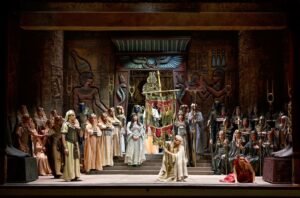
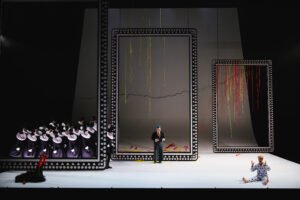
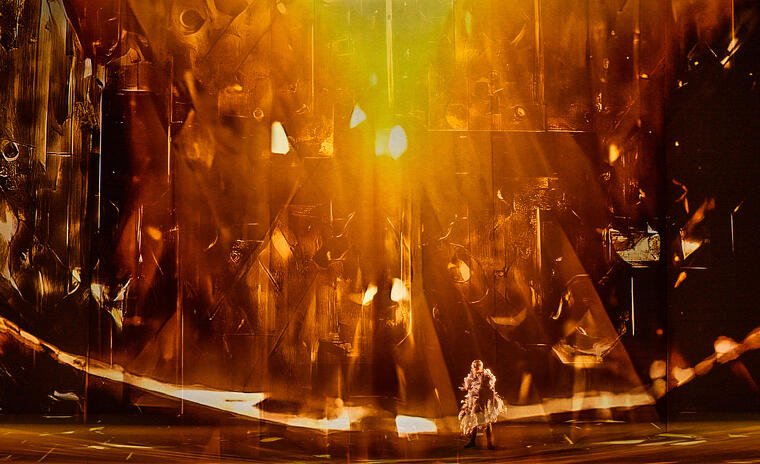
As for the staging, we shall not dwell on criticisms already formulated by colleagues who have elaborated at length on the limits of integrating Artificial Intelligence into a task that is, by definition, human. We shall limit ourselves here to expressing the following wish: that this experiment serve as a reflection leading to a more accomplished and convincing way of associating the unimaginable resources AI can offer with the creativity and inventiveness required by any operatic performance – work that cannot be delegated to an algorithm, however robust it may be.
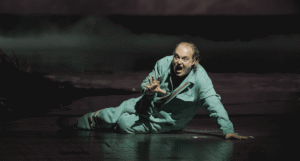
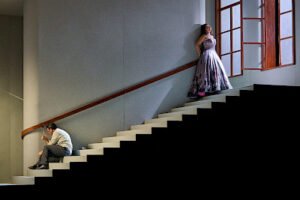
This opera marks a radical shift from those that precede it: myth gives way to tragedy. The world of the Gibichungen (a feudal court governed by honour, marriage of convenience, and intrigue), with Gunther (in a highly elegant interpretation by Michael Kupfer‑Radecky, convincingly restoring the character’s complex psychological profile, oscillating between weakness and indecision on a constant instability, from cowardice to humiliation via remorse) and Gutrune (Magdalena Hinterdobler, an ingenuous yet firmly asserted voice), introduces an almost Ibsen‑like modernity into the mythological cycle. Hagen (embodied by Mika Kares who, despite exceptional darkness of timbre, never loses the lyricism that makes his performance as interesting as it is refined), the darkest character in the entire Wagnerian corpus, belongs to this world too, and incarnates the cold calculation inherited from Alberich (Jochen Schmeckenbecher), while Siegfried (Klaus Florian Vogt), victim of forgetfulness and retaining his radiant voice, loses his heroic freedom without ever realising it. He does not attempt what he cannot do: throughout the opera he preserves the heroism already evident in the eponymous work, illuminating his valiant innocence and maintaining it even when, disguised as Gunther through the Tarnhelm, he must conquer Brünnhilde. There is no true vocal theatricalisation suggesting another timbre without departing from his own voice, and one can do without it: the intelligibility of the text and the orchestra’s participation in the narrative suffice entirely. The declamatory climax at the moment of his agony in Act III (Brünnhilde! Heilige Braut!) is superb, with exemplary expressive intensity.
If we had not necessarily found Erda to be the role that suited her best, Christa Mayer is impeccable as Waltraute. Her Höre mit Sinn is of striking beauty, where the mezzo displays a broad legato, a dark and anxious colour combined with a projection of great authority. The role is brief, but her performance leaves a far stronger and more conclusive impression than her Erda in Rheingold and Siegfried.
Finally, it would not be excessive to say that the final day belongs to Brünnhilde – or to Camilla Nylund. In the most demanding part of the entire cycle, the Finnish soprano shows that, beyond unfailing endurance, her voice is capable of evolving radically from act to act while maintaining true homogeneity. From the radiant lyricism and warmly projected in the Prologue to the public denunciation requiring an almost hysterical declamation, she 20 twenty minutes of monologue!) is of staggering beauty, with absolute breath control, an extraordinary ability to sustain immense phrases over an orchestra at full force, all without a single scream. It is true artistic work – mastery, control, highly developed technique – delivered with dignity and elegance.
If opera is the most sophisticated musical form conceived by the West, Richard Wagner’s Tetralogy appears as its realisation, if not the most astonishing, at least the most ambitious. Like La Comédie humaine in the realm of the novel or the Sistine Chapel in painting, this set of four operas constitutes a complete and self‑sufficient world. The Tetralogy describes the end of myth and the metamorphosis towards a humanity both sensitive and perfectible; it stages more than 30 characters and lasts over 15 hours. To write it (text and music) Wagner took 26 years, and to realise his great work he needed a place apart, built on the heights of Bayreuth with the support of Ludwig II of Bavaria. Is there excess in this project led by a brilliant megalomaniac? There is no doubt. Has its history been tainted by demagogic distortions? We all know it. But beyond constituting a human fresco, almost metaphysical in many respects, Wagner built a work that no longer belongs solely to its era – with Beethovenian escapes beyond tonality, closed forms, instrumental and vocal limits. The Tetralogy is above all an experience of originality without equal in the history of lyric art, conceived through an art as innovative in its time as it remains today, a source of inspiration and emotion for opera lovers.
******************************
GÖTTERDÄMMERUNG (WWV 86D)
Oper von Richard Wagner
Uraufführung: 17. August 1876 im Bayreuther Festspielhaus
Musikalische Leitung・Christian Thielemann | Kurator・Marcus Lobbes | Künstlerisch-technische Konzeption・Marcus Lobbes und Nils Corte | Dramaturgie・Andri Hardmeier | Digital- und KI-Storytelling・Roman Senkl | Creative Code and Visual Art・Nils Corte und Phil Hagen Jungschlaeger | Bühne・Wolf Gutjahr | Kostüm・Pia Maria Mackert
Siegfried・Klaus Florian Vogt | Gunther・Michael Kupfer-Radecky | Alberich・Jochen Schmeckenbecher | Hagen・Mika Kares | Brünnhilde・Camilla Nylund | Gutrune・Magdalena Hinterdobler | Waltraute・Christa Mayer | 1. Norn・Anna Kissjudit | 2. Norn・Alexandra Ionis | 3. Norn・Magdalena Hinterdobler | Woglinde・Katharina Konradi | Wellgunde・Natalia Skrycka | Floßhilde・Marie Henriette Reinhold・Cover photo credits: ©Bayreuther Festspiele
(For further informations) Link to the Bayreuther Festspiele: Götterdämmerung
About the Author