DIE ZAUBERFLÖTE | Festival Aix en Provence
Staging Mozart’s The Magic Flute is always a complex exercise. The masterpiece already contains an enormous amount of subtext and more or less hidden messages, making it difficult to bring fresh breath to it. And yet it’s with many interesting questions that one leaves this Aix production, staged by Clément Cogitore.
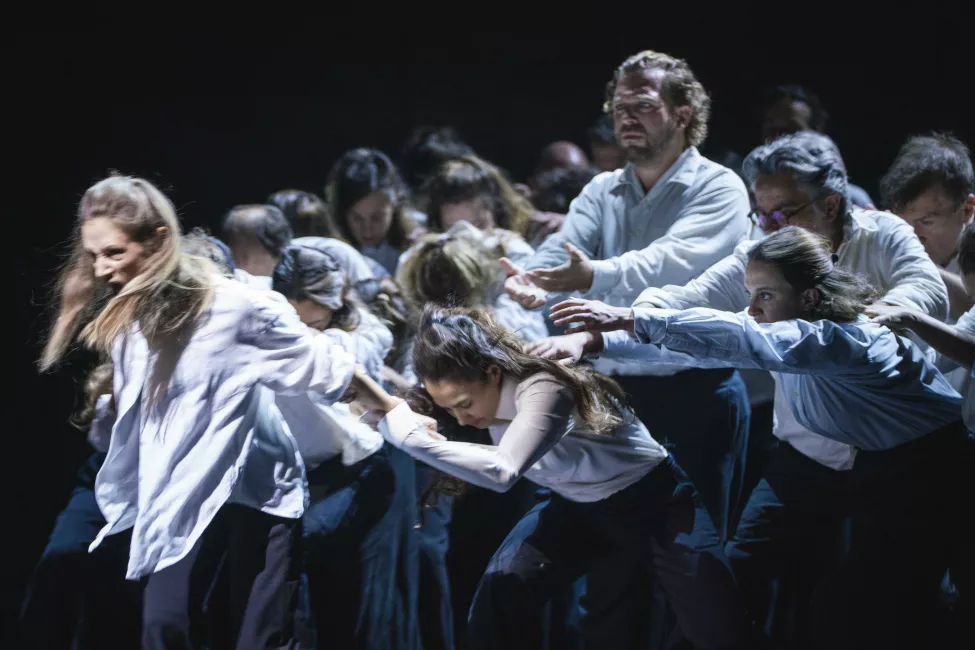
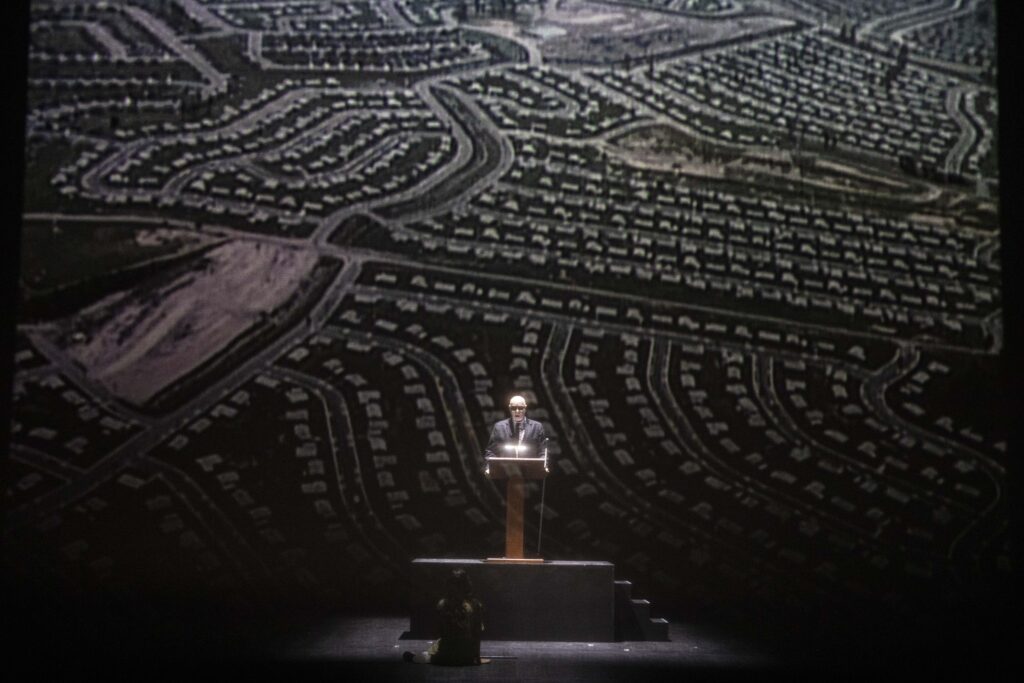
The action is here transposed to the aftermath of World War II and carries us through to the 1960s. We follow Tamino’s initiatory journey through the reconstruction of a continent destroyed by war. Sarastro appears here as an American political leader who proposes his model of an idealized humanity : the American way of life, so to speak. Whereas in Mozart’s original fable we come to understand that Sarastro may not be the true villain of the story, here the message is reversed. Sarastro’s second aria perfectly illustrates the complexity and ambivalence of this American model, judiciously overlaying images of the struggle against racial segregation in the United States with the leader’s words full of humanity. It is therefore a stimulating reading, running counter to classical interpretations, that the French director offers us here.
The stage design, composed mainly of descending shutters allowing for the projection of videos and archival images, works remarkably well in an era when video is unfortunately often used only as a gimmick. Here, it is the very heart of the staging, yet it is integrated with intelligence and never irritates the viewer.
Not everything is perfect, however: too great a number of ideas ultimately risks losing the viewer and potentially dilutes the message being proposed. The experimental section with laboratory guinea pigs, or the Queen of the Night’s relationship with the children, are among the elements that can blur the reading. The magical dimension of the story also integrates only with difficulty into this reinterpretation. The colors, moreover, remain dark throughout the show, and while one understands the potentially bleak message of this reading, it perhaps creates a lack of contrast on stage.
The direction of the actors, particularly that of the children and then the teenagers, is on the other hand quite remarkable.
It is a world in shades of grey, not enchanted at all, that one also finds in Leonardo García Alarcón‘s approach at the head of the Cappella Mediterranea : a stance far from our usual habits of perfect harmony and limpid, clear sound found in most productions of The Magic Flute. Here, the darkness of the work, as this staging intends it, is also pertinently found at the podium.
The vocal lineup displays a very fine homogeneity.
The Three Ladies, Alix Le Saux, Ashley Dixon and Adriana Bignagni Lesca, deliver their spoken and sung parts with brilliance.
Emma Fekete‘s Papagena is convincing as an old woman, while Rodolphe Briand‘s policeman Monostatos succeeds brilliantly in this role, one so complex to stage today.
It is always a pleasure to see Edwin Crossley-Mercer again, and one always regrets that his role isn’t longer.
Brindley Sherratt‘s blind Sarastro fits perfectly with this staging and brings the ambiguity his character needs.
Much appreciated as Billy Budd a few months ago in Lyon, Sean Michael Plumb is a very fine Papageno: secure low notes, a joyful timbre and finely chiseled diction make for a fine success.
Sabine Devieilhe needs no introduction as Queen of the Night. Here one appreciates the nuances she brings to her two arias: far from displays of vocal force and technique, it is the characterization of the role that takes precedence. The high notes, of course, are delivered without any difficulty.
A regular in the role, Mauro Peter delivers a magnificent Tamino. Despite a staging that confines him to the background during the first act, he manages to convey the full range of emotions the young prince goes through.
He forms a very successful pairing with Ying Fang. The latter is a Pamina of the highest order: to her magnificent timbre is added a remarkable intelligence of singing. She is one of the great satisfactions of the evening.
One leaves this performance wanting to see it again later, to better appreciate it as a whole. It is a reading that, though it may seem divisive, keeps alive our questioning of a work that never ceases to fascinate us. Divisive too, perhaps, is the musical direction, which likewise brings new energy and color to Mozart’s masterpiece. The very fine vocal cast, however, will satisfy every enthusiast.
Direction musicale : Leonardo García-Alarcón
Mise en scène et vidéo: Clément Cogitore
Scénographie: Alban Ho Van
CostumesWojciech Dziedzic
Lumière : Sylvain Verdet
Chorégraphie : Evelin Facchini
Dramaturgie : Simon Hatab
Assistant à la direction musicale : Kyrian Friedenberg
Assistant à la direction musicale, chef de chant, répétiteur de langue : Xavier Dami
Chef de chant : David Zobel
Répétitrice de langue :Karola Pavone
Collaboratrice artistique à la mise en scène : Dagmar Pischel
Assistante à la direction des jeunes acteurs : Catherine Umbdenstock
Assistant à la mise en scène : Loïck Massonnaud
Assistante aux décors : Léa Tilliet
Assistante aux costumes : Nathalie Pallandre
Assistante à la chorégraphie : Sabrina Rocha
Assistant vidéo : Nicolas Hurtevent
Pamina : Ying Fang*
Tamino : Mauro Peter
Königin der Nach : tSabine Devieilhe*
Papageno: Sean Michael Plumb*
Sarastro: Brindley Sherratt
Sprecher :Edwin Crossley-Mercer*
Erste Dame : Alix Le Saux
Zweite Dame : Ashley Dixon
Dritte Dame : Adriana Bignagni Lesca
Papagena :Emma Fekete
Monostatos :Rodolphe Briand
Erster Priester, Zweiter geharnischter Mann :Damien Pass*
Zweiter Priester, Erster geharnischter Mann :Jonghyun Park*
Drei Knaben :Membres du Knabenchor der Chorakademie Dortmund
Chef de choeur du Chorakademie Dortmund : Dietrich Bednarz
Comédiennes et comédiens :Julian Mahnke ou Yvon Moltzen (Tamino enfant), Jakob Wasmuth ou Jakob Geppert (Tamino adolescent), Lana Kröger ou Cléo Lou Straka (Pamina enfant), Maartje Barendregt ou Zoé Höche (Pamina adolescente)
Figurantes et figurants : Siméon Baudet, Madeleine Bort, Ferdinand Esnault, Alessia Fortier, Emma Merkt, Achille Morin, Romane Poilpre Garabedian, Federico Vazzola
Chœur: Chœur de Chambre de Namur
Chef de chœur: Thibaut Lenaerts
Orchestre : Cappella Mediterranea
*Anciennes et anciens artistes de l’Académie
About the Author