AIDA | Teatro San Carlo
A concert-format Aida at Teatro di San Carlo in Naples proved a triumphant success, drawing audiences from across Europe and bringing together an exceptional cast of leading international singers. With Anna Netrebko and Jonas Kaufmann at its centre, the performance offered a remarkable showcase of Verdi’s masterpiece, crowned by Netrebko’s extraordinary “O patria mia” and Riccardo Frizza’s energetic musical direction.
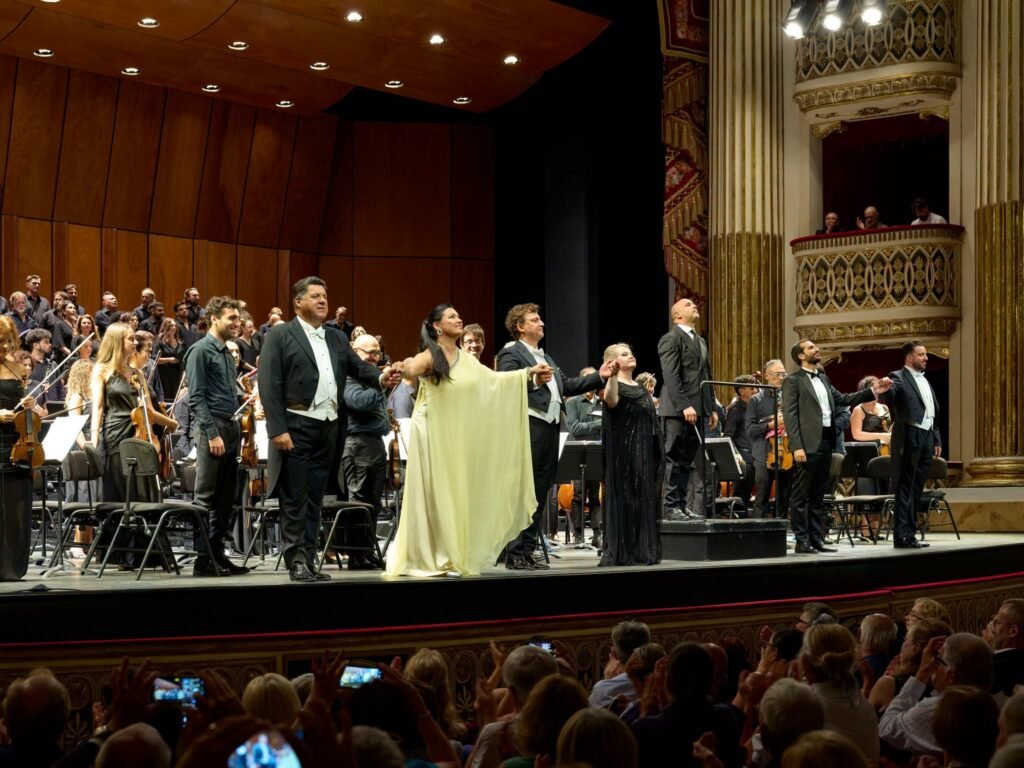
The concert-format performance of Aida at the Teatro San Carlo in Naples was a truly exceptional event. Audiences flocking from all over Europe ensured a triumphal success, that eclipsed even Radamès’ return to Thebes as the acclaimed hero of the Egyptian people and authorities. Credit goes first and foremost to an extraordinary vocal cast, showcasing the very best of today’s international opera scene. Among the leads were singers who represent the absolute gold standard, at least regarding the performance history of Verdi’s masterpiece in this first quarter of the century.
The choice of a concert performance, proved to be a winning formula, as has often been the case at San Carlo. This setup beautifully highlighted the scenic charisma of the protagonists, who moved across the stage to maximize the work’s inherent dramaturgy. Frankly speaking, no one missed the horses and elephants of Arena di Verona memory, and even less so the recent stagings of Aida (such as those by Michieletto and Carsen) set in a destroyed school in Gaza.
[…] Netrebko achieved a true miracle, with a “dolce” high C attacked softly, reinforced, and finally diminished into a sound that seemed endless: a pure magic that would surely have delighted Giuseppe Verdi himself.
Aida has become a signature role for Anna Netrebko, thanks to the sumptuousness of her vocal timbre, her absolute technical mastery of the upper-middle register, and a phenomenal use of pianissimi. The latter, always perfectly supported by her breath control, floated effortlessly, filling the auditorium to the very back of the gallery. Her sheer vocal power during the most agitated moments easily pierced through the wall of the orchestra and chorus (which features three distinct groups in Act II). Interpretively, Netrebko crafts a regal, never submissive Aida, who fiercely clashes with Amneris and accepts her father Amonasro’s demands out of political necessity rather than resignation. Looking stunning in two Eastern-styled gowns – cream yellow in the first two acts and grayish-blue in the final two – she moved with a feline sensuality, reaching the peak of dramatic tension in her Act III duet with the equally charismatic Luca Salsi. From a strictly vocal standpoint, the soprano played her best cards right from her first entrance, delivering a Ritorna vincitor! of remarkable vocal power, a velvety upper register, and a Numi, pietà shaped into a pianissimo of a thousand nuances, never sounding plaintive. While her vocal weight was fully appreciated in Act II, it was in Act III that Anna Netrebko reached the absolute pinnacle of her artistry. Her rendition of O patria mia was flawless, both emotionally and technically. This particular aria strikes terror into the hearts of even the most famous sopranos, especially due to the notorious ascent to the high C: a sustained arch that rises from a middle E-flat in pianissimo, swells slightly into a crescendo up to the C (marked “dolce” by Verdi), and then descends without rushing to the lower notes of the staff. Few singers manage to execute this entire phrase in a single breath (one recalls Caballé and Ricciarelli on record, with Muti and Abbado, respectively) but Netrebko achieved a true miracle, with a “dolce” high C attacked softly, reinforced, and finally diminished into a sound that seemed endless: a pure magic that would surely have delighted Giuseppe Verdi himself.
Jonas Kaufmann is a historic interpreter of Radamès, as documented by his splendid studio recording under Antonio Pappano. The Bavarian tenor appeared at San Carlo in excellent vocal form following a period of vocal fatigue, tackling one of the most demanding tenor roles with the outstanding musicality and interpretive charisma that have always defined him. His Celeste Aida stood out for his meticulous adherence to Verdi’s dynamic markings; in Naples, too, he sealed the aria with a high B-flat that beautifully navigated the three different pianissimi written in the score (first with four, then three, and finally two “p”s). Even the most vocally heavy and dramatic moments, such as Sacerdote, io resto a te at the end of Act III and the Act IV duet with Amneris, were delivered with ringing, well-projected high notes. The tenor remains a consummate master of stage presence, portraying a Radamès who is not a boasting warrior, but rather a fragile man crushed by duty and guilt over his love for the Ethiopian slave. In this light, the magnetic and sensual chemistry on stage with Netrebko was palpable.
Elizabeth DeShong made her debut as Amneris on the very stage where she impressed last year as Ulrica. A true mezzo-soprano voice, the American singer displayed a beautiful color in her middle register and rich lower notes delivered via a highly evocative, never forced chest register. Her ascent into the upper range, executed with great consistency of emission, revealed a striking dramatic instinct. Consequently, her confrontation with Radamès and the priests in Act IV was vigorous and vocally potent. As the only singer who used a score on stage, she proved with this excellent debut that she has all the tools required to fully mature into the character and establish herself as a formidable interpreter of the Egyptian princess.
Luca Salsi is a reference Amonasro, bringing not only vocal power but an authentic Verdian phrasing that digs deep into the text and dramatic accents. Salsi was exemplary both in the nobility of the captive king in Act II and in the ruthless, manipulative fury of Act III, where he found profound synergy with Netrebko, his long-time stage partner.
Alexander Köpeczi was a highly impressive Ramfis, boasting a beautiful, noble bass voice and a sculpted declamation well-suited to the solemn, hieratic nature of the Egyptian High Priest. In his performance, Köpeczi stood out for his vocal power without ever sacrificing softness and legato, proving to be one of the most interesting Verdian voices on the current scene. Andrea Pellegrini provided a secure and correct King, while Désirée Giove gave an excellent performance, effectively resolving the exotic and refined melismas of the Priestess on stage rather than off-stage. Tenor Sun Tianxuefei was precise as the Messenger, though his arioso would have benefited from a more incisive declamation and clearer diction.
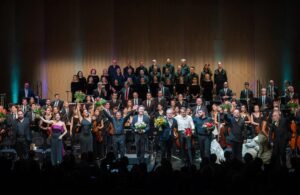
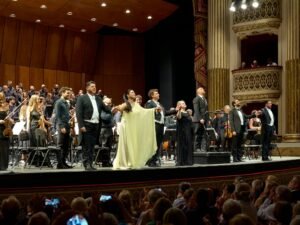
[…] The opera was received with immense enthusiasm by a packed house, yielding twenty minutes of rhythmic applause, stamping, and ovations for the entire cast.
Riccardo Frizza conducted a San Carlo Orchestra in top form. His reading was filled with tension and energy, showing great care in balancing the orchestral forces, the chorus, and the soloists. The Triumphal March and its subsequent scenes were particularly well coordinated, taken at crisp tempos with clear, powerful sonorities while maintaining musical cohesion. What felt missing in Frizza’s interpretation was the exoticism and sensuality embedded in the score, along with the sinuous rhythms of the dances and the nocturnal, erotic atmosphere that culminates at the beginning of Act III. Here, the decision to place the chorus on stage undermined Verdi’s intended effect, resulting in an overly exaggerated reading of O tu che sei d’Osiride that ended up sounding a sort of Va, pensiero.
The San Carlo Orchestra performed brilliantly across all sections, displaying a tight ensemble sound and the right amount of virtuosity in the solo passages. The Chorus, tackling one of the most complex and demanding scores in the repertoire, executed its numerous interventions with confidence and accuracy. The two chorus members reaching their final performance were justly celebrated; however, it remains evident that the ensemble is in need of new, younger voices, particularly within the female section, which at times sounded something dry and worn out.
As noted at the outset, the opera was received with immense enthusiasm by a packed house, yielding twenty minutes of rhythmic applause, stamping, and ovations for the entire cast. This overwhelming, unstoppable success stands as the crowning achievement of a five-year period that has projected San Carlo to the summit of the international opera world through some of the most exciting musical programming and casting in the lyric landscape. It was in this spirit that Anna Netrebko threw flowers to Ilias Tzempetonidis, the theater’s casting manager, who is concluding his time at theatre.
Unfortunately, the upcoming season presented by the new superintendent, Fulvio Macciardi, appears banal and predictable, doing little to encourage international audiences to make the journey to the most beautiful theater in the world.
______________________________
Aida
Giuseppe Verdi
Conductor | Riccardo Frizza
Master of the Chorus | Fabrizio Cassi
Aida | Anna Netrebko · Radamès | Jonas Kaufmann · Amneris | Elizabeth DeShong · Amonasro | Luca Salsi · Ramfis | Alexander Köpeczi · The King of Egypt | Andrea Pellegrini · The Messenger | Sun Tianxuefei · A Priestess | Désirée Giove
Orchestra and Chorus of Teatro di San Carlo
About the Author