SIMON RATTLE, ISABELLE FAUST and FREIBURGER BAROCKORCHESTER | Ravello Festival
At Ravello’s magical Villa Rufolo, Sir Simon Rattle and Isabelle Faust offered a rigorously historical reading of Schumann’s Violin Concerto and 2nd Symphony. Transparent and finely controlled, the performance illuminated Schumann’s troubled inner world, though Rattle’s restraint occasionally came at the expense of spontaneity and emotional urgency.
Ravello is a world-renowned clifftop town in Southern Italy, perched on a rocky spur overlooking the Amalfi Coast, offering breathtaking panoramic views of the famous coastline. For musicians and music lovers alike, Ravello is indissolubly linked to the name of Richard Wagner, who arrived here on muleback in 1880 alongside his wife, Cosima. Captivated by the gardens of Villa Rufolo – adorned with ancient trees, exotic flowers, and medieval ruins – the composer wrote in the guestbook of his hotel: “The magical garden of Klingsor is found.” This phrase, immortalized today on a commemorative plaque inside the Villa, stands as an everlasting testament to the inspiration behind the second act of Parsifal, the musician’s final monumental masterpiece.
The Ravello Festival – established in 1953 and now in its 74th edition in 2026 – celebrates this historic bond by promoting celebrated Wagnerian pages performed by world-class artists. The program also features composers and concerts that share ideal, historical, or geographical ties with the Leipzig master. The 2026 edition stands out for its eclectic repertoire – ranging from Götterdämmerung to Baroque music and even jazz – and an impressive lineup of world-renowned conductors, including sir John Eliot Gardiner, Kent Nagano, Jordi Savall, and Daniele Gatti.
The festival’s closing concert was entrusted to Sir Simon Rattle – chief conductor of the Berliner Philharmoniker from 2002 to 2018 – leading the Freiburger Barockorchester, with the acclaimed Isabelle Faust as violin soloist. The program was entirely dedicated to Robert Schumann, presenting two works that, despite their formal differences, were both conceived during one of the darkest periods of his life, a time tormented by depression, psychosis, and suicide attempts. Both pieces vividly chronicle the genesisof inner torment and a dramatic, desperate descent into madness.
The Violin Concerto in D minor suffered the same tragic fate as its creator. A radical and innovative work that rejects empty virtuosity and purely exhibitionist passages, it was hidden away by the composer’s wife, Clara Schumann, and his violinist friend, Joseph Joachim. They sought to conceal the signs of the composer’s mental decline and dementia, which they felt transpired from the music. Adventurously rediscovered, the concerto was not premiered until the 1930s, at which point it was exploited by Nazi propaganda, which was seeking a major German violin concerto to replace the banned masterpiece by Felix Mendelssohn due to his Jewish origins. Far better known is the Sinfonia N° 2, which by contrast can be interpreted as a triumph over madness: moving away from the darkness and anxiety of the opening movements, the work culminates in a luminous, cathartic C-major finale.
Faust consistently sought equilibrium and fusion with the orchestra, eschewing soloist self indulgence during turbulent moments and avoiding mere pyrotechnics in the more virtuosic passages.
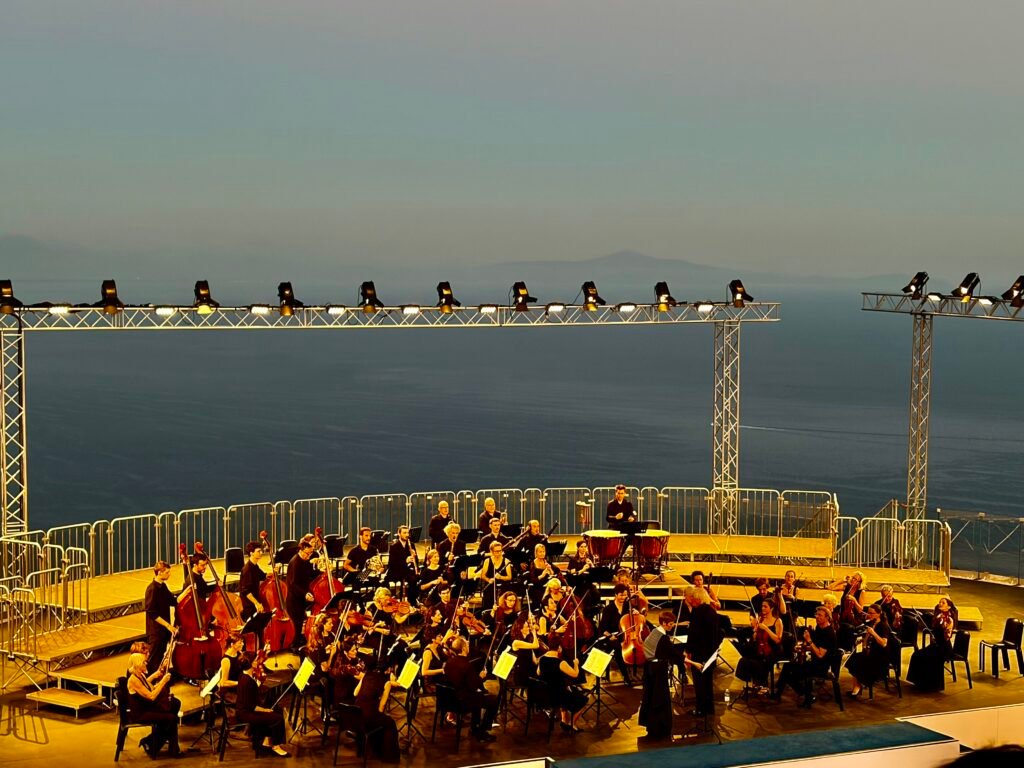
The performance took place at the spectacular Belvedere of Villa Rufolo, on an open-air stage suspended over the abyss at 350 meters above sea level. Here, the orchestra appears to float in the sky while the stunning Amalfi landscape blushes with sunset hues before twilight ignites the distant lightsof the coastal towns below. While the location is undeniably one of the most evocative in the world (Wagner docet), the performance inevitably suffered from the inherent limitations of open-air classical concerts. As Arturo Toscanini famously quipped, “All’aperto si gioca solo a bocce o si fa la guerra!“(“Outdoors, one only plays boules or goes to war!“). Beyond the acoustical compromises, off-stage noises drifting up from the towns below proved somewhat distracting.
Sir Simon Rattle adopted a highly cautious approach at the helm of an ensemble rooted in early music, which applies historically informed performance practice even to 19th-century repertoire. This choice yielded a crisp,transparent sonic texture that, however, occasionally felt dry and steril. Rattle’s technical prowess deserves high praise; he achieved an impeccable balance with the soloist, navigating a dense orchestral fabric and an instrumental writing that emphasizesthe violin’s lower strings to evoke a shadowy, almost suffocating timbre. The tempi strictly adhered to Schumann’s indication – Nicht zu schnellem Tempo – yet the musical discourse felt over-controlled and at times pedantic, failing to fully capture thescore’s underlying restlessness. Equally disorienting was the sluggish pacing of the Polacca in the 3rd movement, which stripped the dance of its nimble, joyful character, rendering it overly lugubrious.
German violinist Isabelle Faust is a champion of this concerto, performing it regularly across Europe’s premier concert halls. Her approach is strictly historical, and her performance was laudable precisely forher refusal to indulge in late-Romantic sentimentality. Faust consistently sought equilibrium and fusion with the orchestra, eschewing soloist self indulgence during turbulent moments and avoiding mere pyrotechnics in the more virtuosic passages.
In the Sinfonia N° 2, Rattle displayed rigorous attention to tempo and score markings, stripping the work of the heavy, late-Romantic varnish typical of other famous interpretations. The transparency of the orchestralfabric emerged forcefully, with prominence given to the woodwinds, allowing the melodic lines and solo interventions of the oboe and clarinet to sing out beautifully. The succession of the four movements was cohesive and compact (though unfortunately disruptedby premature audience applause), and the work’s emotional arc was masterfully traced. The Trios within the second movement assumed an almost chamber-like intimacy, while the final movement was not artificially bombastic but rightly radiant and Beethovenianin spirit.
The audience rewarded the performance with enthusiastic acclaim. The beauty and enchanted magic of this summer night allowed me, too, to find my very own “magical garden of Klingsor.“
___________________________________________________________
Robert Schumann
Concerto per violino e orchestra in Re minore WoO 1 (opera postuma)
- In kräftigem, nicht zu schnellem Tempo (Energico, ma non troppo veloce)
- Langsam (Adagio)
- Lebhaft, doch nicht schnell (Allegro, ma non troppo)
Robert Schumann
Sinfonia N° 2 in Do maggiore op. 61
- Sostenuto assai. Allegro ma non troppo
- Scherzo: Allegro vivace
- Adagio espressivo
- Allegro molto vivace
About the Author