Jon Vickers at One Hundred: The Voice, the Man and the Imagination
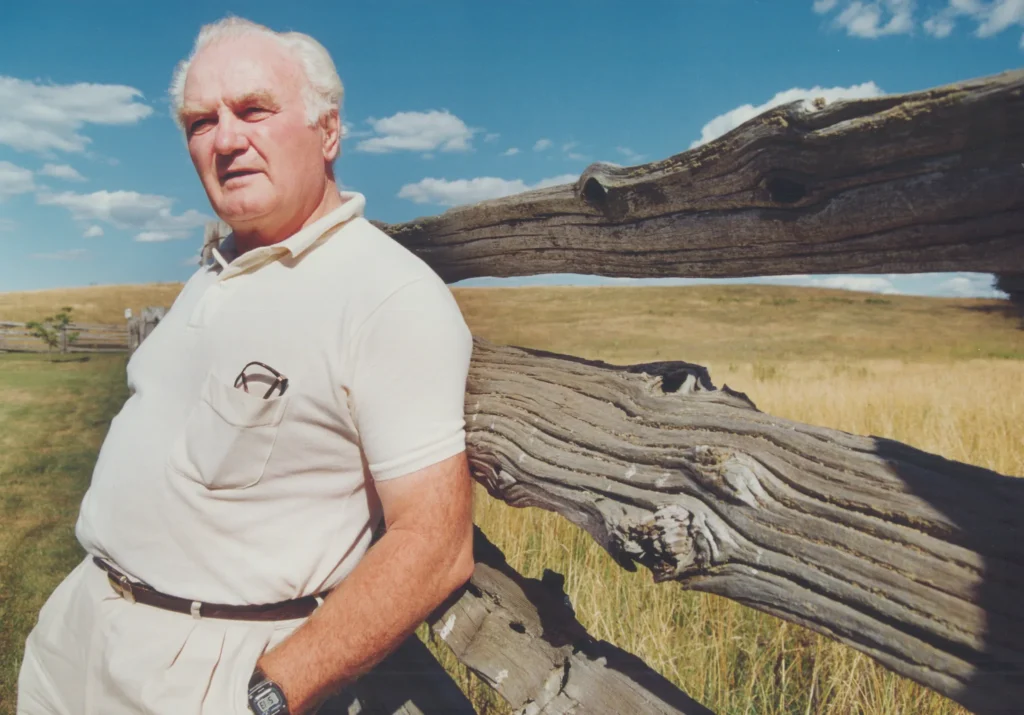
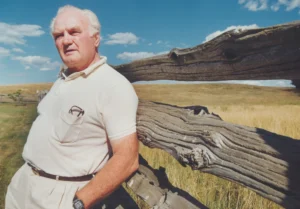
Canadian tenor Jon Vickers at his farm near Kitchener (Canada) in 1991 ©Getty - Keith Beaty / Toronto Star
The centenary of Jon Vickers’ birth provides an opportunity not merely to commemorate one of the greatest tenors of the twentieth century, but to reflect upon what made him unique. There have been voices of greater innate beauty, singers of more obvious vocal glamour, and artists whose careers were less controversial. Yet few performers have ever possessed Vickers’ extraordinary ability to inhabit a character from within, to probe the psychological depths of a role until music, drama and human truth became inseparable.
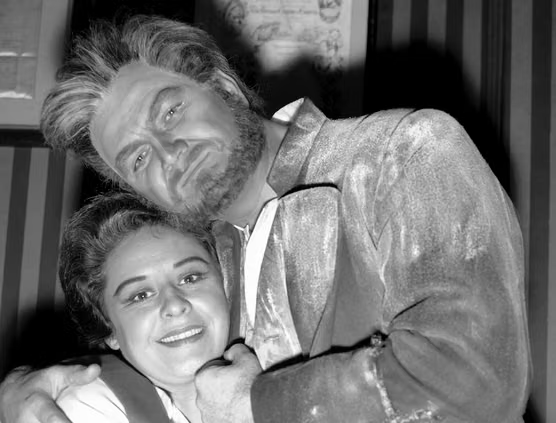
Born in Prince Albert, Saskatchewan, on 29 October 1926, Jon Vickers rose from remarkably modest beginnings to become one of the defining operatic artists of his age. Whether singing Florestan, Énée, Peter Grimes, Tristan or Otello, he brought to the stage an intensity that could be overwhelming. Audiences did not merely hear him: they experienced him. His performances often seemed less like interpretations than acts of dramatic possession.
Nothing illustrates this more powerfully than the two roles that follow. In Verdi’s Otello, Vickers created one of the most searching portrayals in the history of the opera. In Bellini’s Norma, he transformed Pollione from a conventional heroic tenor into a profoundly conflicted human being. Together, these two perspectives reveal the essence of an artist whose greatness lay not only in the voice itself, but in the singular dramatic intelligence that animated it.
Jon Vickers – The Otello I Keep Coming Back To
There are singers you admire, and then there are singers who somehow become part of your own personal history with opera.
For me, Jon Vickers is very much in the second category.
As we celebrate the centenary of his birth, I wanted to pay tribute to him through the role that, perhaps more than any other, fascinates me: Otello.
I have three or four Vickers vinyl records at home, and I still find myself goingback to them. There is something almost impossible to explain about his Otello. It is not simply the size of the voice, or the power, or even the darkness of the character. It is the feeling that he is living through every psychological stage of the tragedy.His Otello is a great soldier, a lover, a proud man, a frightened man, and finally a completely broken human being.
And then there is something I particularly love about his recordings: listen to Vickers with different Iagos and the character almost seems to change.
The recording with Tito Gobbi is a perfect example. There is something fascinatingin the electricity between these two artists. It reminds me a little of Mario Del Monaco: put the same Otello in front of a different baritone and suddenly you discover another side of the character. With Gobbi, Vickers seems more dangerous, more suspicious,more psychologically exposed. You almost feel the two men feeding each other’s intensity. Their Si, pel ciel is not simply a great duet – it feels like two forces colliding. Vickers and Gobbi recorded Otello together in 1960, and later appeared together in live performances as well.
What makes Vickers’ story with Otello even more remarkable is that he recorded thecomplete opera before he had ever performed the role on stage. His actual stage debut as the Moor came in Buenos Aires on 17 May 1963. He would go on to make the role one of the pillars of his career, including 31 performances at the Metropolitan Opera alone.
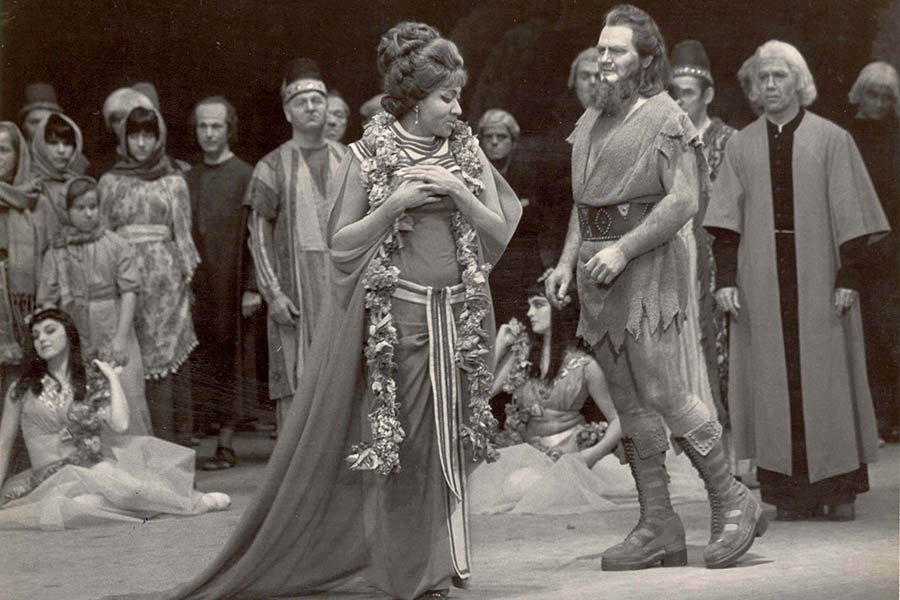
Then came the great chapters: the Met, Athens, Covent Garden, Paris, and above allSalzburg, where his collaboration with Herbert von Karajan produced one of the great Otello documents of the twentieth century. Vickers himself later described the Salzburg Otello as one of the six crucial experiences of his career.
And when we talk about the great Otellos of the last century and beyond, it is extraordinaryto see the lineage: Mario Del Monaco, Jon Vickers, Plácido Domingo, and, decades later, Jonas Kaufmann – each completely different, each revealing another face of Verdi’s extraordinary creation. Kaufmann himself eventually approached the role in 2017, consciouslystepping into a tradition that included Vickers and Domingo.
For me, however, Vickers remains something very particular.
His Otello does not simply sing the tragedy.
He seems to think it, fear it, fight it and finally die inside it.
And perhaps that is why, a hundred years after his birth, putting one of those oldvinyl records on the turntable can still feel less like listening to a historical recording and more like opening the door to a theatre that has somehow never closed.
Happy centenary, Jon Vickers.
If Otello reveals Vickers at the summit of his tragic powers, his Pollione demonstrates another aspect of his artistry: his refusal to accept operatic conventions at face value. Throughout his career, Vickers consistently sought the inner truth of a character, often challenging long-established traditions in the process. Even in repertory commonly associated with bel canto elegance rather than psychological exploration, he searched for human conflict, moral ambiguity and emotional vulnerability.
One performance, in particular, has acquired an almost legendary status among admirers of the Canadian tenor. It remains one of those rare evenings in which a great artist, a great colleague and extraordinary circumstances combined to create an event that has entered operatic folklore.
“If you had a time machine and a single ticket for an opera performance of the past, which evening would you choose and why?”
As far as I am concerned, I would have no doubts: I would rush to the Roman Theatre of Orange on the evening of July 20, 1974. The opera on stage was Vincenzo Bellini’s Norma. A fierce Mistral wind was shaking the ancient stones of the stage and rattling the music stands of the orchestra conducted by Giuseppe Patanè.
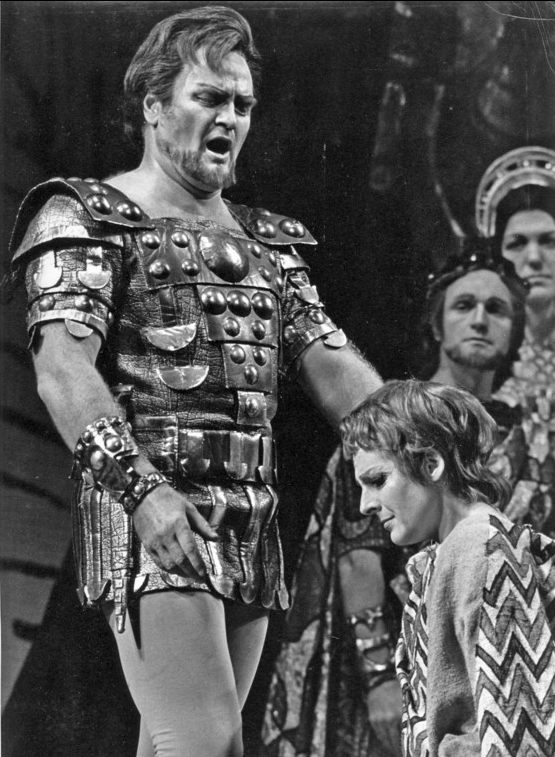
The long veils and cloaks of Caballé’s costume, caught by the gusts, fluttered and billowed around the Gallic priestess, while Montserrat wove one of the most extraordinary Casta Diva ever heard. The protagonist, in a state of absolute grace and at the zenith of her physical and vocal powers, delivered one of the most memorable performances of her legendary career, featuring monumental breath control and filati, high notes like steel blades, and noble, chiseled inflections.
Yet, this performance would not have gone down in history had she not been joined by the equally legendary Pollione of Jon Vickers. The Canadian tenor, endowed with a magnetic and imposing stage presence and a volcanic vocal power, was a unique phenomenon in opera history, capable of excelling and leaving benchmark interpretations in both the German and Italianrepertoires. In his interpretations, the mythological torment of Tristan and the flesh-and-blood anguish of Otello assumed an absolute tragic dimension, where the sheer gigantism of his voice yielded to a painful and profound psychological introspection.
In a purely bel canto role like Pollione, Vickers became the ultimate anti-Mario Del Monaco. Worlds away from the Italian tenor’s sun-drenched, monolithic heroism, he turned the character into a primitive warrior – psychologically torn, devoured by guilt, and fully capable of confronting Montserrat Caballé’s majestic and stratospheric vocalism.
The duet “In mia man alfin tu sei” thus becomes one of the most memorable pages in the history of opera. Norma is no longer the hieratic priestess of “Casta Diva”; she is a betrayed woman driven by her vengeful fury. Facing her, Vickers’ Pollione bends, lacerated and tormented under the weight of his guilt, and falls into despair. We are standing before the true theater of the soul and of myth, whereevery single note becomes an inescapable advance toward the final pyre, in a hand-to-hand duel that defies the wind and the history of Bellini’s masterpiece.
The full video of this historic performance has fortunately survived and is easily available across all major specialized platforms and online archives.
A Legacy Beyond Categorie
What ultimately distinguishes Jon Vickers is that he seemed to belong to no single school of singing. He was neither a traditional Italian tenor nor a conventional Wagnerian heldentenor. He occupied a territory entirely his own, where vocal power served dramatic truth and where heroic figures were stripped of their certainties and revealed in all their humanity.
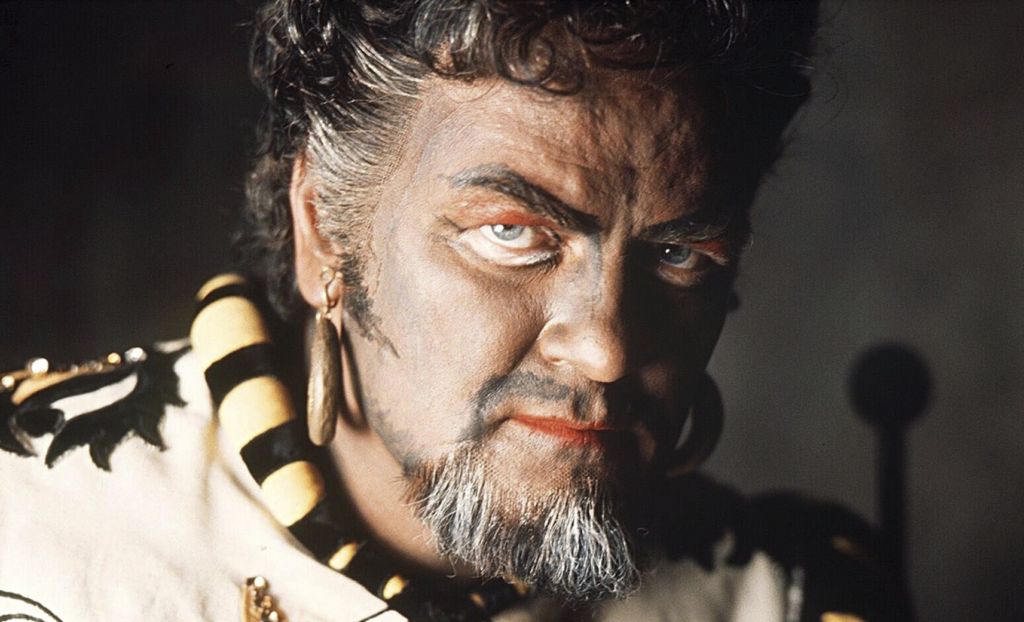
A century after his birth, the enduring fascination of Vickers lies in that rare combination of grandeur and vulnerability. His Otello is consumed by fear as much as by jealousy. His Pollione is broken by guilt as much as driven by passion. In both cases, the listener encounters not an operatic stereotype but a living, suffering human being.
That is why his recordings continue to feel remarkably modern. They are not museum pieces, nor historical curiosities. They remain encounters with an artist who compelled audiences to confront the emotional and psychological realities hidden beneath the notes.
One hundred years after his birth, Jon Vickers still reminds us that opera can be more than beautiful singing. At its highest level, it can become an exploration of the human soul. And few artists have travelled further into those depths than he did.
About the Author