LA TRAVIATA | Bühnen Bern
©Tanya Dorendorf
La traviata at Bühnen Bern: A Fourth Traviata, and Still Plenty to Discover.
On Tuesday 29 September, I found myself sitting in the Stadttheater Bern for my fourth La traviata in a single month. After Sion, Verona, and with Milan waiting for me in just a few days, one might reasonably ask: Why on earth would you need another one?
The answer is simple: because it is Verdi.
And when it comes to Giuseppe Verdi, I am perhaps a little less objective than usual. He is, in a way, my musical child. So everything that follows should be understood for what it is: one opera lover’s very personal reaction to a score I know almost by heart.
That is precisely the strange thing about returning to La traviata so many times in such a short period. It is like listening to an old cassette you have played hundreds of times. You know every track, every turn, every little detail. And therefore, when something changes, or when something does not quite work, you notice it immediately.
Yet despite a few reservations, I had a genuinely wonderful evening in Bern.
And before anything else: thank you, Bühnen Bern. Why, two things in particular deserve applause. First, the decision to raise the stage for this production. Anyone familiar with the Stadttheater knows that the flat orchestra level can make seeing the stage from some of the stalls seats rather difficult. Here, that problem was considerably improved.
And then there were the French surtitles.
Honestly: thank you. What a lovely touch. For a French-speaking opera lover travelling through Switzerland, being able to follow the Italian text with French surtitles made the evening particularly enjoyable.
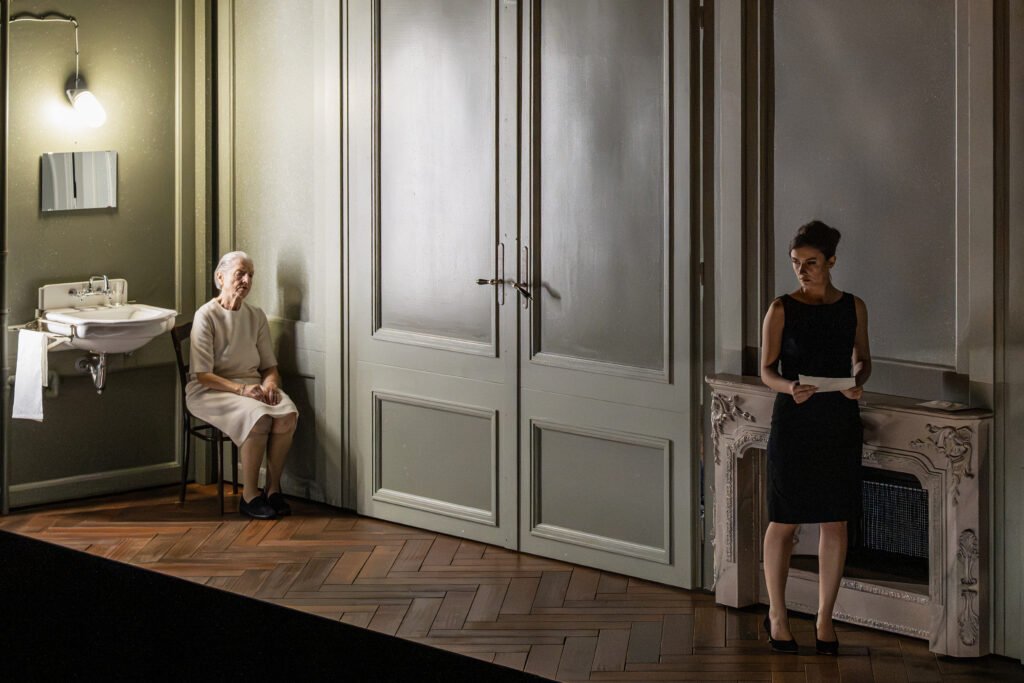
Lina Tsiklauri: the revelation of the evening
Let us start with Violetta. Lina Tsiklauri was, without any doubt, my greatest discovery of the evening. This was the first time I had seen her on stage, and I sincerely hope it will not be the last. Her Violetta was superb from beginning to end. Tsiklauri is a Georgian lyric-coloratura soprano, and this Bern production marks an important series of debuts for her.
What impressed me most was the sheer quality of the upper register. Her high notes were extraordinary – brilliant, secure and beautifully projected – and her Sempre libera stopped the room in its tracks. But there was more than vocal fireworks.
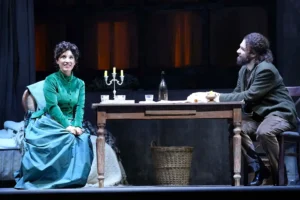
Her acting was excellent, particularly in the moments when she was alone. This is important because the production does not necessarily do her many favours visually. Violetta is not especially highlighted through costume or colour, and the staging often places her inside a rather restrained visual world. Yet Tsiklauri found her own way of commanding the stage. I particularly loved the moment when she reads the letter near the end of the opera. It was one of those small, devastating theatrical moments where the singer simply stands there and lets the music and the character do the work.
For me, she was the revelation of the evening.
Alfredo: very good, with one frustrating moment
Davide Tuscano took on Alfredo Germont. Overall, I enjoyed his performance very much, and I thought he was particularly strong in the final act. There was a real sense of vulnerability and dramatic commitment there.
I did, however, find myself slightly frustrated during Act II, particularly towards the end of Alfredo’s departure for Paris. It is one of those moments I always look forward to in La traviata, and here I felt the ending was a little rushed. It left me wanting more. That is perhaps the most annoying kind of criticism to make: not because the performance was bad, quite the opposite, but because you can feel that a scene you love could have been even more powerful.
Giorgio Germont: a role I am particularly demanding about
And then comes Papa Germont. Jonathan McGovern, a long-standing member of the Bern Opera ensemble, took on Giorgio Germont. McGovern has been part of the company since the 2022/23 season and has built a substantial repertoire in Bern, including major Verdi and Wagner roles. I have to admit that I am particularly demanding when it comes to Giorgio Germont. It is a role I love enormously, and I have seen McGovern several times before. I actually prefer him in some of his other roles.
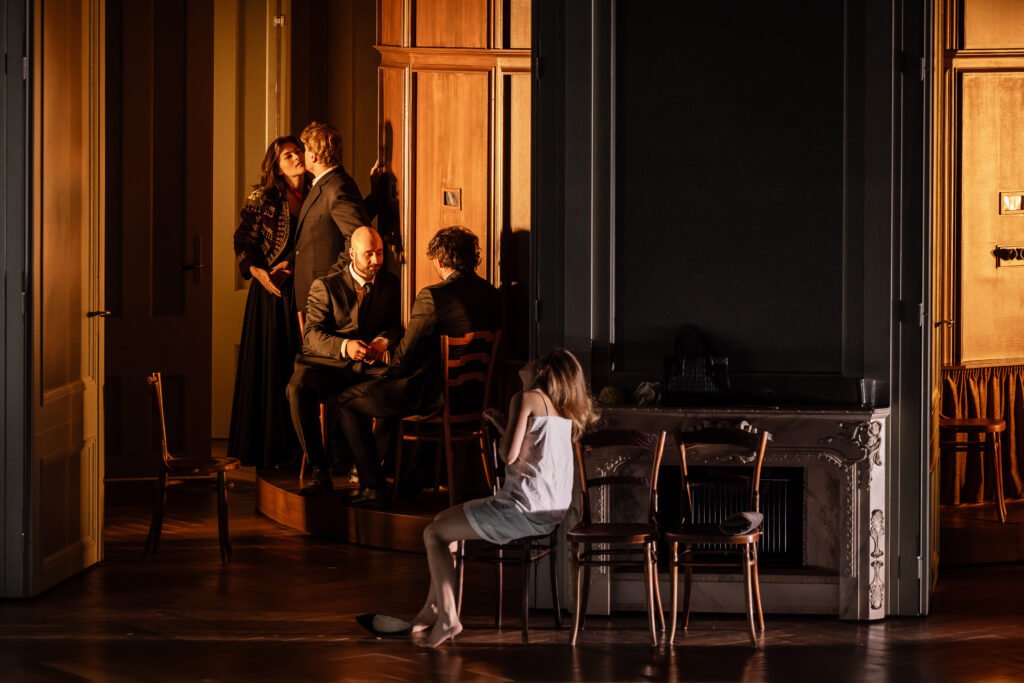
There were beautiful moments here, particularly in his scenes with Alfredo. Their duets had real dramatic weight.
But vocally, I sometimes felt that the words were not quite as clearly articulated as I would have liked, and some of the orchestral balance seemed to work against him. I found his Di Provenza il mar, il sol and the other major aria a little below what I know he can do. This is not to say it was poor. It was not. It simply did not reach the level I have come to expect from him.
And perhaps that is the price of having seen an artist several times: expectations become higher.
Flora, Belle-voix
Sophie Kidwell made a lovely impression as Flora Bervoix. She is joining the Bühnen Bern soloist ensemble for the 2026/27 season, after previous work at Theater Basel and a rapidly expanding career across German-speaking Europe.
Flora is not a role in which you get enormous amounts of stage time, but Kidwell made every appearance count. There was warmth, presence and a very attractive mezzo-soprano sound.
And then there was William Meinert as Baron Douphol
I have to say it again: I love this man. I still remember his Sparafucile in Rigoletto at this very theatre, and I continue to wonder why we do not get to see more of him in bigger roles. Meinert has been a member of the Bühnen Bern ensemble since the 2024/25 season, where he has already appeared as Sparafucile, Sarastro, Gremin and Oroveso.
He has one of those faces that directors should simply want to put on stage. A proper actor’s face, and a bass voice to match it. Give this man a bigger role, please.
Christian Valle: why wasn’t he Giorgio Germont?
And then, unexpectedly, one of my biggest highlights came from Christian Valle, who sang Doctor Grenvil. I have seen Valle on stage many times before, but tonight I was struck all over again by the sheer beauty of his bass. Honestly, at moments I found myself thinking:
Why wasn’t he singing Giorgio Germont?
His voice was magnificent. Rich, warm and immediately recognisable, with the kind of sound that makes even a relatively small role feel important.
Valle has been a member of the Bern Opera ensemble since 2021/22 and has already built an impressive repertoire there, including Wagnerian bass roles such as Fafner and Hagen, as well as Osmin and other major parts. I would very happily hear much more of him in Verdi #DonCarlo.
When Verdi touches genius.. and then suddenly boredom
Now we come to Alevtina Ioffe and the Bern Symphony Orchestra.
This is where my feelings became considerably more complicated.
Ioffe is now the Chief Conductor of Opera Bern, having taken up the position for the 2025/26 season. Her international career includes appearances at institutions such as Komische Oper Berlin, Stuttgart and Gothenburg, as well as Opernhaus Zürich.
There were moments when I thought: yes. This is exactly how I want my Verdi. For me, Verdi needs movement. He needs tension. He needs rhythm. He needs that almost physical sense of forward motion, I always say that I want my Verdi veloce – and preferably at 1.5 speed.
The first act had exactly that quality. It was raw, immediate, energetic. There was tension in the music, and the dramatic pulse was alive, but then, strangely, the evening would suddenly slow down, and I mean really slow down.
There were stretches where I found myself wondering where the urgency had gone. The genius came very close to boredom, that contrast was frustrating because the production showed us that the musical energy was there. When it was allowed to move, it worked wonderfully, I simply wanted more of that.
A very green Violetta
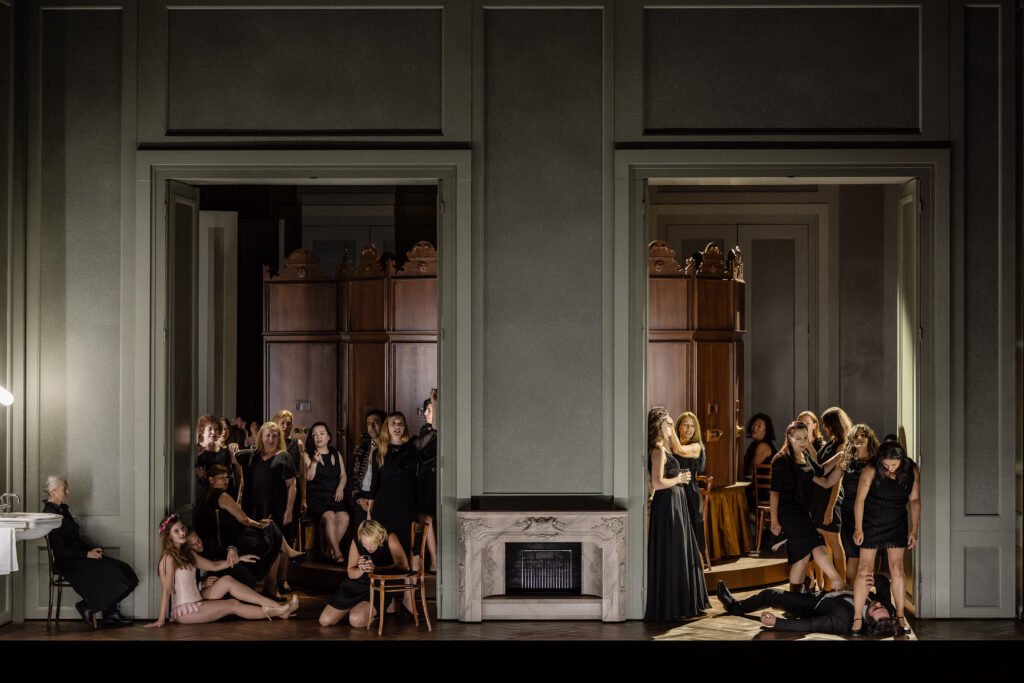
The staging by Raimund Orfeo Voigt, who also designed the set, is perhaps where I had the most reservations.
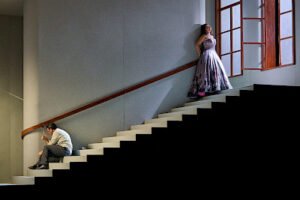
I understand the idea, Bern has its famous green Federal Palace, and here Violetta’s apartment is dominated by almost exactly the same shade of green, but I kept thinking:
Can we have a little colour, please?
A little more decoration.
A little more theatrical imagination.
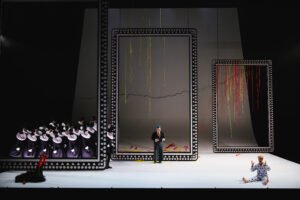
The same two doors remain central throughout the three acts, taking up an enormous amount of visual space. And the strange thing is that they seem to hide much of what is happening behind them.
Even the chorus is sometimes barely visible.
I found myself wondering why the production had been designed in such a way when so much could have been done with the space.
Most importantly, I do not think the staging does enough for Violetta herself.
This is a character who can – and often should – dominate the visual world of the opera. I personally love productions where Violetta is immediately identifiable through colour, costume and visual presence.
Here, she is almost absorbed into the architecture.
Fortunately, Lina Tsiklauri is more than capable of fighting her way out of it.
And, Grazie Dio, the the chorus…
One thing I absolutely cannot leave without mentioning is the Chorus of Bühnen Bern, what a fantastic ensemble.
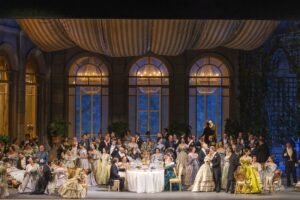
Both the women and the men were excellent, and Act III was particularly impressive. During the party scene, everything suddenly came together: the rhythm, the movement, the orchestra, the stage energy, It felt alive, it felt like an opera house.
A huge congratulations to the chorus master and to the entire ensemble. They brought a level of energy and precision that made those moments among the most enjoyable of the evening.
So, should you go?
Absolutely.
Even after all my little complaints – and I have certainly made a few, I came out of the Stadttheater having had a fantastic evening.
That is perhaps the most important thing, the public have always right.
This was my fourth La traviata in one month. In a few days, I will be hearing it again in Milan. At some point, I really ought to stop.
And in Bern, Lina Tsiklauri gave me a Violetta I will remember.
So, despite my reservations about the staging and some unevenness in the musical direction, I can only encourage you to get yourself to the Stadttheater if you can find a ticket. Many performances are already sold out, and I completely understand why.
Bühnen Bern has opened its 2026/27 operatic season with a Traviata that is very much worth seeing.
And to Bühnen Bern: thank you again, because, more than ever, VIVA VERDI!
About the Author