L’ELISIR D’AMORE | Teatro alla Scala
© Brescia e Amisano
With L’elisir d’amore, the Accademia Teatro alla Scala delivers a performance that goes far beyond a training showcase: a young, credible passing of the torch, reminding us that the future of opera is also built this way, on stage.
The elixir of the future: at La Scala, the Academy proves that opera still has much to say
In today’s theatrical landscape, often marked by questions around generational renewal and opera’s ability to speak to the present, productions such as L’elisir d’amore staged by the Accademia Teatro alla Scala take on a meaning that extends well beyond their musical outcome. Donizetti’s work, entrusted to the Academy’s young artists, embodies one of the noblest missions of a great theatre: to shape the talents of tomorrow by offering them not merely a technical training ground, but a genuine artistic experience before an audience.
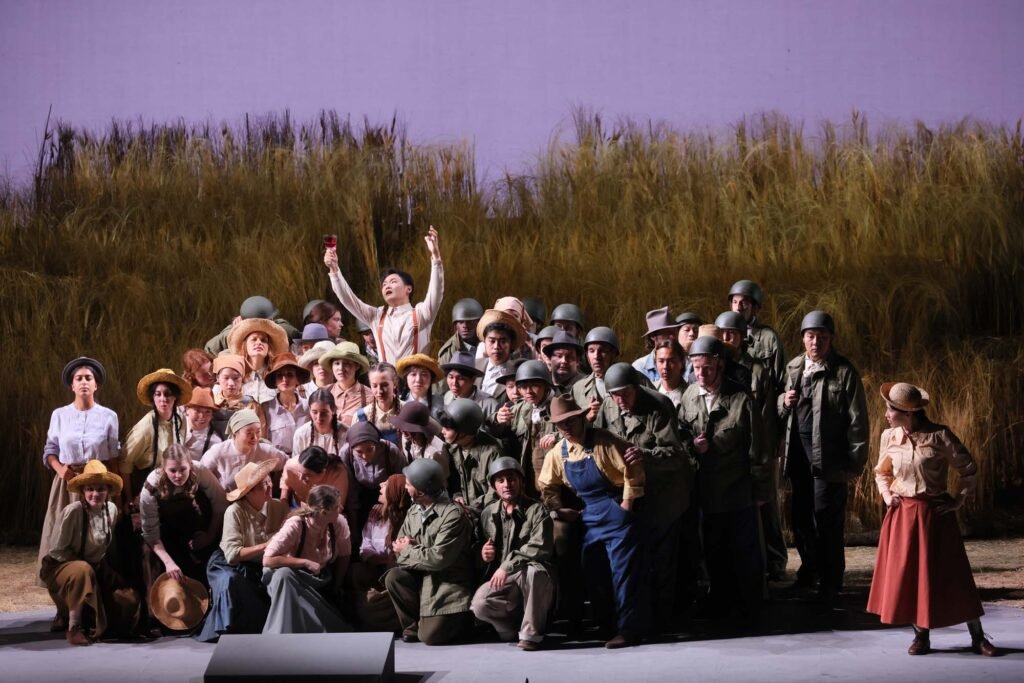
Seeing the wheat field unfold on the stage of La Scala, I was instinctively reminded of The Ripening Seed or Green Wheat by Colette, a novel devoted precisely to that suspended age in which adolescence opens itself to the discovery of desire, love and the loss of innocence. In that golden expanse, chosen by the staging as a symbolic rather than a realistic space, the world of L’elisir d’amore also seems to be reflected: a universe of youthful feelings still unripe, of emotions maturing almost without the protagonists being fully aware of it. As in Colette’s novel – published almost a century later – love in Donizetti’s opera too is born in a fragile and luminous season, made of sudden impulses and first wounds. Wheat thus becomes the ideal thread connecting the two works: an image of growth, promise and transformation, but also a perfect metaphor for a project entrusted to young artists who, before the audience’s eyes, are themselves still “green wheat”, ready to ripen and to find their own voice.
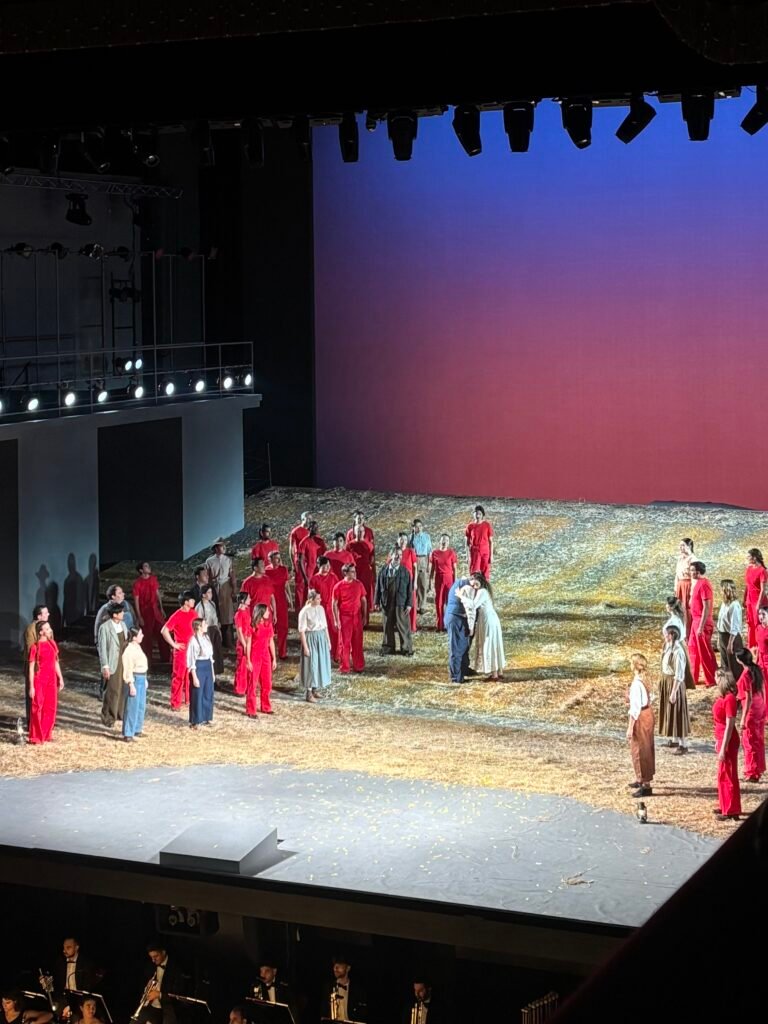
The impression that remains at the end of the evening is above all this: the future of Opera is not an abstract idea, but has precise names, faces and voices. These young artists, despite margins for growth that are still evident, show that they possess the tools, preparation and, above all, the passion needed to inherit an extraordinary tradition.
On the podium, Marco Alibrando accompanies the young performers’ journey with a lively and attentive conducting style. His reading favours a consistently fluid theatrical rhythm, placing the singers in ideal conditions to express themselves. The orchestra responds with precision, while the balance between pit and stage generally appears well calibrated – an especially important element in a production entrusted to voices still in the process of maturing.
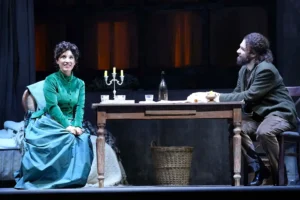
The female lead, Sabrina Sanza, shapes a fresh, elegant and theatrically credible Adina, naturally conveying the character’s evolution from initial frivolity to the discovery of her own feelings. What stands out above all is her confident command of the bel canto idiom: the vocal line, elegant throughout, is supported by polished phrasing and by a refined attention to the scenic word. The high notes are secure, bright and well projected, emerging naturally without ever seeming forced. Her timbre is enriched by a fine range of overtones, bringing colour, charm and recognisability to the voice. The singer reveals significant qualities, particularly in her ability to maintain scenic naturalness and expressive coherence.
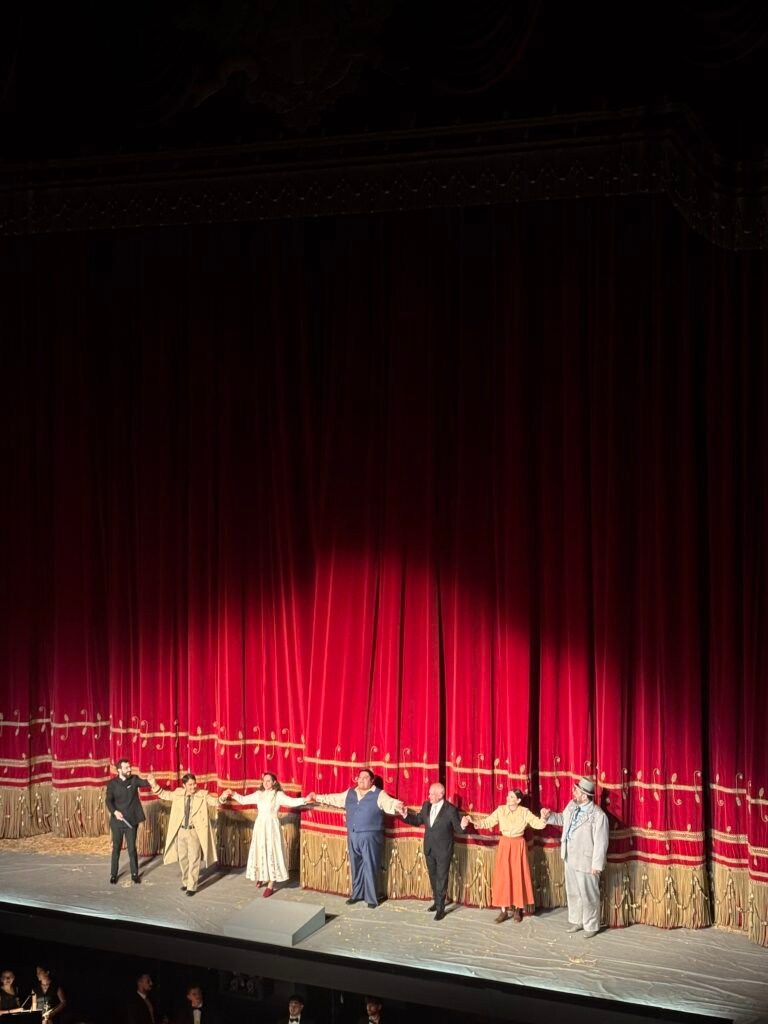
Cristóbal Campos Marín’s Nemorino possesses the role’s essential ingredient: sincerity. His interpretation avoids comic excess, choosing instead the authenticity of feeling and portraying a young lover who is vulnerable and genuine. The voice is distinguished by a warm, golden timbre and by a well-controlled vocal line. In the more lyrical pages, a musical sensitivity emerges that suggests promising future development, even if fuller maturation is still needed in terms of vocal authority and dynamic variety.
The most eagerly awaited moment of the evening, the renowned Una furtiva lagrima, finds in Cristóbal Campos Marín a measured and sincere interpreter. The young tenor approaches the romance without indulging in external effects, privileging instead the purity of the vocal line and the truth of the accent. His reading stands out for its ability to sing “sul fiato”, with careful phrasing and a legato that restore all the melancholic sweetness of Donizetti’s page. The voice, luminous and youthful in timbre, finds in the famous aria the ideal setting to express softness and sensitivity, building a progressive and convincing emotional climax. Rather than seeking immediate applause, what emerges is the desire to reveal Nemorino’s moment of amorous self-awareness, offering an interpretation that is musically respectful and theatrically authentic.
Among the evening’s greatest surprises is Geunhwa Lee’s Belcore. The young baritone approaches the character with scenic assurance and a natural presence that immediately captures attention. The vocality appears solid and well projected, while the phrasing helps define a vain sergeant who is never reduced to a mere caricature. Particularly successful is his ability to embody Belcore’s character, effectively conveying his mischievous, bold and slightly arrogant nature without ever slipping into parody. Lee finds a convincing balance between the comic and human dimensions of the role, giving him scenic vitality and a clearly defined personality. It is a performance that reveals interpretative and musical qualities of considerable interest for the future.
This is not a simple academic exercise, nor an end-of-course showcase: the production has its own theatrical identity and succeeds in conveying to the audience the lightness, grace and melancholy that make L’elisir d’amore one of Donizetti’s most perfect masterpieces
Drawing on solid theatrical experience, Misha Kiria’s Dulcamara – the only artist of full interpretative maturity and not part of the Academy project – establishes himself as a central figure in the opera’s dramaturgical balance. The bass displays complete command of the stage and a sure sense of comic timing, indispensable qualities for bringing Donizetti’s famous charlatan to life. His vocality retains authority, and the character is built with craft and intelligence, often becoming the driving force of the action.
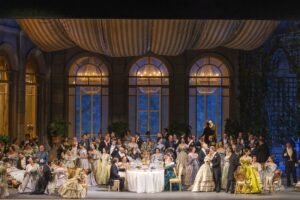
Beyond the individual performances, what impresses most is the overall level achieved by the ensemble. This is not a simple academic exercise, nor an end-of-course showcase: the production has its own theatrical identity and succeeds in conveying to the audience the lightness, grace and melancholy that make L’elisir d’amore one of Donizetti’s most perfect masterpieces. It is perhaps no coincidence that L’elisir d’amore should be the title entrusted to a company of young artists. In Donizetti’s opera, everything speaks of youth: the spontaneity of feeling, the stubborn faith in dreams, the capacity to believe that the future may still hold wonders. The same spirit animates these Academy students, called today to write the first pages of an artistic journey that represents a promise for the theatre of tomorrow.
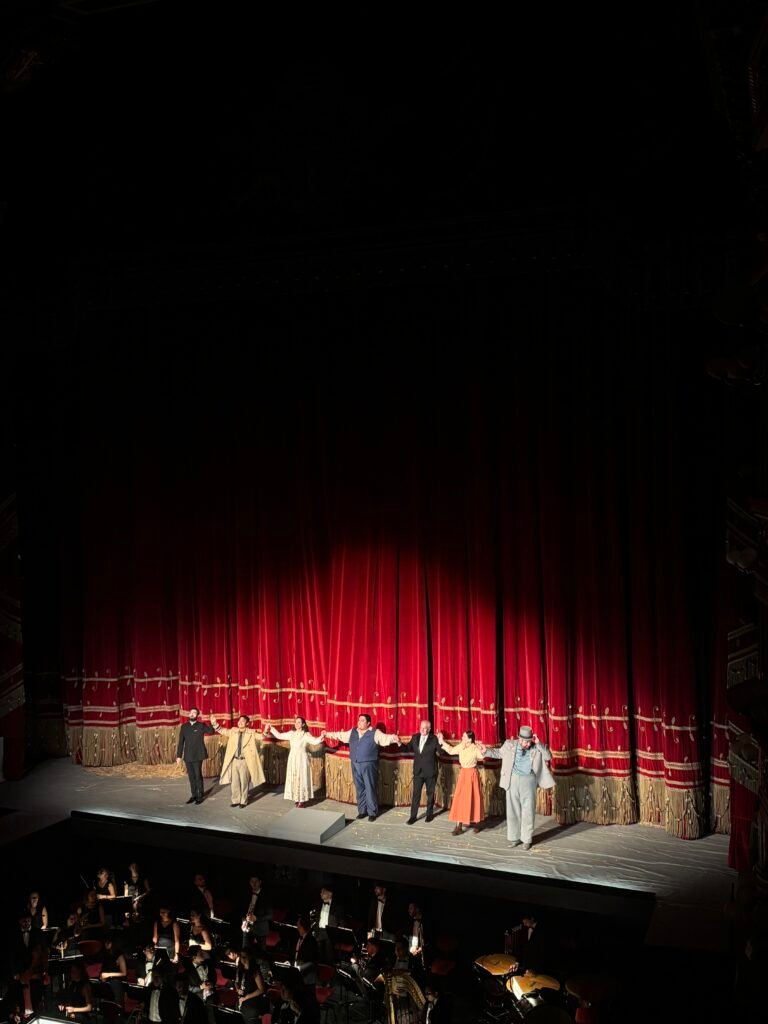
Naturally, given that these are young artists, there are still aspects that can be refined. Some performers may further polish their breath management, deepen their work on the text, or develop a more incisive stage presence. Yet it would be a mistake to judge a production such as this solely by the measure of absolute perfection. Its value lies above all in the growth process it makes possible and in the quality of the prospects it allows us to glimpse
It is precisely here that the irreplaceable role of the Accademia Teatro alla Scala emerges. At a time when the world of opera is called upon to renew itself without denying its own history, investing in training means investing in the very survival of music theatre. These young singers do not represent merely individual promise: they embody an artistic community preparing to take up the legacy of the great generations that came before them.
At the end of the evening, more than the memory of a single aria or a particular scenic moment, what remains is a feeling of trust. Trust in talent, in study, in discipline and in the ability of young artists to continue giving voice to a cultural heritage that lives only if it is passed on. If the future of opera depends on new generations, productions such as this L’elisir d’amore show that this future is already on its way – and that at La Scala it has found one of its most solid and prestigious homes.
About the Author