WOZZECK | Teatro del Maggio Musicale Fiorentino
Credits: Gianluigi Toccafondo
Wozzeck demands a production effort and a level of technical prowess that few theaters can afford: a monumental orchestral apparatus and a vocal and musical score of extreme difficulty.
The Florentine production of this undisputed masterpiece of opera is a luxury edition, having recently celebrated its first centenary—the world premiere took place on December 14, 1925, at the Berlin State Opera, under the legendary baton of Erich Kleiber. The opera is rarely performed in Italy, primarily because it demands a production effort and a level of technical prowess that few theaters can afford: a monumental orchestral apparatus and a vocal and musical score of extreme difficulty. Wozzeck made its Italian debut on November 3, 1942, at the Teatro dell’Opera in Rome, in the midst of World War II, as Mussolini’s regime deliberately chose not to align itself with the Nazi censorship of “entartete Musik” (degenerate art). At the Maggio Musicale Fiorentino, the opera has enjoyed notable past performances under the direction of Bruno Bartoletti (1963, 1964, 1979) and Zubin Mehta, who conducted the most recent run in 1998.
Wozzeck is directly adapted from Georg Büchner’s stage play Woyzeck, written in 1836 but left unfinished due to the author’s untimely death. Alban Berg was deeply shaken by a performance of the play, with its shocking level of delirium and paroxysm, to the point that he immediately decided to turn it into an opera, reproducing the theatrical piece within a sphere of heightened—one might say hysterically heightened—intensity. At the center of this spiral of madness lies the tragic story of the poor soldier Wozzeck: to support his partner, Marie, and their child, the man submits to the humiliations of the Captain and serves as a guinea pig for the cruel experiments of a Doctor. It is a daily ordeal that disintegrates his psyche, fueling hallucinations and paranoia that culminate in the jealousy murder of Marie—who has been seduced by a boastful Drum Major—and his final, desolate suicide in a frozen lake, which Berg masterfully translates into one of the most agonizing scores of the twentieth century. In musical terms, a story already rich in dramatic tension is amplified by leveraging the power of post-Wagnerian orchestration and blending extreme atonality with traditional forms such as the variation, sonata, and suite, thereby creating a rigidly organized structure that contrasts with the apparent fragmentation of Büchner’s play.
The Conducting: The Groundbreaking Debut of Thomas Guggeis
In search of this unity and unsettling theatricality lies the groundbreaking interpretation by Thomas Guggeis, the German conductor and pianist born in 1993, making his operatic debut in Florence. What struck most about the 33-year-old conductor’s reading was the absolute technical mastery with which he governed the orchestra and the vocal ensemble; thanks to a rigorous and analytical gesture, he unraveled a conducting performance of extraordinary lucidity, controlling both pit and stage like a conductor of immense experience and maturity. Crucial is the choice to perform the three acts without intermission, maintaining a narrative and dramatic balance that culminates in Marie’s murder and the suicide, both rendered in a shocking and emotionally lacerating manner, transforming the score’s lucid violence into a painful and memorable listening experience for the Florentine audience. In approach and generation, Guggeis stands apart from another cornerstone of the German conducting school, Christian Thielemann, whose interpretation of the score is crystal-clear, rendering every single instrument and timbre recognizable. Guggeis endows the score with sharp textures and tight tempos, amplifying acoustic contrasts and giving the interludes a narrative edge that does not seek beautiful sound for its own sake, but rather depicts the claustrophobic atmosphere of the drama.
The Direction: The Essentialism and Theatricality of Deborah Warner
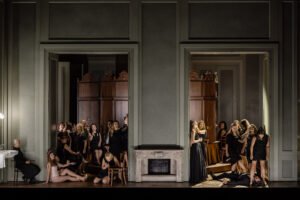
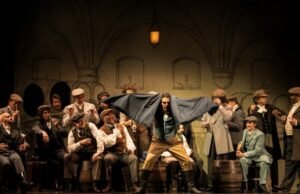
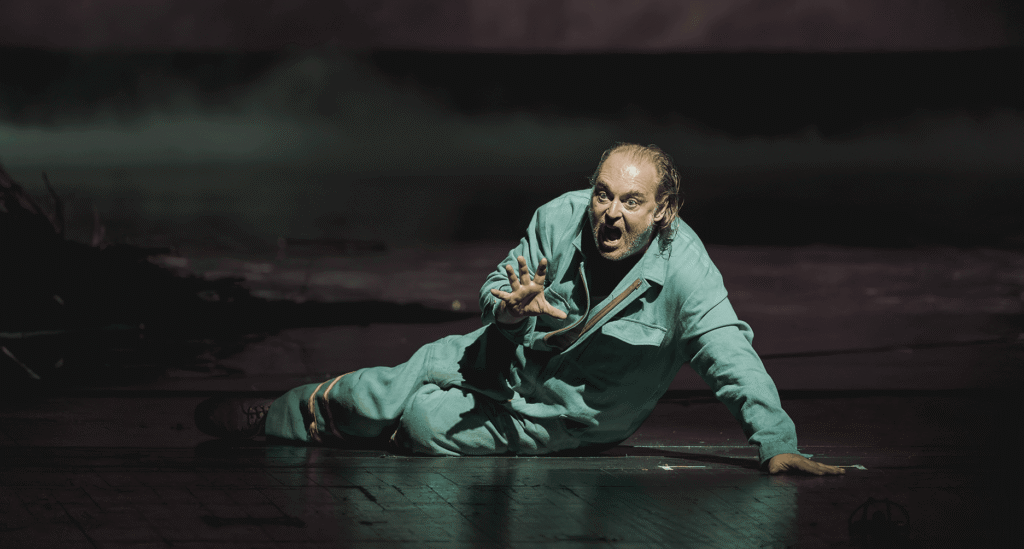
Particularly noteworthy is Deborah Warner’s direction, reviving a production staged at the Royal Opera House in 2023. The English director signs a minimalist and austere staging of extraordinary dramatic force and visual impact. Warner rejects the plot distortions typical of certain Regietheater, and the opera unfolds according to Berg and Büchner’s original dramaturgy, with the sole exception of introducing a prequel. This takes place with the house lights up, set in the barracks’ bathrooms and latrines, where soldiers come and go to change, relieve themselves, and brutally mock Wozzeck, who is cleaning the floors and urinals in worn-out work clothes. As the lights dim, the conductor appears on the podium and the first notes rise from the orchestra, splicing directly into the first scene—where Wozzeck shaves the Captain—set seamlessly in the same latrine, where the protagonist’s daily ordeal and humiliation continue. Marie’s appearance, in a threadbare and discarded dressing gown, occurs in an anonymous domestic setting, her lullaby sung with anguish, trepidation, and a repressed sensuality upon the Drum Major’s arrival. The production develops with narrative coherence and acting work worthy of a straight play; exemplary is the execution of the tavern dance scene, with the band positioned directly on stage, the out-of-tune piano and the accordion becoming an integral part of the set design, while the patrons, degraded by alcohol and violence, move in an awkward and brutal manner, and an isolated Wozzeck watches Marie dance with the Drum Major. Another moment of great visual impact is the appearance of the massive red moon—”Wie der Mond rot aufgeht!” / “Wie ein blutiges Eisen!”—which stands witness to the final unfolding drama, its fiery red suddenly vanishing with Marie’s murder to give way to a thick, cold fog that envelops the pond until the protagonist’s suicide. The opera’s finale gains an even rawer impact, with the young, orphaned child being jeered at by his peers beneath a wall where the words “Du! Dein Mutter ist tot!” are scrawled, sealing a work that, after a hundred years, continues to be shockingly relev.
A Seasoned Vocal and Dramatic Cast
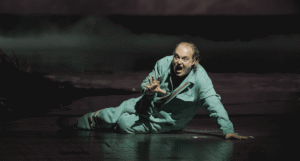
The cast assembled consists of excellent professionals, specialists in their respective roles, whose greatest merit lies in their ability to fully immerse themselves in the directorial vision with superb acting performances. The lead couple is portrayed by Wolfgang Koch (Wozzeck) and Anja Kampe (Marie), who exemplarily master the vast expressive range required by Berg’s score, shifting from the most lyrical, soaring singing to delirium and Sprechgesang at the height of restlessness and anguish. Koch outlines a suffering and tormented protagonist on the path leading to madness, while Kampe portrays a visually striking Marie, restless and sensual, who attempts to escape the social order within which she is meant to be confined while simultaneously remaining crushed by guilt.
Notable, too, was the characterization of Wozzeck’s two tormentors: Wolfgang Ablinger-Sperrhacke’s Captain and Clive Bayley’s Doctor, both of whom delivered extraordinary theatrical performances, portraying their characters in a grotesque and caricatured fashion through the Captain’s falsetto high notes and the Doctor’s artificial, cynical singing. In contrast, one notes the virile, showy singing and bravado of Ian Koziara in the arrogant and seductive shoes of the Drum Major. Helena Rasker is a Margret of great stage presence and vocal temperament, and equally convincing are the performances by Sam Furness (Andres), Dafydd Jones (der Narr), Barnaby Rea, Alex Otterburn (die Handwerksburschen), and Massimiliano Esposito (ein Soldat).
Orchestral Excellence and a Triumphant Success
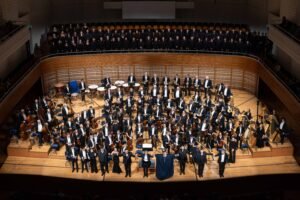
The performance of the Orchestra del Maggio Musicale Fiorentino was of the absolute highest caliber, confirming its status as one of Italy’s finest ensembles, as were the challenging interventions of the Chorus, directed by Lorenzo Fratini, and the Children’s Chorus, directed by Sara Matteucci.
It was an enormous success with the public, from a packed and deeply moved house that rewarded the entire cast with applause and gave genuine standing ovations to conductor Thomas Guggeis.
About the Author