DER PRINZ VON HOMBURG | Salzburger Festspiele
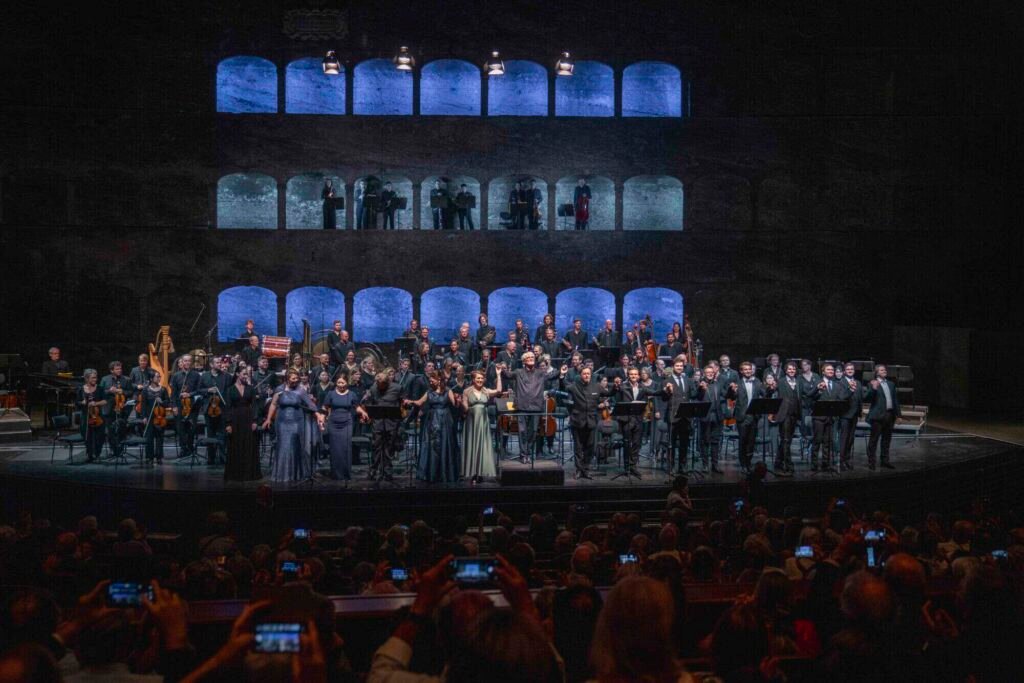
It was among the most keenly awaited events of the 2026 Salzburger Festspiele. The work itself is a rarity: compact (under two hours without an interval) yet poised on a delicate balance of contrasts. It is lyrical without lapsing into sentimentality, tonal without any hint of backward‑looking nostalgia, orchestrally sumptuous yet psychologically razor‑sharp. In essence, it dramatises the struggle of a dreamer caught within the machinery of an unyielding order. Small wonder, then, that Der Prinz von Homburg drew such fervent interest. The single performance (presented in concert) on 20 August at the Felsenreitschule had been ausverkauft for days.
Henze and Bachmann first met in October 1952 at Schloss Berlepsch near Witzenhausen, during a gathering of the Gruppe 47, the influential literary circle that, from 1947 to 1977, brought together the leading voices of German‑language literature. Born five days apart in 1926 (Henze on 1 July, Bachmann on 25 June), they recognised one another instantly: the connection between the German composer and the Austrian poet was immediate and profound.
Their earliest collaboration produced the ballet‑pantomime The Idiot, after Dostoevsky, yet Der Prinz von Homburg is often regarded as their first true joint creation (though the initial suggestion came from Luchino Visconti). Bachmann had seen Jean Vilar’s Paris production of Kleist’s play, reframed through an existentialist lens: the staging stripped away patriotic bombast and the hero’s sacrifice for the state, revealing instead his rebellion and his confrontation with mortality. Bachmann adopted this perspective not only out of artistic affinity but also to reclaim Kleist from Nazi appropriation (Prinz Friedrich von Homburg and Die Hermannsschlacht were among Hitler’s favourites) while preserving what Henze called “the extraordinary monologues, the most tightly wrought and dense in all literature”. Henze, for his part, softened the subject’s Germanic edge with discreet allusions to Italian Romantic opera: “Bellini’s angelic melancholy (I even considered calling the opera La sonnambula), Rossini’s glittering brio, Donizetti’s passionate intensity, all bound together by Verdi’s sturdy rhythms, the freshness of his orchestral colour and his unforgettable melodies”.
The opera premiered on 22 May 1960 at the Hamburg State Opera under Leopold Ludwig, in a staging by Helmut Käuter, and was warmly received. The work met with a similarly enthusiastic reception in Salzburg sixty-six years later. Ingo Metzmacher’s direction of the ORF Radio‑Symphonieorchester Wien honoured the work’s dramaturgical duality, keeping the dream‑world – supple, at times almost belcantist – distinct from the military sphere, with its rigid, metric writing, while allowing the two to permeate one another. Transitions were sometimes deliberately exposed, granting moments of silence (more accurately, moments of dramaturgical breathing) in which the audience could absorb what had unfolded before moving on. Yet the tension never slackened, not even in the duets between the Prinz and Natalie. The words remained remarkably intelligible: one could easily have dispensed with surtitles. The legato had an almost Italian pliancy, and the orchestra, even at full force, never overwhelmed the singers.
Georg Nigl’s portrayal of the Prinz was riveting. BR Musik, in a recent article on his new album Die schöne Müllerin, described him as a phenomenal baritone, a singer unlike any other. The description holds, yet scarcely suffices. Nigl carries himself lightly, almost casually, until the moment he begins to sing – when a voice of extraordinary richness, nuance, chiaroscuro and shadow emerges. His primacy of Wort over tone restores to the text its full poetic weight. His singing never strays into Wagnerian territory, yet the projection can be unmistakably heroic. The character’s ambiguity becomes all the more striking when moments of grandeur erupt after passages of the most translucent fragility. Nigl commands attention without ever monopolising it: he listens, responds, and shapes the stage with his colleagues. His pliant vocal line creates a luminous halo in moments of pure lyricism, where the character’s constant psychological vulnerability comes fully into view.
Natalie von Oranien was sung by the German soprano Kathrin Zukowski. At first, her timbre seemed perhaps too light for a role often associated with a fuller lyric voice (no doubt influenced by Vera‑Lotte Böcker’s superb performance in the 2020 Capriccio recording). Yet any reservations quickly dissolved. Zukowski’s radiant tone, free of vibrato excess and marked by a poised, understated lyricism, proved ideal. Her flexibility was remarkable, and the performance of the highest refinement. As the Prinz’s emotional anchor, she offered precisely the equilibrium needed to complement Nigl’s portrayal.
Maximilian Schmitt gave a commanding account of the Kurfürst von Brandenburg: natural authority, sculpted declamation, vertical projection, and a dark timbre that never grew heavy. He provided the perfect moral counterweight to the Prinz, maintaining a measured coolness and a dignified reserve.
Graf Hohenzollern was sung by tenor Magnus Dietrich. It is impossible to overstate how beneficial Mozart is for singers of every type, and Dietrich exemplified this truth. His ability to shade intentions, refract colours and modulate inflection with refinement – never precious, never overstated – was striking. His noble, luminous timbre, exemplary articulation and ideal projection suited the hall, the orchestra and the ensemble perfectly. Making his festival debut, he left one hoping for many returns.
Tanja Ariane Baumgartner, a familiar presence at Salzburg since her 2010 debut as Gräfin Geschwitz in Lulu, brought warmth, elegance and quiet nobility to the Kurfürstin. Her timbre and phrasing offered comfort and gravity without ever tipping into caricature – an ideal match for a mezzo of such distinguished experience. Anthony Robin Schneider’’ deep timbre and firm projection made for a convincing Kottwitz, his Prussian rigour rendered with vocal authority. Lauri Vasar brought the Feldmarschall Dörfling vividly to life, his measured legato and crisp syllabic line perfectly suited to moments of command.
By evening’s end, one thought prevailed: this work is far too seldom heard. Yet, given performances of such calibre, one might almost prefer rarity – if it guarantees artistry of this standard. For those unable to attend, the concert was broadcast on Austrian radio and remains available via Ö1 ORF – Der Prinz von Homburg.
******************************
Der Prinz von Homburg
Oper in drei Akten und neun Bildern von Hans Werner Henze (1926-2012)
Libretto eingerichtet von Ingeborg Bachmann nach dem Schauspiel Prinz Friedrich von Homburg von Heinrich von Kleist
Musikalische Leitung Ingo Metzmacher :: Friedrich Wilhelm, Kurfürst von Brandenburg Maximilian Schmitt :: Die Kurfürstin Tanja Ariane Baumgartner :: Prinzessin Natalie von Oranien Kathrin Zukowski :: Feldmarschall Dörfling Lauri Vasar :: Prinz Friedrich Artur von Homburg Georg Nigl :: Obrist Kottwitz Anthony Robin Schneider :: Graf Hohenzollern Magnus Dietrich :: ORF Radio-Symphonieorchester Wien
(For further informations) Link to the Salzburger Festspiele: Der Prinz von Homburg
About the Author