LA SCALA DI SETA | Rossini Opera Festival
“From the Overture to the very last note of the Finale, there was nothing but thunderous applause. I was called out on stage both last night and tonight; in short, I am the idol of the Venetians.” Thus wrote Gioachino Rossini to his mother following the success of his third farce, which premiered at Venice’s Teatro San Moisè on May 9, 1812. The libretto, adapted from the 1808 French opéra-comique L’échelle de soie, tells the story of Giulia, secretly married to Dorvil, whom she meets every night via a silken ladder lowered from her room. The plot is a classic comedy of errors involving her guardian Dormont, the servant Germano, the suitor Blansac, and her cousin Lucilla—misunderstandings that untangle in the finale with the revelation of the marriage and the union between Lucilla and Blansac.
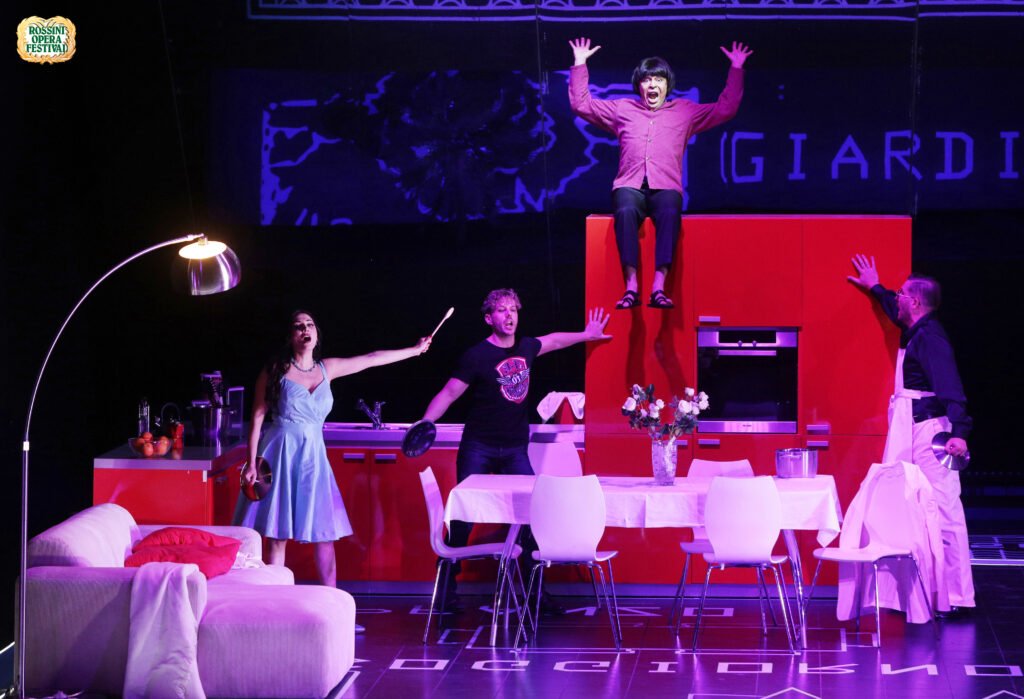
As with L’occasione fa il ladro, the Rossini Opera Festival has revived a milestone production directed by Damiano Michieletto. First seen in Pesaro in 2009, this staging was subsequently mounted with enormous success at Milan’s Teatro alla Scala, Zurich, and other major houses, establishing itself as a contemporary classic. Michieletto transposes the setting from 1812 Paris to a hyper-technological present. Following Jean-Pierre Ponnelle’s legendary, historically faithful production of L’occasione fa il ladro, Michieletto brilliantly demonstrates that one can “betray” the literal libretto without undermining the mechanics of the farce and Rossini’s prodigious musical wit. It is evident that the director finds his ideal stylistic voice in Rossini, a synergy previously proven by his acclaimed stagings of Il viaggio a Reims and La gazza ladra.
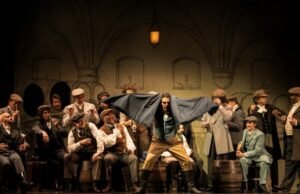
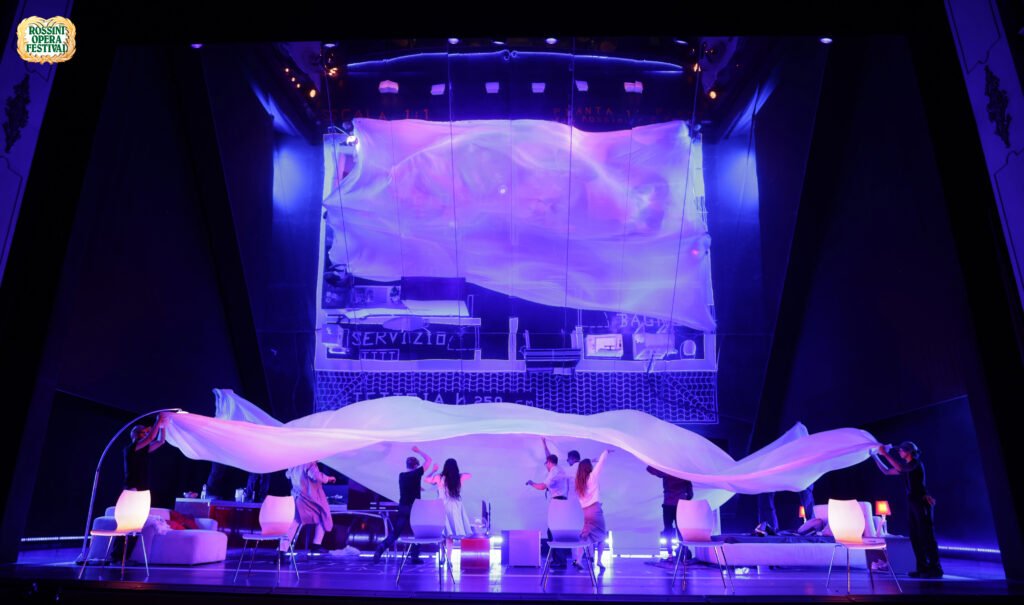
In this Scala di seta, the contemporary setting is a sleek designer loft that takes shape during the Overture. An angled mirror initially reflects the apartment’s floor plan before becoming a dynamic backdrop and a secondary visual layer for the audience. The decor oscillates between luxury and kitsch, featuring an island kitchen and a goldfish bowl. This open-plan structure heightens the frantic game of misunderstandings, disguises, and hiding places. The cast delivers a style of acting far removed from operatic stereotypes, shifting fluidly between cinematic comedy and telenovela. Much like Ponnelle’s approach, the Overture serves as a narrative prologue: the house is built from a bare stage as extras and stagehands move in perfect synchronization with the music—a sharp contrast to the festival’s opening production of Le siège de Corinthe, where the dramatization of the overture was far less successful. The opera’s conclusion is equally striking, as the silken ladder transforms into a massive white sheet that wraps around the house, furniture, and reconciled characters, making the theatrical illusion vanish.
The vocal ensemble was solid, balancing seasoned veterans with rising stars. The true triumph of the evening belonged to Paolo Bordogna, the undisputed master of this production since its 2009 premiere. In Michieletto’s concept, Germano is reimagined as a Filipino butler inseparable from his teddy bear. Stripped of the traditional “foolish servant” tropes, he becomes a modern, melancholic figure observing the vices and neuroses of the wealthy bourgeois residents. Bordogna is a theatrical phenomenon; he commands the stage with immense class, delivering recitatives inflected with a “Filipino” accent without ever lapsing into vulgarity. Vocally, his timbre and execution represent the gold standard for a Rossini buffo, demonstrating exquisite legato and expressiveness. His performance of the lengthy aria “Amore dolcemente / tu prima accendi il core” was irresistible, delivered while ironing and daydreaming over a TV soap opera. He balanced irony with a delightfully comic sentimentality in the opening cantabile. In the subsequent allegro, taken by the conductor at a breakneck pace, Bordogna shone brilliantly: his exceptional technique allowed him to conquer the formidable sillabato and the rapid shifts in tessitura with razor-sharp diction. Alongside Alessandro Corbelli, he remains the definitive interpreter of this role.
Hasmik Torosyan’s Giulia, however, was somewhat disappointing. The Armenian soprano, who has recently expanded her repertoire into roles like Violetta (La traviata) and Liù (Turandot), possesses a vocal weight and color better suited to late 19th-century opera than to Rossini’s comic farces, which demand a brighter, leighter vocalism. Her upper register proved problematic, particularly above the passaggio (F4), where the sound became pushed, introducing a harshness that disrupted the vocal line. Nevertheless, she excelled in her elegant phrasing, meticulous diction, and a charismatic stage presence, utilizing her charm to portray a wealthy, capricious Giulia that perfectly aligned with the directorial vision.
Alasdair Kent delivered a clear, bright Dorvil, well-suited to the character of the secret young husband. The tenor showcased a solid bel canto technique that allowed him to master the upper-middle and high register. His rapid runs, coloratura, and agilities were well-managed, culminating in a successful performance of the demanding aria “Vedrò qual sommo incanto”, where he displayed excellent legato in the lyrical section and navigated the cabaletta’s frantic coloratura with precision.
Iurii Samoilov, as Blansac, brought a warm, virile baritone to the stage, complemented by a fine command of coloratura and rapid patter. He effectively captured the essence of the small-town seducer—elegant when courting Giulia, yet boastful and ironic in his duet with Germano, where he matched Bordogna note for note in the rapid-fire sillabato.
Mezzo-soprano Mara Gaudenzi was superb as the “seconda donna” Lucilla. Her velvety vocal timbre and vibrant stage presence made the character irresistible, executing her aria di sorbetto with elegance and brio.
Enrico Iviglia was equally impressive as the gruff guardian Dormont. A seasoned Rossini specialist and an excellent interpreter of Almaviva, the tenor embraced the character role with an irresistible stage presence, utilizing sharp phrasing and diction to illuminate every word of the recitativi secchi, while his bel canto technique allowed him to stand out in the ensembles.
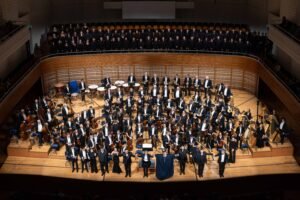
Iván López Reynoso’s conducting, however, alternated between highs and lows. While his tempos were appropriately tight and driving, he occasionally let the orchestral volume overwhelm the singers, sacrificing clarity in the instrumental details. Conversely, his accompaniment during the slower, more lyrical passages was highly evocative. Here, López Reynoso lightened the orchestral textures, allowing the voices and the excellent musicians of the Orchestra del Teatro Comunale di Bologna to shine with warmth and lyricism—most notably during the gorgeous oboe solo in the introduction to Giulia’s aria.
The evening was a resounding success, enchanting even my octogenarian lady neighbour in the stalls. Before the curtain rose, she had expressed her deep dislike for directors who alter traditional librettos, yet she found herself entirely captivated by Michieletto’s theatrical flair.
Pesaro remains a place close to my heart, one I have visited regularly since 1994 and to which I always return with immense joy. This specific edition could be described as a transitional one; nevertheless, the festival deserves high praise for reviving these highly successful stagings of Rossini’s Venetian farces, which are unfortunately all too rarely performed. Not wanting to sound like the stereotypical Don Bartolo—wistfully recalling the days “ quando cantava Caffariello quell’aria portentosa”—one cannot help but feel a touch of nostalgia for past festival editions, when these very same works featured definitive vocal icons like Luciana Serra, Mariella Devia, and Cecilia Bartoli.
However, looking ahead, the 2027 season promises to be exceptionally engaging. The lineup includes exciting new productions: La donna del lago, conducted by François López-Ferrer and directed by Johannes Erath, alongside Tancredi, under the baton of Yves Abel with stage direction by Paul Curran. The program will be rounded out by the revival of Adina, returning in the highly acclaimed 2018 staging by Rosetta Cucchi, conducted by Yves Abel.
CAST
Dormont ENRICO IVIGLIA
Giulia HASMIK TOROSYAN
Lucilla MARA GAUDENZI
Dorvil ALASDAIR KENT
Blansac IURII SAMOILOV
Germano PAOLO BORDOGNA
–
Conductor IVÁN LÓPEZ-REYNOSO
Director DAMIANO MICHIELETTO
Settings and costumes PAOLO FANTIN
Lighting designer ALESSANDRO CARLETTI
ORCHESTRA DEL TEATRO COMUNALE DI BOLOGNA
About the Author