NORMA | Bayerische Staatsoper
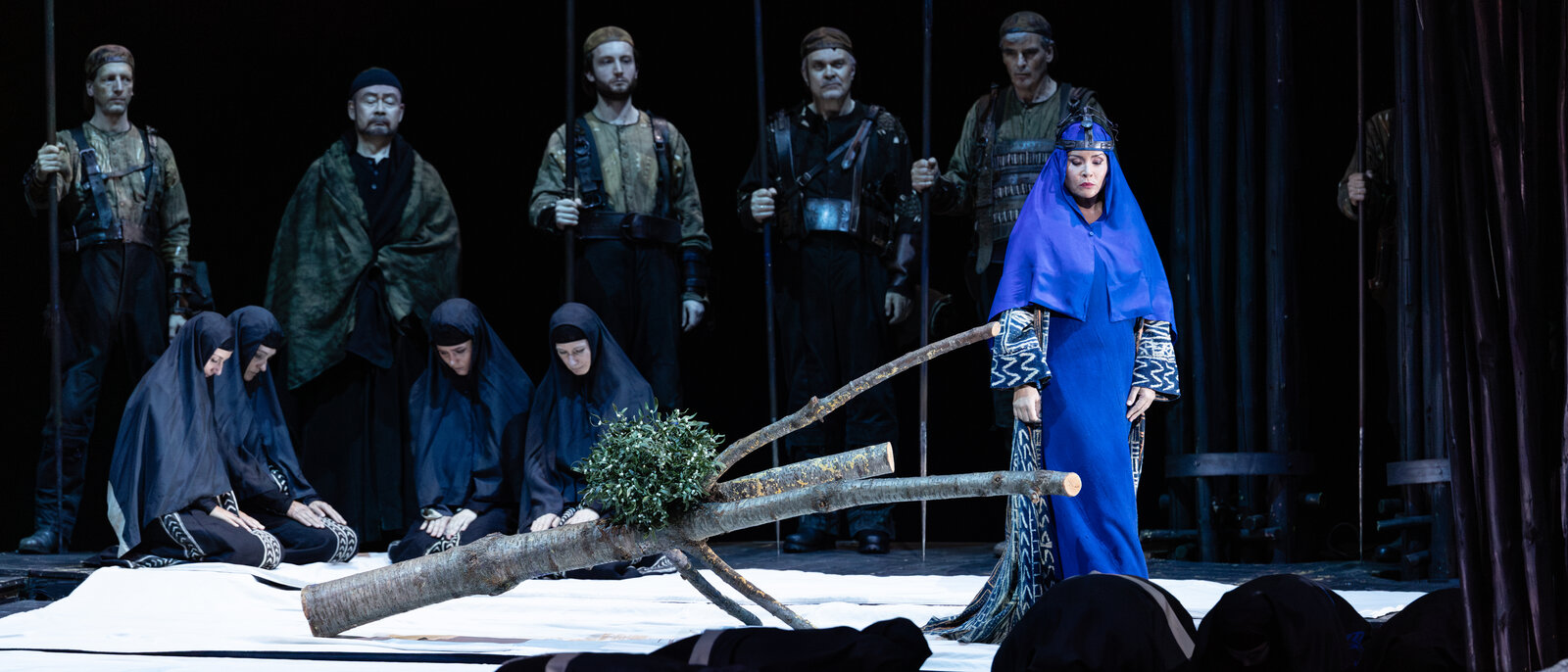
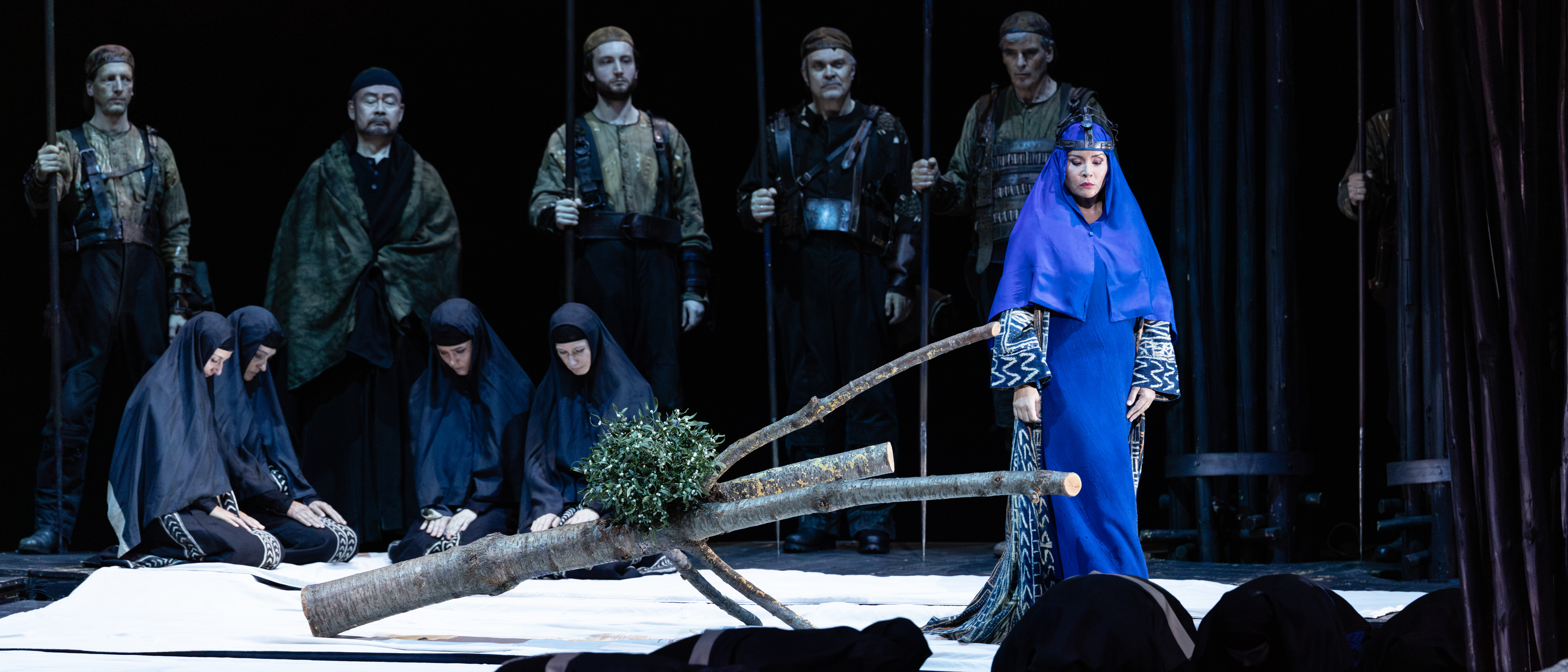
There is no opera that punishes imprecision more ruthlessly than Norma. Every exposed line, every phrase of cantabile over the slow chromatic harmonies Bellini stretches beneath his priestess, demands absolute vocal sovereignty—and the knowledge that any deficiency of range, of timbre, of style will be heard by everyone in the house. When the Bayerische Staatsoper announced Vasilisa Berzhanskaya in the title role of Jürgen Rose‘s production—a mezzo-soprano where convention calls for a falcon-voiced spinto—the announcement was either a stroke of radical reinterpretation or a temptation of fate. What Berzhanskaya delivered on the 2nd of June was neither capitulation nor compromise. It was a Norma reconceived from the ground up: darker, more carnal, the “keusche Göttin” revealed as a woman of violent passions barely contained beneath the ceremonial veil.
“Casta diva” opened cautiously, the long melodic arc taken at a pace that felt almost interrogative, and in the first minutes one noticed what was absent: the floating pianissimi in the stratosphere, the silvery attack above the staff that a soprano brings naturally to Bellini‘s orchestral garland. What Berzhanskaya offered instead was a mezza voce of extraordinary richness—the middle voice velvet-dark, the ornamented cabaletta “Ah! bello a me ritorna” dispatched with a ferocity of coloratura that turned it from a reverie into a threat. This is the great interest of a mezzo Norma: the register shift at the top is exposed, yes, but the entire emotional weight of the role lands differently. When she descended into “qual cor tradisti,” the tessitura sat squarely in her most opulent range, and the effect was shattering—a woman not ascending toward tragedy but dragging us down into it.
Giacomo Sagripanti kept the Bayerisches Staatsorchester on a tight but flexible leash, the Act I overture crisply theatrical, the Act II ensemble moments held with a conductor’s hand alive to both the long arc and the sudden dramatic accelerations. He allowed the Act II duet—that extraordinary confrontation between Berzhanskaya and Mavlyanov—space to breathe without becoming slack.
Najmiddin Mavlyanov was a Pollione of genuine vocal weight: a tenor with the squillo to cut through Bellini‘s brass-heavy ensembles, and enough legato in “Meco all’altar di Venere” to establish Pollione as a man who can actually seduce, not merely insist. The voice tightens marginally under sustained pressure at the top, but the dramatic commitment was unimpeachable.
Erwin Schrott is Oroveso, and this means exactly what it promises: a bass of plummy authority, his “Ite sul colle, o Druidi” commanding, his stage presence formidable. Schrott has been in this house long enough to know precisely how much he can afford to relish these moments.
The evening’s deeper revelation, however, was Emily Sierra as Adalgisa. The role is routinely treated as support—a beautiful voice that exists to trigger Norma’s jealousy and then provide the second voice for those ineffable duets. Sierra refused this diminution. Her timbre, a genuine lyric soprano with a golden sheen in the upper middle, matched Berzhanskaya with uncanny warmth in “Mira, o Norma,” the two voices blending and then separating with that bittersweet precision that makes this duet one of the supreme moments in all opera. Her Adalgisa was also a fully realized human being: young, frightened, genuinely loving. What an artist.
Shannon Keegan handled Clotilde with the discretion this small but crucial role requires—a warm, well-schooled presence in every ensemble.
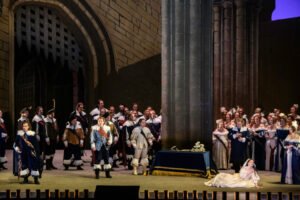
Rose‘s production, now twenty years old, wears its age well precisely because it was never fashionable in the first place. The stone trilithons, the ritual torchlight, the muted earth tones of the costumes—all serve Bellini‘s score rather than competing with it. One asks, looking at this stage picture, whether Rose‘s restraint isn’t itself a radical act in an era of directorial excess. The answer is probably yes.
***
CAST
• Norma — Vasilisa Berzhanskaya
• Adalgisa — Emily Sierra
• Pollione — Najmiddin Mavlyanov
• Oroveso — Erwin Schrott
• Clotilde — Shannon Keegan
• Flavio — Michael Butler
PRODUCTION
• Musical direction — Giacomo Sagripanti
• Production, sets, costumes, lighting concept — Jürgen Rose
• Choreographic assistance — Jo Siska
• Lighting — Michael Bauer
• Chorus master — Franz Obermair
• Dramaturgy — Peter Heilker
About the Author