LE NOZZE DI FIGARO | Teatro Carlo Felice Genova
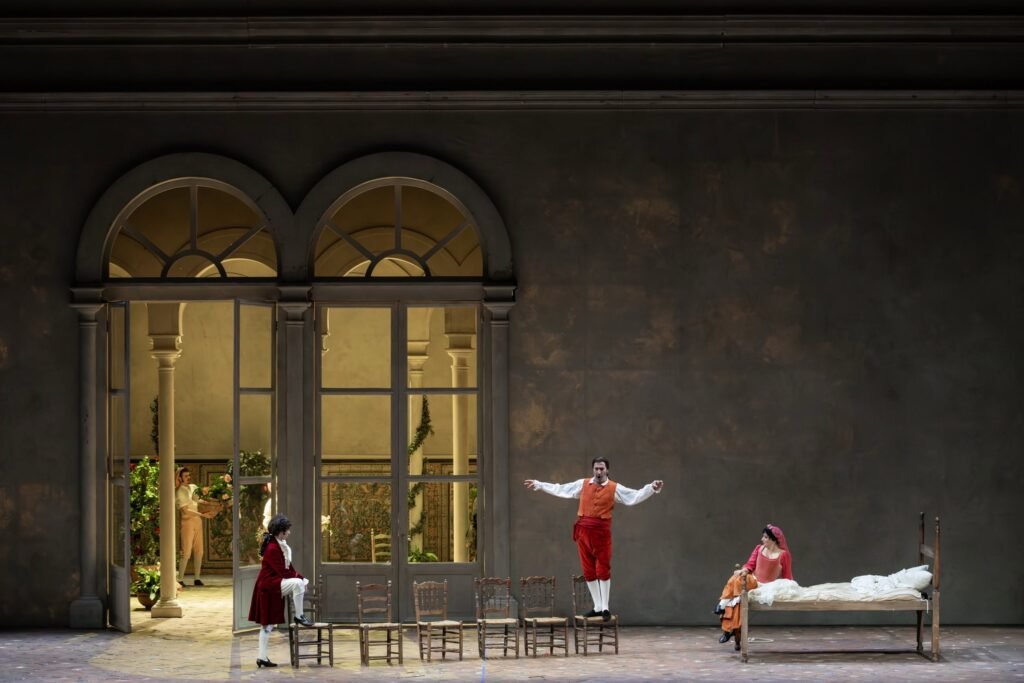
Photo credits: Silvia Aresca
Le Nozze di Figaro opens the 2026-2027 Season at Teatro Carlo Felice of Genova in a traditional production without major surprises or insights.
For the opening of the 2026-27 season, Teatro Carlo Fenice in Genoa chooses to play it safe, opting for a programming that, in some respects, appears somewhat risk-averse:
- An acclaimed Spanish conductor, trained under the guidance of legendary masters;
- One of the most beloved titles in the repertoire – the perfect opera that alternates sweeping comedy with moments of profound melancholy and dramatic introspection;
- A production, on loan from Teatro Regio di Torino, of a hyper-traditional style, with sets and costumes strictly faithful to Lorenzo Da Ponte’s libretto;
- A well-assorted company of Italian singers, bridging debutants and veterans, who master Mozart’s writing and recitatives with style and poise.
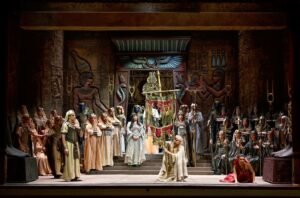
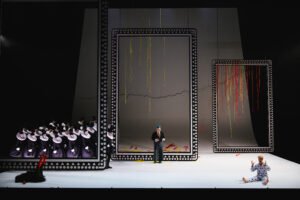
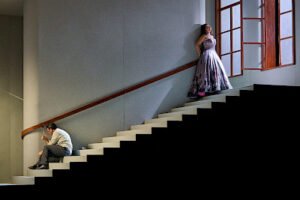
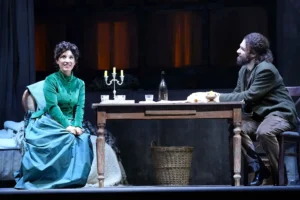
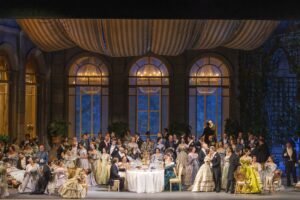
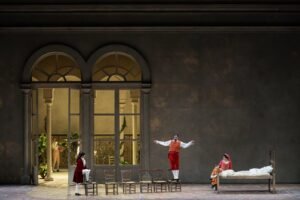
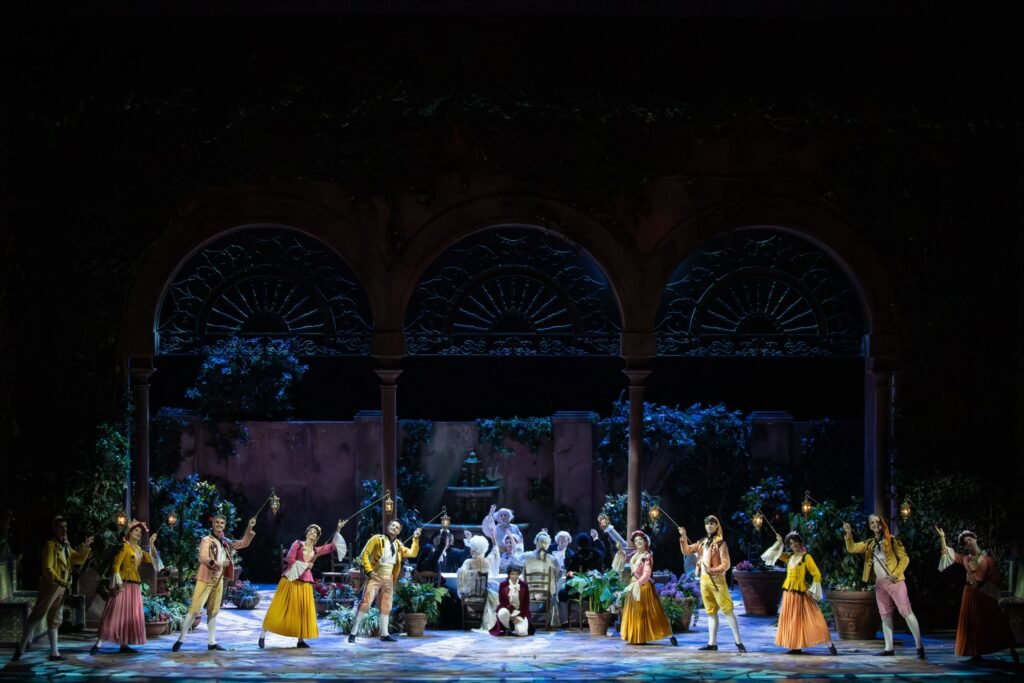
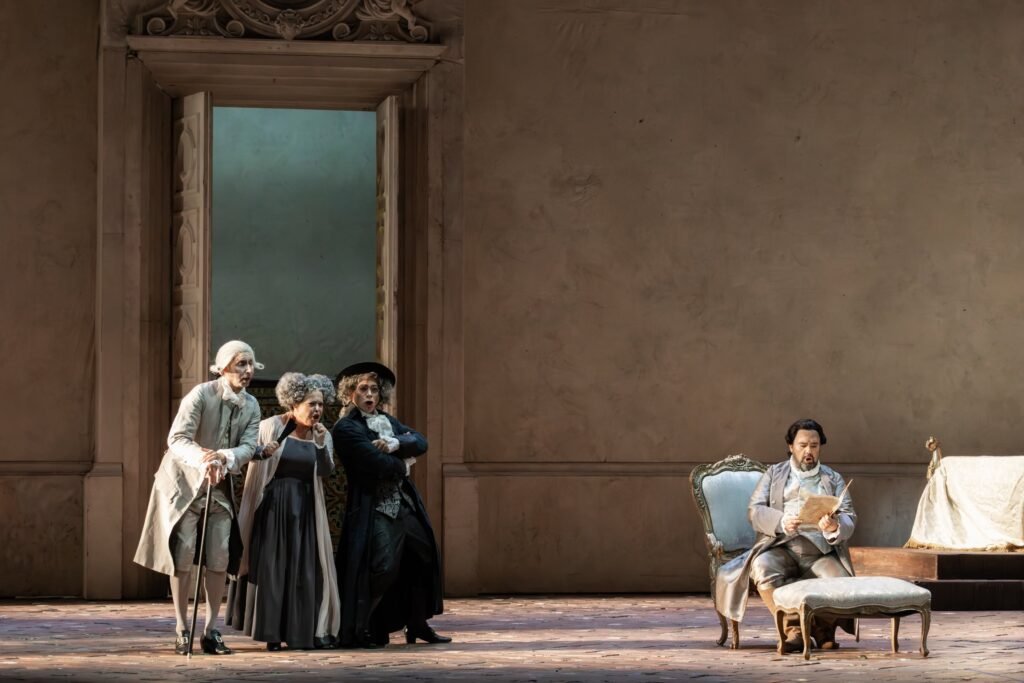
The result is a packed house and an excellent success, even if, at the end of the nearly four-hour performance, perhaps too little lingers in the mind for an opera that has historically seen the greatest directors, conductors, and most celebrated singers test their mettle. The production by Emilio Sagi, revived by Matteo Anselmi, is beautiful in its geometry, elegance, and its numerous nods to Seville, the setting for the second chapter of Beaumarchais’ famous trilogy – unquestionably the most visited city in all of opera – Cecilia Bartoli once counted 153 works set in the Andalusian capital for a Whitsun Festival in Salzburg. On stage, a bustling patio unfolds; through the windows of the Countess’s chamber, light and colors pour in, evoking the atmosphere of southern Spain, while the beautiful, colorful costumes are steeped in references to Goya’s paintings. All very lovely, to be sure, but everything is too predictable; there is not a single moment that makes the spectator bolt upright in their seat. For comparison within traditional-style productions, one thinks of the bare, immense, and profoundly deep architectural perspective of the third act in Giorgio Strehler’s staging, or the Garden of Bomarzo in which Luchino Visconti set the fourth act. It takes more than castanets accompanying the fandango or the auditorium lights turning on during Figaro’s tirade against women to give a stroke of genius to a production that unfolds across the four acts with elegance and refinement, but without major surprises or insights.
A Swift and Vibrant Folle Journée: Jordi Bernàcer Captures the Brilliant Equilibrium of Mozart’s Masterpiece
The musical execution, however, was decidedly good. Jordi Bernàcer’s conducting stood out for its clarity of sound and the sharp pace he imposed on the Folle Journée, delivering a rendition that was theatrical yet rich in contrasts and nuances. The excellent Orchestra of the Carlo Felice followed him with great energy, fully capturing the brilliance of Mozart’s writing right from the famous overture, with its rapid and tight forward momentum. The principal players were superb, particularly the woodwinds (flute, oboe, clarinet, and bassoon) and the brass, especially the horns in their celebrated passages during Figaro’s fourth-act aria. Bernàcer’s reading does not dwell excessively on melancholy and introspection; instead, it unravels all the interlocking melodic lines with transparent sound within the perfect equilibrium of Mozart’s masterpiece, allowing the theatrical component not to prevail over the human comedy.
Pristine Da Ponte Text and Formidable Baritones: An Authentic Italian Resonance for Teatro Carlo Felice’s Nozze
The assembled cast of singers was effective too, and to the great credit of the theater’s artistic direction, it was fortunately composed entirely of Italian artists. As a result, both the secco and accompanied recitatives finally received the vital prominence they hold within the opera, sparing native listeners from the butchered pronunciations usually offered by singers of the Germanic and Anglo-Saxon schools. It must be noted, however, that the sheer scale of the Carlo Felice auditorium, combined with the configuration of the sets – originally designed for the stage of Teatro Regio di Torino – severely hindered the projection of the voices into the hall. This was particularly true for the female voices, which sounded notably faint even from the front rows of the stalls.
Vito Priante’s Figaro was undoubtedly the best on field. The singer asserted himself right from the opening duet with his dark, virile timbre. His voice is characterized by a remarkable uniformity across all registers – round in the low notes, yet brilliant and swaggering in the upper register, which proved to be the true strength of his performance. His high Fs in the Cavatina (“Se vuol ballare”) were resolved with ease, never weighing down the sound. Through his sculpted phrasing and recitatives, Priante showcased his vast Mozartian experience, imparting weight and theatrical meaning to every single word of Da Ponte’s text. He drew a volitional and ironic Figaro, sharp but never vulgar, aligned with a directorial vision that favors vital aspects over the more revolutionary undertones of Beaumarchais’ original character. In this reading, the character evolves over the course of the opera, culminating in a masterful execution of his final aria, “Aprite un po’ quegli occhi”, where the psychological breakdown emerged through crisp, cutting phrasing, remarkably agile articulation in the sillabati, and explosive high notes.
A worthy antagonist was found in Roberto De Candia’s Count, possessing a bright and noble timbre. He made smoothness and elegance his vocal hallmark, also by virtue of his bel canto background. De Candia is an Almaviva who remains consistently noble, even when wounded in his class pride and rank. His singing was always clear and never muscular, leading to a successful execution of his grand third-act aria, where suspicion and jealousy were rendered through meticulous phrasing and timbral softness, without ever falling into monotony.
Vocal Polish and Timbral Limits: A Delicate Balance for the Women of Genoa’s Nozze
On the female side, things fared less well, beginning with Carmela Remigio’s Countess. A supreme Mozartian interpreter and a benchmark Donna Anna, she nonetheless lacked the timbral requirements, the purity in the high notes, and the nobility of color that this character demands. Remigio sings and phrases beautifully; she is always expressive and, musically speaking, a phenomenon. Her reading fully embraced the directorial vision, portraying a slightly more mature version of Rosina from The Barber of Seville – remaining essentially a bourgeois girl rather than a precursor to the Marschallin seen in celebrated historical interpretations. After a cautious and unfocused start in “Porgi, amor”, Remigio came into her own in the duets and ensembles, delivered with style and personality, finding an excellent timbral and expressive rapport with Susanna in the famous duettino “Sull’aria… che soave zeffiretto”. Her grand third-act aria, “Dove sono i bei momenti”, was also very well sung, with the singer displaying a beautiful vocal line and pertinent variations in the reprise.
Hampered by the aforementioned acoustic issues, Daniela Cappiello’s Susanna aligned more with the tradition of the soubrette soprano rather than that of the lyric soprano, for a monumental character who serves as the true engine of the entire comedy. The voice is exceptionally light, bright, and agile, and the performer is sensitive, witty, and equipped with the right theatrical verve. Given these vocal traits, her performance of the aria “Venite… inginocchiatevi” was highly successful, sung with verve and malice. Conversely, the rendition of her grand fourth-act aria, “Deh, vieni, non tardar”, proved more problematic: the lack of solid, full-bodied middle notes and virtually non-existent low notes did not allow her to give the page the extraordinary sensuality and erotic charge that Mozart infuses into it.
Josè Maria Lo Monaco possesses a dark, velvety timbre particularly suited to the en travesti role of Cherubino. Her solo moments displayed fine musical and expressive intentions, alongside an excellent legato in the canzone “Voi che sapete”. In her case as well, however, the voice struggled to cut through the orchestra, and the lower register, where much of the role takes place, was nearly inaudible
The Winning Supporting Cast of Genoa’s Nozze
Following a career that has seen her triumph in Rossini and Mozart roles, Sonia Ganassi is a true luxury as Marcellina. In this role, she is able to showcase all her vocal and scenic charisma, offering a sharp, biting characterization of the serva antica in her first-act duet with Susanna, “Via resti servita, Madama brillante”.
Alex Martini is a Bartolo of fine basso buffo quality, displaying appropriate vocal weight and navigating with confidence the formidable and rapid sillabati of the aria “La vendetta, oh la vendetta”.
Enrico Iviglia confirms himself as an exceptional character actor in the role of the music master Basilio, perfectly capturing his ironic, slimy, and caricatured nature. The nasal and emphatic vocal accents the tenor lends to his character were highly effective theatrically, in addition to his customary, ever-moving stage presence.
Gianluca Moro’s Don Curzio was also good; he stammers in accordance with tradition and just as recounted in the memoirs of the Irish tenor Michael Kelly, the original creator of the role.
Chiara Maria Fiorani is a Barbarina who resolves her aria with a childlike timbre and pure emission, adding a highly effective emotional puntatura.
Stefano Marchisio endows the role of the gardener Antonio with an appropriate character-bass vocal quality and a stage presence marked by great, stubborn physical comedy.
At the conclusion of the performance, the large audience in attendance paid a warm and prolonged ovation to the entire cast, decreeing the full success of this season-opening production.
About the Author