LA BOHÈME | Teatro Regio Torino
©Mattia Gaido
“L’altra Bohème”: Leoncavallo’s Lost Youth Moves the Teatro Regio.
Stepping out of Puccini’’ shadow, Francesco Micheli’s staging transforms the verismo opera into a poignant parable on the seasons of life. An excellent cast and warm applause in Turin.
L’altra Bohème: a challenge that for a long time seemed impossible, if not lost from the very start. On one side stands Puccini’s masterpiece, an inseparable cornerstone of collective musical memory, bolstered by its universal melodies and immortal characters. On the other lies the opera of the same title by Ruggero Leoncavallo – a composer historically frozen in time by the global success of Pagliacci alone – who chose to engage in hand-to-hand combat with his rival Puccini to translate into music, according to his own highly personal stylistic signature, the Paris of artists, loves, and illusions described in Henri Murger’s Scènes de la vie de bohème. Leoncavallo’s work debuted at La Fenice in Venice on May 6, 1897, just over a year after Puccini’s triumph at the Regio in Turin (February 1, 1896), ultimately succumbing rapidly under the weight of an overbearing comparison. Eclipsed by its rival, the opera gradually dropped out of the repertoire of major houses; yet, l’altra Bohème does not deserve le rang infamante as a mere historical duplicate, akin to Gazzaniga’s Don Giovanni or Paisiello’s il Barbiere di Siviglia in comparison to the masterpieces of Mozart and Rossini.
Therefore, unconditional praise is due to the artistic direction of the Teatro Regio di Torino which, as part of its early-season Verismo Festival, chose to gamble on the revival of this score. Despite the inevitable mirror-image relationship with Puccini, Leoncavallo’s composition preserves intact the epochal charm of an autonomous voice that mirrors a fertile era, one striving toward the renewal of late-nineteenth-century musical theater. Leoncavallo, here also the author of the libretto, distinguishes himself through a rigorous philological fidelity to the spirit of Murger’s original text, conceiving a markedly choral opera. At the center of the dramaturgy lies not a single sentimental axis, but rather the entire community of the bohémiens, portrayed in its aesthetic aspirations, febrile passions, and a daily life of misery faced through sheer resourcefulness. If Puccini’s choice to sublimate the fleeting nature of youth (la jeunesse n’a qu’un temps) through the melancholic, individual arc of Mimì proved historically more brilliant and successful, Leoncavallo’s approach fascinates by how it restores depth and centrality to that Parisian milieu which in Puccini remained more in the background.
Among the tables of the Caffè Momus and the alleys of the Latin Quarter, Leoncavallo completely redraws the balance of vocal and dramatic forces. The main destinies cross around Marcello – who here discovers a vibrant tenor vocalism – and Musette, assigned to the dark and seductive register of the mezzosoprano, making them the true protagonist couple. Moving alongside them are Rodolfo (baritone) and Mimì (soprano), joined by a third and unprecedented narrative line formed by the baritone Schaunard and the washerwoman Eufemia (mezzosoprano), a character entirely expunged by Puccini. This crowded human polyphony also dictates the sharp structural fracture of the opera: while the first two acts maintain a joyful, frenetic, and almost hyperkinetic character – an uninterrupted flow of toasts, amorous skirmishes, and grotesque situations – in the third and fourth tableaus, the bohémien world suddenly loses its colors and vitality. Comedy gives way to the more cruel face of misery and loneliness, leading up to the final agony of Mimì whose death inexorably erases the last illusion of youth.
Visual Geometry and Musical Coherence: The Miraculous Synergy of Micheli and Battistoni
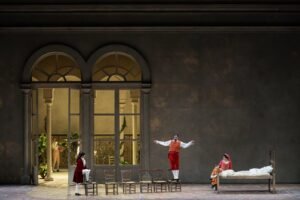
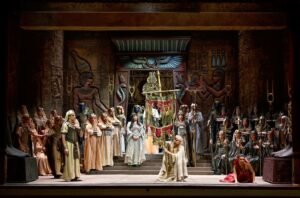
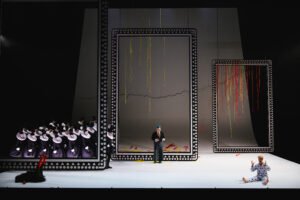
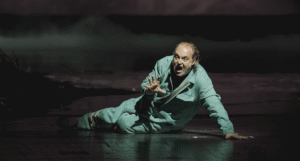
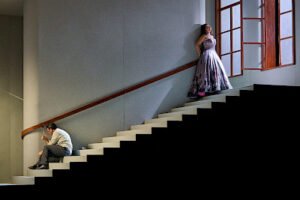
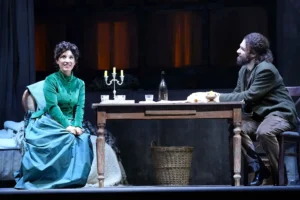
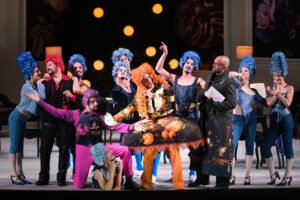
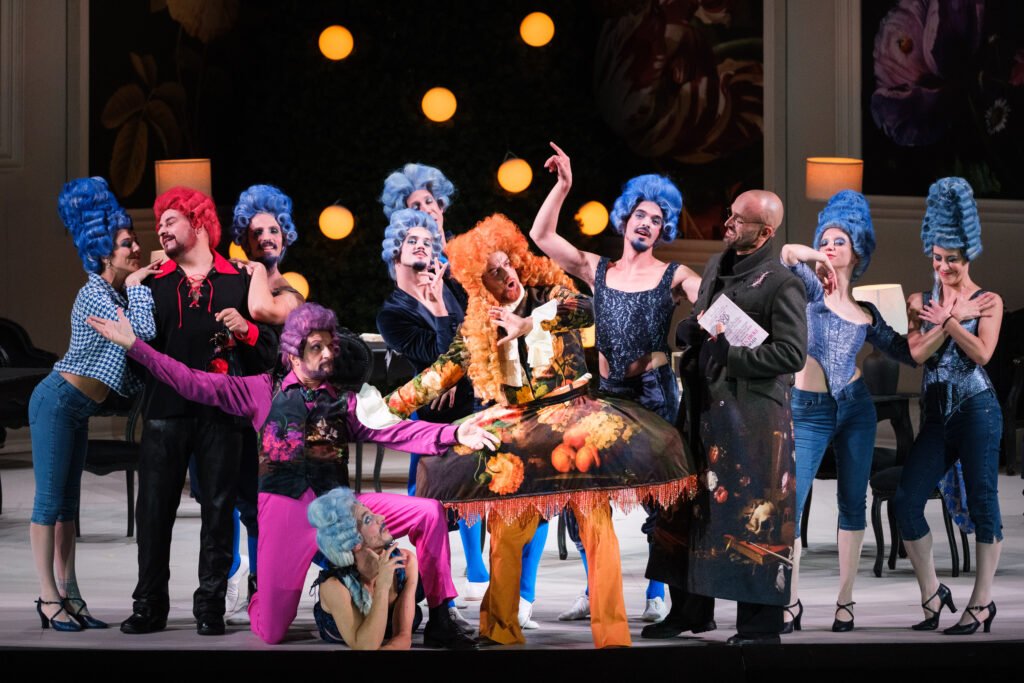
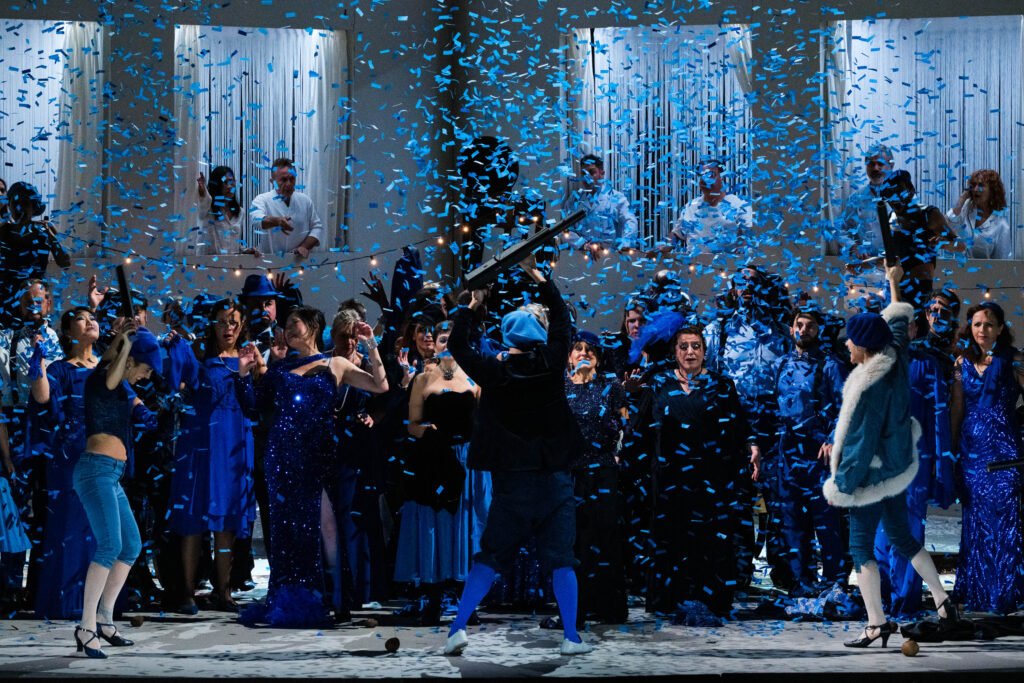
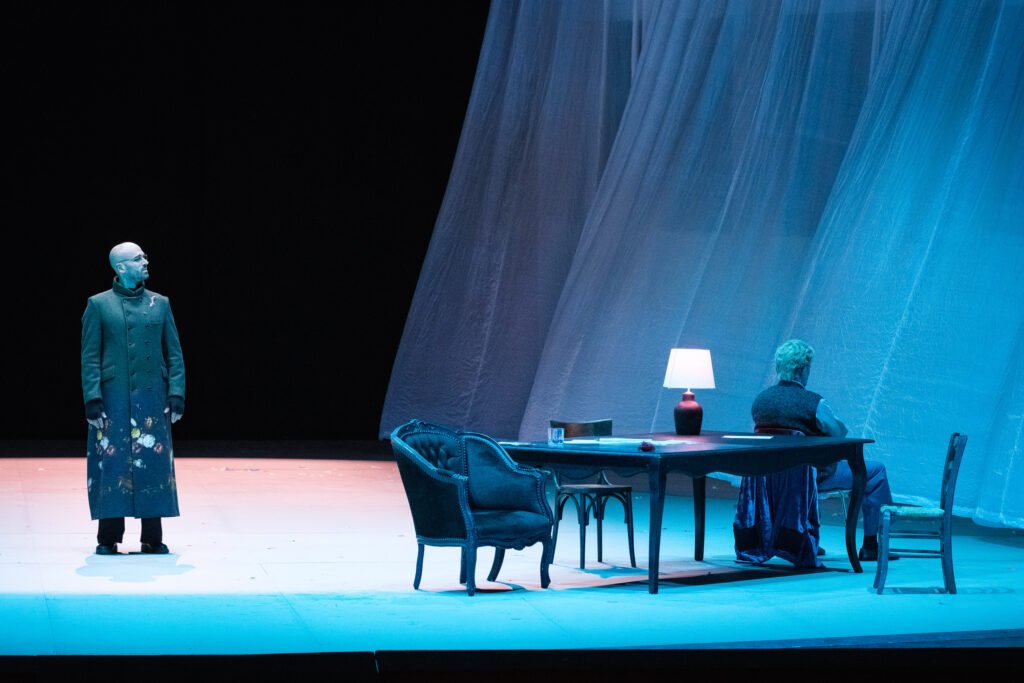
It is precisely upon these polyphonic contrasts that Francesco Micheli’s highly successful production unfolds, finding a perfect visual counterpart in Davide Signorini’s beautiful sets and Giada Masi’s colorful costumes. The four acts alternate like the seasons of life and the grand historical eras, linking the microcosm of the protagonists to a universal time. The first act, set on Christmas Eve at the Caffè Momus, welcomes the viewer with walls saturated with still-life paintings – a visual concept also echoed in the shapes of the eighteenth-century-inspired costumes: the bright colors of the garments and wigs become an essential chromatic code to define the affinities of individual couples. That same conceptual space shifts in the second act into the claustrophobic courtyard where the evicted Musette’s furniture lies. The clothes, while keeping their floral and natural motifs, veer toward a nineteenth-century line that accommodates the denser, more romantic evolution of Leoncavallo’s music. It is a crescendo that culminates in the grand final celebration, conceived as a moment of total theater in which the chorus, deployed among the audience, erases the distance from the auditorium in a sweeping emotional short-circuit. The third act marks the fracture, the geometric clash with the reality of pain: the scene becomes bare, stripped of embellishments, a mirror of a misery that is not merely material. The protagonists appear prematurely grey-haired and aged, prematurely deprived of youth, covered only by poor, bleak, and colorless garments. The allegory reaches fulfillment in the fourth act (Christmas Eve of the following year): Mimì, transformed into an elderly lady reflecting fleeing time, dies among the ghosts and survivors of her brief existence. Thus close the four seasons of human existence, a tragic parabola symbolized from the appearing of a skull and an hourglass – a grim memento mori that Colline ritually manipulates at every act change.
In perfect harmony with the directorial vision is the conducting of Andrea Battistoni, called upon to govern that labyrinth of eclectic styles which constitutes the most complex feature of Leoncavallo’s opera. Battistoni is to be praised for his millimetric control of dynamics, the richness of orchestral colors, and an admirable balance in the relationship between pit and stage. This acoustic stability proves miraculous especially in the second act, when the spatial dispersion of the chorus – dislocated throughout the vast and monumental hall designed by architect Carlo Mollino – could have compromised the ensemble; the conductor, on the contrary, turns it into a theatrical strength. Battistoni succeeds in illuminating the score from within, lending a tight narrative coherence to what might otherwise risk appearing as a mere fragmentary pastiche: in the first two acts, seemingly distant genres such as the minuet, the gavotte, echoes of Rossinian opera buffa, the salon song, and the Viennese valse find a necessary and highly fluid dramaturgical placement. Even more rigorous and penetrating is the rendering of the final two tragic acts. Here, Battistoni’s baton tightens the reins of the drama, bringing to light with cutting lucidity and deep emotional involvement the dense Wagnerian chromaticisms and that twilight pathos which definitively seals the aesthetic of Leoncavallo’s verismo.
Vocal Elegance and Dramatic Awareness: An Outstanding Ensemble Cast
The cast assembled for this revival is excellent, featuring artists capable of embracing the musical and directorial vision with absolute awareness, bringing to life a production of rare coherence and strong visual impact. From an expressive standpoint, all the singers deserve credit for pursuing a vocal style that is consistently elegant and refined, intelligently reining in those declamatory excesses to which the verismo repertoire is all too often subjected.
Above all, Matteo Lippi’s Marcello stands out: his voice, boasting an authentic tenor color and squillo, possesses the ideal volume for this complex late-nineteenth-century writing. The character’s theatrical rendering is flawless: ironic, brilliant, and in love during the first two acts; appropriately dark and dramatic in the final two. His emotional peak arrives in the celebrated aria “Musetta! Testa adorata”, tackled with a tragic accent, great assurance, and vibrant high notes. By his side, Lamia Beuque’s Musette asserts herself through commanding stage presence and a bright timbre. Although her line lacks depth in the middle and lower registers – rendering her less effective in the verismo clash of the third act – the singer proves perfect whenever Leoncavallo demands an alluring operetta or café-concert vocalism.
Alessandro Luongo lends Rodolfo a clear and elegant baritone voice, fully restoring the soul of the idealist poet through a remarkably rich phrasing, evocative mezze voci, and soft high notes. Equally convincing is the Mimì of Sara Cortolezzis: the lyric soprano exhibits excellent technical control and, rightly distancing herself from the Puccinian model, sharply defines the character’s evolution. From her initial brilliance, Cortolezzis veers toward intense dramatic accents in the third-act duetto with Musette, before fading away with touching pathos in the death scene.
Within the trio of bohémien baritones, Ramiro Maturana outlines a snappy and agile Schaunard. Here, the musician enjoys a far greater theatrical space than in Puccini’s version, and Maturana becomes the stage engine in the opening acts, thanks to perfect theatrical timing. Francesco Salvadori’s darker voice stands out in sharp contrast of color, portraying a Colline who is a philosopher and intellectual of great depth. Salvadori excels in diction, sculpting the libretto’s numerous learned citations. Entrusted to him is Francesco Micheli’s evocative dramaturgical insight: the insertion, between acts, of two chansons by Georges Brassens. The conjuring of lost youth through the famous line Mais où sont les neiges d’antan? is sung by Salvadori with magnetism and impeccable French.
Among the numerous roles crowding the stage, a special mention goes to Matteo Peirone’s Barbemuche. After having portrayed the Puccinian roles of Benoit and Alcindoro in the world’s leading opera houses, the bass-baritono tries his hand here as the wealthy and cultured literary critic who craves the acceptance of the young artists. The character, absent in Puccini, is drawn faithfully from the original novel, where Murger uses him to satirize the eccentric intellectuals of the era, and in particular the figure and style of Charles Baudelaire. Peirone showcases exceptional phrasing, capable of giving rhythm to every single word in accordance with the great tradition of Italian opera buffa. His stage presence outlines a bizarre yet never caricatured character, enhanced by the direction, which even has him appear in the stalls among the audience at the end of the second act.
A “luxury” presence is also found in Manuela Custer in the role of the washerwoman Eufemia, interpreted with vibrant temperament, strong presence, and a working-class, veracious verve in perfect contrast to Musette and Mimì. The cast is authoritatively completed by Manuel Pierattelli’s agile Gaudenzio, Pablo Gálvez’s effective Viscount Paolo, and Roberto Covatta’s solid Durand.
Finally, a note of absolute merit goes to the orchestra and the Teatro Regio Chorus, masterfully led by Gea Garatti Ansini, the true protagonist of the gigantic musical and social fresco of the second act at Caffè Momus. At the conclusion of the performance, the Turin audience accorded an enthusiastic success to the entire company, rewarding the courage of a non-repertoire proposal realized at the highest artistic and musical levels.
About the Author