LA BAYADERE | Opera de Paris
There is a question opera lovers always end up asking themselves when a ballet programme lands in their hands: what to do with an evening that has no voice? With La Bayadère, the answer turns out to be obvious. This is an opera. It has Verdi’s love triangle, Meyerbeer’s supernatural grandeur, Poulenc’s fatalism. What it doesn’t have is the voice — and in its place, it gives you the body at its most extreme. Anyone willing to make that leap will not regret it.
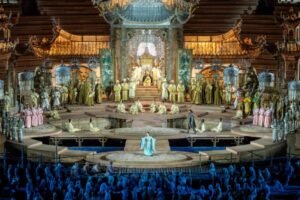
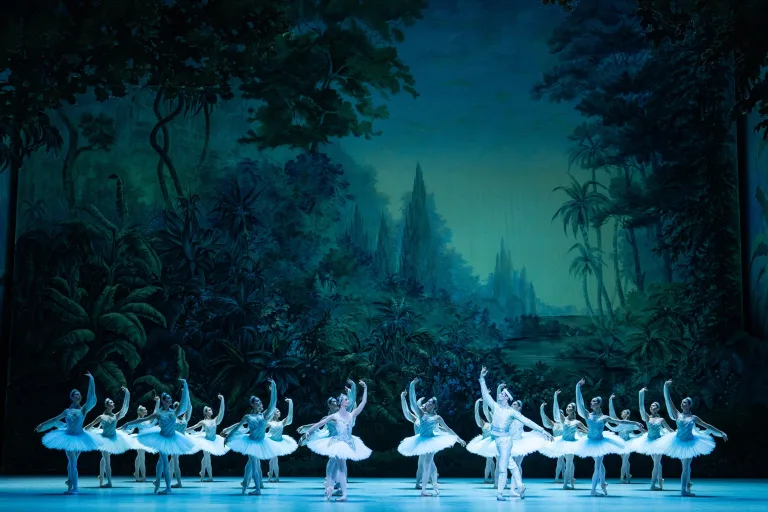
Rudolf Nureyev’s staging — created for the Paris Opera in 1992 — is still standing as one of the great monuments of the classical repertoire, and it shows no sign of age. It doesn’t update Marius Petipa: it transfigures him. The visual world that Ezio Frigerio and Franca Squarciapino built around it is the kind of thing you rarely see anymore — the temple scenes soaked in deep gold, the costumes moving between archaeological fantasy and pure theatrical opulence. The corps in their whites at the end of the second act alone would justify the evening.
Koen Kessels conducted Ludwig Minkus’s score in John Lanchbery’s arrangement with real attention to what was happening on stage. Minkus is not Tchaikovsky — nobody would claim otherwise — but in the right hands his music breathes and gives the dance something to push against. The pit was engaged throughout.
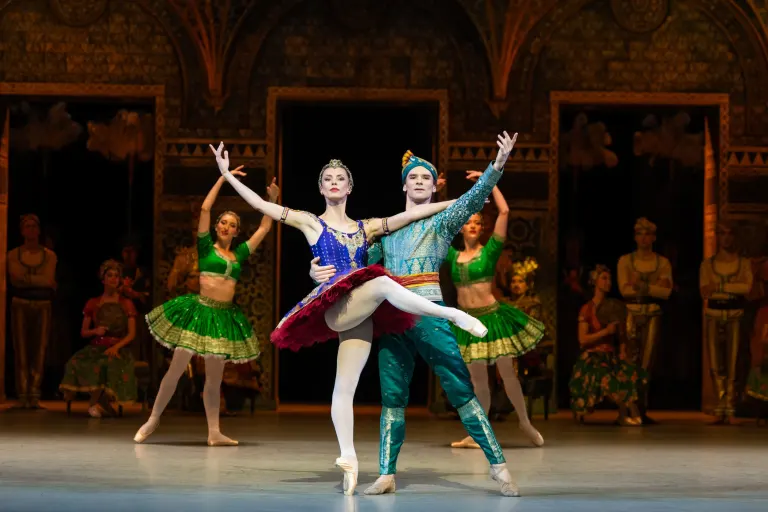
And then there is Paul Marque. Saying he was the revelation of the evening would be wrong, because Marque stopped being a revelation some time ago — he is a certainty now, one of those dancers you watch knowing there is nothing left to prove. The elevation is extraordinary, the line immaculate, and yet none of it feels like a display: jevery jump has a reason, every arabesque carries some dramatic weight. The very best dancers share something with the very best singing actors — a point at which the technique stops being visible and only the character remains. Marque lives there. His Act II pas de deux with Nikiya was one of the most affecting things I have seen on a ballet stage — tender, anguished, completely real. What struck me most, though, was how he handled the moral dimension of Solor: the warrior who loves Nikiya but cannot bring himself to choose her. He doesn’t try to redeem him or make him sympathetic. He plays a man, with all the weakness that implies. Technically exceptional, dramatically honest.
Léonore Baulac’s Nikiya asks for something different. Where Solor burns, Nikiya suffers and endures — and Baulac knows this and builds her performance accordingly, slowly, through silences, through held positions, through the quality of stillness she brings between steps. Her technique is solid and her line beautiful, but what you remember is the weight she puts into the moments that aren’t dancing. Her death scene is devastating precisely because there is no sentimentality in it at all — just a very quiet, very interior grief.
Against her, Bleuenn Battistoni as Gamzatti brings an entirely different kind of presence — more assertive, more territorial. The confrontation between the two women in Act I works so well because they are genuinely opposite in temperament: where Baulac withdraws and absorbs, Battistoni fills the stage and takes it over. Shale Wagman’s Golden Idol is worth singling out too — a few minutes on stage, treated as a complete statement. The control is something else. And the three Shades variations — Camille Bon, Saki Kuwabara, Célia Drouy — were danced with a musicality and cohesion that made them feel like more than a warm-up for what was to come.
Which brings us to the Shades. Any serious discussion of La Bayadère has to end here, the way any discussion of Norma has to end at Casta Diva. Sixty-four dancers descending the same ramp in the same arabesque, one after another, building a vision of the afterlife that is at once mathematical and overwhelming — structured like a fugue, felt like an elegy. On this night it was danced with a purity and unanimity that genuinely stopped the room. The white tutus in the darkness of the Bastille, the long slow procession of bodies, the orchestra underneath: you sit very still and something happens to you that is hard to name but easy to recognise.
One thing that struck me about this production, beyond the performances, is the audience it pulls in. At the Bastille that evening you had seasoned opera regulars sitting next to people who had perhaps never seen a ballet in their lives; children and grandparents; people for whom Nureyev is a living memory and people who were discovering him for the first time through his choreography. Very few performances manage that — erasing the distances between generations, between degrees of familiarity with the art form, between people who know what they are watching and people who don’t. La Bayadère does it, and it does it without trying. That is rare.
An opera audience coming here will find nothing foreign. The passions are the same, the stakes are the same, and the catharsis at the end — when Solor and Nikiya are finally reunited in the destruction of the temple, beyond death, beyond guilt — is as complete as anything Verdi or Puccini ever wrote. The instrument is different. The art form is the same.
Long live the Paris Opera Ballet. Long live Nureyev. Long live La Bayadère.
***************************************
CAST
Nikiya — Léonore Baulac
Solor — Paul Marque
Gamzatti — Bleuenn Battistoni
Golden Idol — Shale Wagman
L’Esclave — Florent Melac
1st Variation — Camille Bon
2nd Variation — Saki Kuwabara
3rd Variation — Célia Drouy
–
Musical direction — Koen Kessels
Choreography — Rudolf Noureev after Marius Petipa
Music — Ludwig Minkus, arrangement John Lanchbery
Set design — Ezio Frigerio
Costume design — Franca Squarciapino
Lighting design — Vinicio Cheli
About the Author