TURANDOT | Bayerische Staatsoper
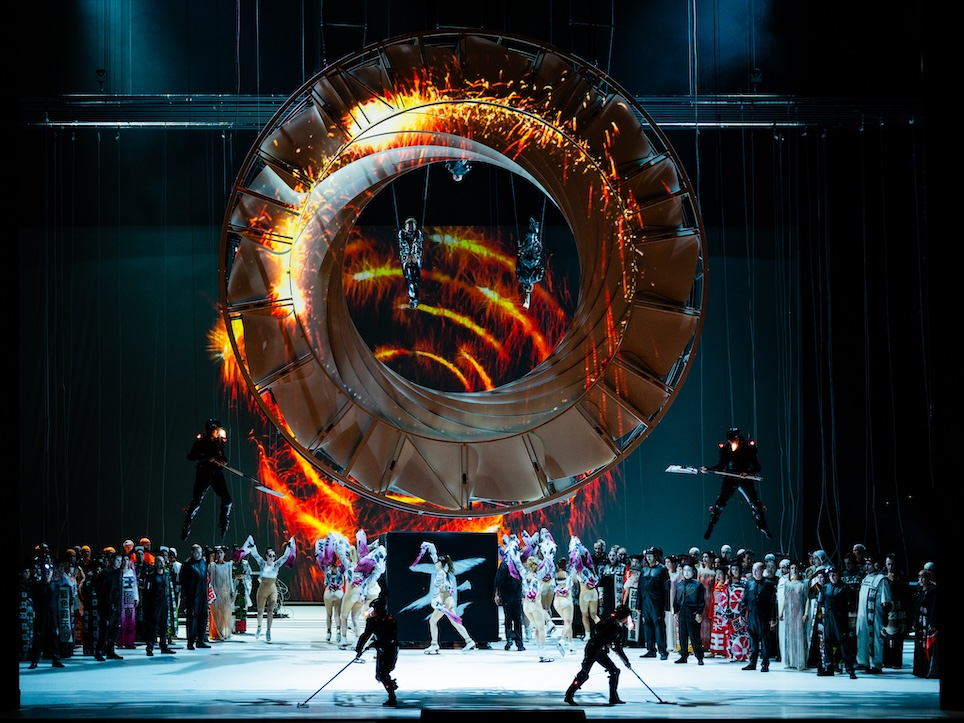
A new run of La Fura dels Baus’s Turandot at the Bayerische Staatsoper. And what a cast to bring it back. Carlus Padrissa’s concept is by now well established: 2046, a Europe absorbed into Chinese economic domination, Puccini’s coldest heroine refigured as a totalitarian controller of desire. Roland Olbeter’s sets and Franc Aleu’s video work make for something visually overwhelming and occasionally excessive, but the theatrical intelligence behind every image is real, and the dystopian framework suits this opera’s cruelty far better than one might initially expect. Andrea Battistoni conducts with conviction and a genuine gift for the dramatic architecture of this score, drawing rich and detailed playing from the Bayerisches Staatsorchester throughout the evening. One can hardly keep still during the great ensemble moments of Act II, such is the energy he injects into every bar. He is one of the most exciting conductors currently working in this repertoire, and this evening was further proof of it.
In the title role, Sondra Radvanovsky delivers exactly what Turandot demands and then some. The top notes land with full force, the legato is commanding, and her In questa reggia in Act II is everything one could hope for. What impresses most, however, is the intelligence of her reading: she plays Turandot as genuinely cold and genuinely cruel, without concession, right up until the moment the score requires otherwise, which makes the final transformation all the more striking. To stand opposite her, Yonghoon Lee brings a Calaf of real, natural tenor power, free and open at the top, entirely comfortable within the grand scale of this music. His Nessun dorma built with the kind of slow, inevitable momentum the aria demands, and arrived exactly where it needed to arrive. The hall’s reaction said the rest.
Christian Van Horn‘s Timur is a lesson in what a great bass can do with a role that gives him relatively few pages. The voice is simply beautiful: an extraordinary natural resonance, a warmth in the lower register, a legato of uncommon generosity that lends every phrase a weight the music doesn’t always ask for but always benefits from. One finds oneself wishing Puccini had given the old king considerably more to do. The revelation of the evening is Golda Schultz as Liù. From her very first entrance, the hall understands that something exceptional is happening. The voice is warm, perfectly centred, entirely without affectation, and her Signore, ascolta stopped the room. Her death scene generated a silence so specific and so complete that it lasted well after the last note. There are sopranos who sing Liù well, and there are sopranos for whom the role seems to have been written and held in reserve. Golda Schultz belongs to the second category. A performance of rare purity.
Vitor Bispo, Tansel Akzeybek, and Samuel Stopford make a nimble and theatrically alert trio of ministers; Kevin Conners is a dignified Altoum, and Bálint Szabó’s Mandarin has the presence the role requires.
As one leaves the Bayerische Staatsoper, one thought lingers above all others: how fortunate to have heard this cast in this house on this evening. What a conductor. What a soprano.
Cast & Creatives
Conductor — Andrea Battistoni
Director — Carlus Padrissa / La Fura dels Baus
Sets — Roland Olbeter
Costumes — Chu Uroz
Video — Franc Aleu
Lighting — Urs Schönebaum
–
Turandot — Sondra Radvanovsky
Calaf — Yonghoon Lee
Liù — Golda Schultz
Timur — Christian Van Horn
Ping — Vitor Bispo
Pang — Tansel Akzeybek
Pong — Samuel Stopford
Altoum — Kevin Conners
Mandarin — Bálint Szabó
About the Author