
DIE FRAU OHNE SCHATTEN | Festival d’Aix en Provence
“you’ve never written anything more beautiful and compact in your life… I only hope my music will be worthy of your fine poetry”
Die Frau ohne Schatten is Richard Strauss’s seventh opera and his fourth collaboration with Hugo von Hoffmannsthal. It is undoubtedly the most complex and fecund work born from the encounter between the Bavarian composer and the great Austrian poet and playwright. Composed between 1914 and 1918, during the turmoil of the First World War, it premiered on October 10, 1919, at the Vienna State Opera. Over a century later, this masterpiece continues to challenge conductors, singers, and directors alike, as they grapple with what can be considered the most complex, ambitious, and impenetrable score of the entire twentieth-century musical era. Performances of this work are always extraordinary events, drawing passionate opera lovers from around the world, who affectionately call it die Frosch (the frog), a nickname given by Strauss himself, taking the initials of the original title.
Summarize the plot in a few words is difficult; it is dense with symbolism, literary and musical references, and driven by the two authors’ stated intention to compose a modern Magic Flute. The shadow is the symbol of the human dimension- the ability to procreate while simultaneously accept the sufferings of life. The Empress, a fairy daughter, is sterile and childless. To save her husband, the Emperor, from turning into stone, and under the influence of a diabolical Nurse, she tries to buy the shadow of the dyer Barak’s wife, who is willing to sell it to escape poverty. Yet, it is precisely here that the final drama unfolds with the Empress’s renunciation, “ich will nicht,” when she understands that entering humanity depends on refusing the sacrifice of Barak and his wife: a shadow cannot be bought or stolen at the expense of their earthly happiness.
It is equally difficult to describe Barry Kosky‘s prodigious staging, which confirm- for anyone who still had doubts- the best opera director working today. One should start with his interview in the program before reviewing any performance itself. “Opera can never be reduced to just one thing; name me a single masterpiece, from Monteverdi’s L’incoronazione di Poppea to Saariaho’s Innocence, that speaks to just one thing: great musical theater confronts us with multiple themes and questions, sometimes in contradictory ways.”
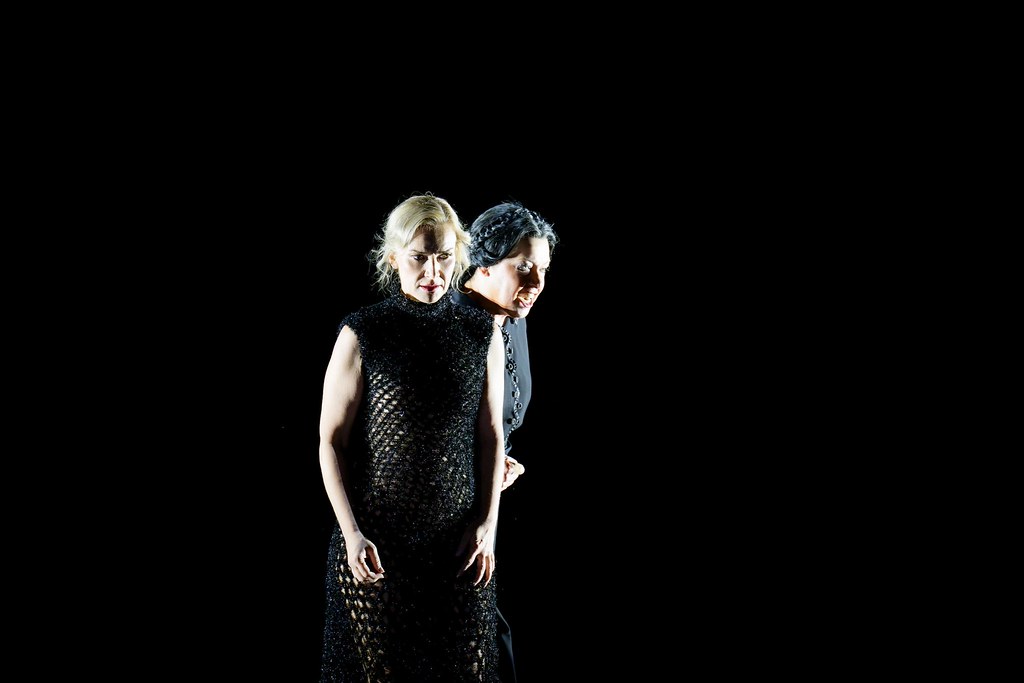
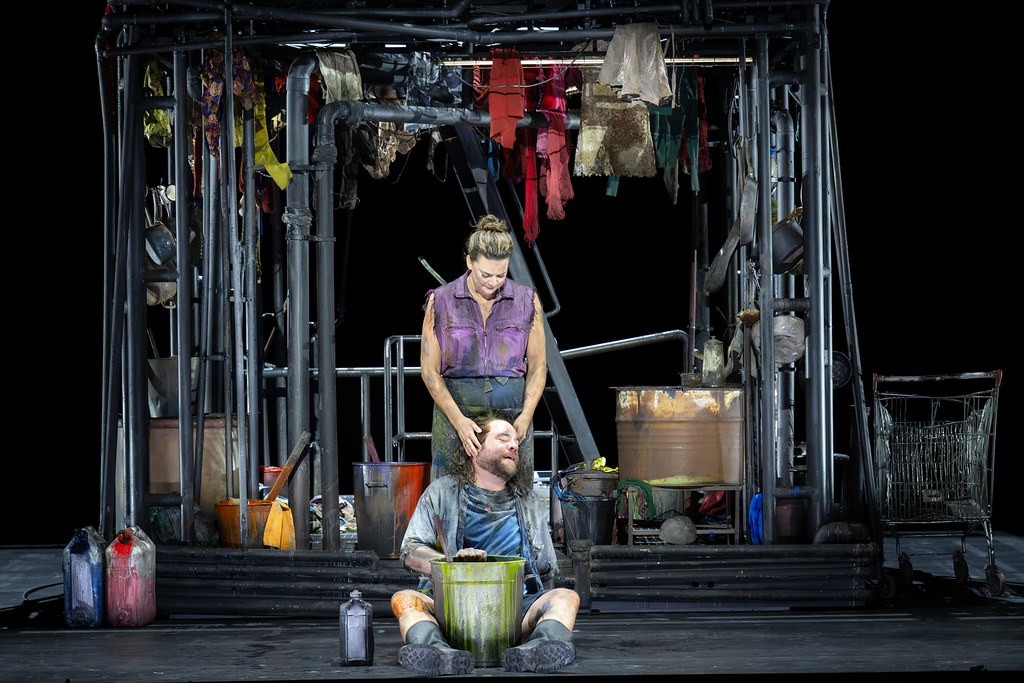
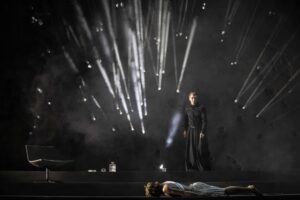
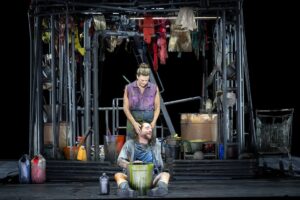
Kosky begins by rejecting the literal interpretation of the libretto as a mere celebration of heterosexual marriage and motherhood. Instead, he offers a reading where psychological and Freudian aspects intersect with the fantastical, symbolic, and fairy-tale elements of Hoffmannsthal’s text. A key aspect of Kosky and his set designer, Michael Levine, is the clear division between the two worlds: the abstract, impalpable realm of the supernatural- a black box where the emperor and empress live- and the earthly, suffocating world of humans. For the latter, Levine builds a three-story tower of scaffolding and pipes, with clothes hanging out to dry and all the furnishings exposed, where Barak and his family work, cook, argue, and sleep as on a mountain in the purgatory of a megalopolis. In the final act, all five protagonists find themselves catapulted into an enormous, white, brightly lit space, where no one casts a shadow and no one recognizes one another until the final catharsis. Kosky’s production is also characterized by strong visual symbolism, accentuating both the psychological and the purely fantastic aspects of the opera: the immense androgynous head representing Keikobad, king of the spirit world and father of the Empress; the Emperor’s gigantic rocking horse; and the rocking chair from which the Nurse diabolically manoeuvres her pawns. The magical aspects are sensational, such as the silver-covered Greek god who plays the Young Man or the headless dervish dancers the Nurse conjures up to ensnare the fantasies of Barak’s wife and obtain her shadow. Furthermore, it is impossible not to mention the finale, which Kosky reinterprets in an ambiguous and cynical manner compared to the libretto’s traditional happy ending. Alongside the two finally reunited couples, the long-awaited children appear on stage, dressed exactly like their parents, but with their faces covered by old men’s masks. This indicates the inevitability of time and a humanity that, having acquired a shadow, finds itself in all its fragility.
This directorial vision perfectly complements the musical interpretation of Klaus Mäkelä, a conductor in his early thirties making his operatic debut in an international production. Gone are the days when even Karajan spent decades apprenticing with provincial orchestras, yet one cannot help but be astonished by the young Finnish conductor’s interpretation. His technical mastery of this monstrous score, with its enormous orchestral force, is absolute: Mäkelä analytically renders the sonic texture with crystal clarity in both the most dramatic and chamber-like moments, consistently maintaining a perfect balance between the pit and the stage, despite the exhausting demands placed on the singers. The strength of his conducting lies precisely in the fluid clarity of the sound, the timbral contrasts, the unfolding of leitmotifs, and the way solo interventions from the magnificent instrumentalists of the Orchestre de Paris are highlighted. Marvelous in this regard is the Falcon’s famous cello solo in the second act, which imitates the animal’s flight and wail. Similarly, the flutes and piccolos in the famous leitmotifs are hallucinatory and penetrating. This conducting enhances the individual instruments and timbres within the immense magma of Strauss’s orchestral texture, delivered with full stylistic awareness and a volcanic explosion in the Act II finale. Consistent with the director’s vision, the famous orchestral interludes, in Mäkelä’s interpretation, are not simple musical gaps but form a bridge between the two sonic worlds- moving from the ethereal and suspended sounds of the spiritual realm to the dark, heavy sounds of the terrestrial world.
The opera demands an exceptionally taxing vocal cast and is inextricably linked to legendary voices of the past like Leonie Rysanek, Birgit Nilsson, and Dietrich Fischer-Dieskau. The Aix Festival has succeeded in fielding a prodigious lineup with a quintet of leading roles that can easily become part of the performance history of the Frau ohne Schatten.
Vida Miknevičiūtė approaches the role of the Empress with a lyric spinto soprano voice of great volume and perfect technical command across the entire, enormous vocal range required- from middle C (C3) to the very high D (D5). The Lithuanian soprano perfectly delineates the character’s vocal and psychological evolution, which requires virtuosic, coloratura vocalism in the first act, a denser, more centralized tessitura in the second act, and a dramatic declamation in the final act, that abandons the melodic line to become a sort of sprechgesang. Miknevičiūtė’s voice rises confidently above the massive orchestra of over a hundred players, with a firm low and mid-register and blazing, steely high notes in the finest Straussian tradition. Her performance is fully in tune with Kosky’s directorial vision, portraying a haughty, cold woman who becomes human through her contact with Barak’s humanity and suffering. The singer’s beautiful stage presence is enhanced by Victoria Behr‘s exquisite costumes, particularly the stunning orange dress that contrasts with the Nurse’s black clothes and the dazzling white of the prison room.
Michael Spyres makes his debut in the challenging role of the Emperor, putting his exceptional, chameleon-like vocal range and Rossinian bel canto technique at the service of a dramatic tenor role. Spyres, unlike famous past interpreters, lends the Emperor a softness and Italianate quality that help delineate the character’s initial fatuity and subsequent internal turmoil. His vocal performance in the great Act II monologue,“Falke, Falke, du wiedergefundener,” in which the Emperor sings of his jealousy and inner torment, is exceptional. Spyres is a master at realizing the entire palette required by Strauss- from the initial pianissimo (pp)to the fortissimo (ff) of “wehe, o weh,” with incredibly soft attacks on the high A-flats and consistently sculpted and incisive phrasing.
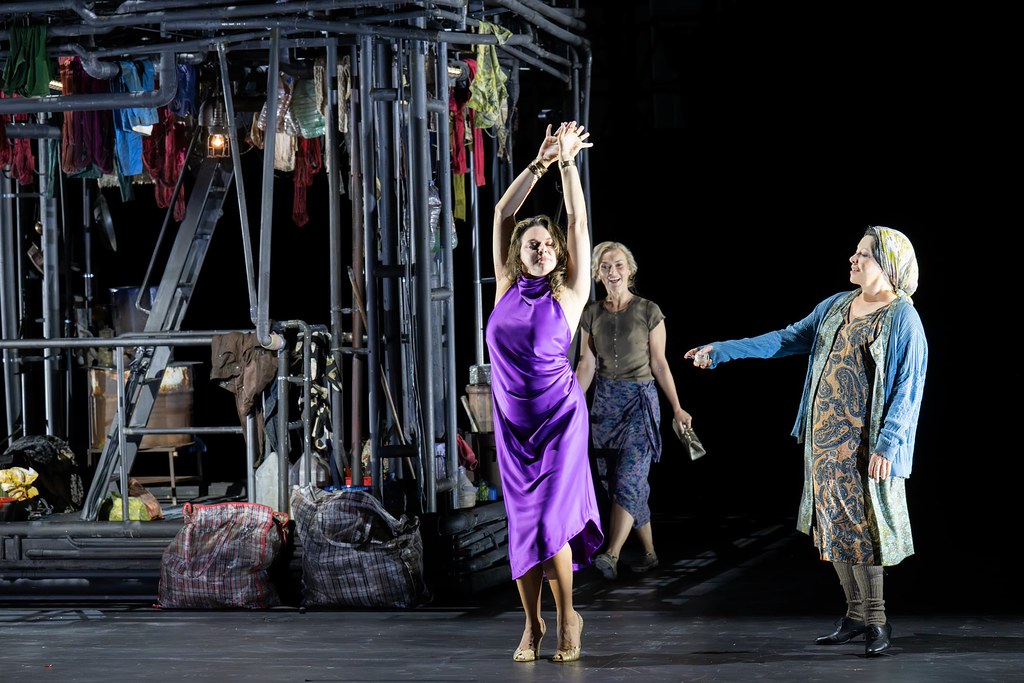
The other leading couple is also phenomenal. Ambur Braid is the true revelation of the evening, delivering an extraordinary performance as the earthy and dissatisfied dyer’s wife. The Canadian soprano lends her vocal power and sumptuous timbre to a role that, along with Elektra, can be considered the most gruelling in the Straussian repertoire. Braid excels both in the hysterical, dramatic declamation of the first act, and in the legato phrases and poignant lyricism that mark the end of the character’s psychological transformation. This is particularly evident in the duet at the beginning of the third act, which constitutes the emotional climax, and features one of the most touching melodies ever written by Strauss. If her vocals are sumptuous, her interpretation is masterful; she fully embraces Kosky’s directorial intuitions, with truly magnetic stage charisma. Hysterical and sarcastic, frustrated and dissatisfied by her beauty and youth, Braid portrays the woman’s inner turmoil, culminating in remorse, repentance, and the ultimate acceptance of her own shadow- and consequently, of Barak’s love. An extraordinarily engaging and modern interpretation by a singer who proves to be one of the most compelling artists on the current operatic scene.
In the role of Barak, Brian Mulligan, a Wagnerian specialist, offers his Heldenbariton vocals to the opera’s most human and positive character. His warm, mellow voice fully conveys the dyer’s purity of soul and emotionality, effortlessly navigating all the changes in texture. He displays an exemplary legato in the most lyrical moments while mastering the dramatic, violent momentum at the end of the second act, when his wife informs him that she has sold her shadow. On stage, Mulligan proves to be a well-rounded interpreter, portraying a good-natured but never naive character who moves through his earthly world with humanity and optimism.
As the Nurse, the legendary Nina Stemme -after dominating stages around the world with her Wagnerian and Straussian interpretations- takes on the role of the evil character, who in Kosky’s production serves as the driving force behind all the action. Stemme is impressive for her vocal range and the strength of her upper register, which still stands out with the same majesty as the Hojotoho of her celebrated Brunhilde. Her vocal charisma remains intact and is matched by a stage presence that commands the theater: a demonic creature dressed entirely in black who, from her rocking chair, manipulates and destabilizes the human characters in search of their shadows. As Kosky’s direction subtly suggests, the woman without a shadow is not only the Empress, but also the Dyer’s wife and perhaps the Nurse herself.
Among the numerous supporting roles, bass-baritone Daniel Miroslaw stands out for his compelling scenic and vocal performance as Barak’s one-armed brother. Tenor Robert Lewis literally captivated the audience with his rendition of the piercing phrases of die Stimme des Jünglings, hinting at a bright future as a Heldentenor.
The audience, which packed the hall of the Grand Théâtre de Provence, declared the performance a triumphant success, offering standing ovations and acclamations for all the entire cast. It was undoubtedly the best show among the thirty I have seen in 2026, and even as I write this review, I remain deeply moved by such a memorable evening.
CAST
Der Kaiser: Michael Spyres
Die Kaiserin: Vida Miknevičiūtė
Die Amme: Nina Stemme
Barak, der Färber: Brian Mulligan
Die Färberin: Ambur Braid
Der Geisterbote, Die Stimmen der Wächter, Männerchor: Jean-Sébastien Bou
Der Einäugige, Die Stimmen der Wächter, Männerchor: Tomasz Kumięga
Der Einarmige, Die Stimmen der Wächter, Männerchor: Daniel Miroslaw
Der Bucklige, Die Erscheinung eines Jünglings, Die Stimmen der Wächter, Männerchor: Robert Lewis
Die Stimme des Falken, Der Hüter der Schwelle des Tempels: Ella Taylor
Eine Stimme von oben: Héloïse Mas
–
Dienerinnen: Laurence Pouderoux, Eugénie Lefebvre, Laura Jarrell
Conductor: Klaus Mäkelä
Stage direction: Barrie Kosky
Set design: Michael Levine
Costume design: Victoria Behr
Lighting design :Franck Evin
Chœur de l’Orchestre de Paris
Choirmaster: Richard Wilberforce
Orchestre de Paris
About the Author

très sympa le nouveau format du site bravo..