DIE WALKÜRE | Bayerische Staatsoper
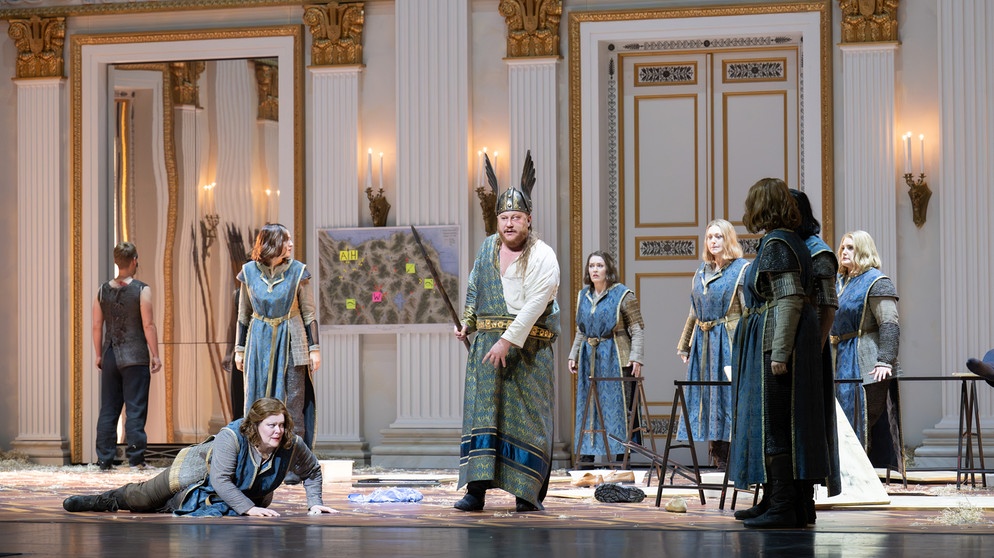
There are evenings at the opera that stay with you for years because something in them exceeds what you were expecting and, frankly, what you thought the art form was still capable of producing. Die Walküre at the Bayerische Staatsoper on 4 July 2026 was one of those evenings. Tobias Kratzer’s Ring in Munich is already, at its second instalment, one of the most exciting operatic projects of the decade. His Das Rheingold last season established the terms: contemporary, theatrically alive, anchored in real ideas rather than aesthetic posture. This Walküre goes further. The concept deepens and opens up: film projections weave the mythological and the contemporary together with striking fluency, the Englischer Garten appearing as a space of ordinary life against which the extraordinary drama of gods and mortals unfolds, the horses in Act III materialising at a moment I will not describe here because it must be encountered without preparation. Rainer Sellmaier’s sets and Manuel Braun’s video work are excellent and make this Ring feel urgent and immediate without over-explaining it. Vladimir Jurowski and the Bayerisches Staatsorchester give a reading of the score of extraordinary range: from the chamber delicacy of the Act I opening scene to the full orchestral force of the Ride of the Valkyries, culminating in a final scene of such cumulative emotional weight that it becomes genuinely difficult to remain composed in one’s seat. What an orchestra. What a conductor.
First among equals: Nicholas Brownlee as Wotan. There is bronze in this voice — a natural weight and authority that most baritones spend entire careers chasing without ever quite reaching. His Act II monologue, one of the most demanding pieces ever written for a baritone voice, was simply one of the great operatic performances of recent years: fully inside the text, fully inside the music, the two things fused into something completely convincing from the first phrase to the last. What an artist. Irene Roberts gives a Sieglinde of burning intelligence and meticulous construction: she builds from a kind of frozen, watchful restraint in Act I to a shattering outburst at the end of Act III, and by the time she arrives there, one understands, note by note, exactly how she made the journey. Joachim Bäckström is a Siegmund of real metallic presence and genuine dramatic commitment, his Winterstürme ringing through the hall with a clarity and warmth that matched his partner’s intensity at every step. Ain Anger gives Hunding all the dark authority the role requires, and Miina-Liisa Värelä as Brünnhilde is excellent throughout: the voice substantial and covered in every register, the farewell scene in Act III devastating in the particular way that only sneaks up on you once you are already inside it.
The revelation of the evening is Ekaterina Gubanova. Her Fricka is the kind of performance that reframes an opera. She is not the jealous wife making things difficult: she is the only person on stage who has genuinely understood what the consequences of Wotan’s scheme will be, and she plays her accordingly, with absolute authority, with genuine moral weight, with a mezzo voice of remarkable fullness and colour that fills the house without the slightest apparent effort. The great confrontation scene in Act II was one of the finest pieces of ensemble singing heard in Munich in recent memory, and Gubanova drives it from first word to last. That she stands opposite one of the finest Wotans of his generation and concedes nothing is, in the end, all one needs to know about the level at which she operates.
Dorothea Herbert, Julie Adams, Elene Gvritishvili, Claudia Mahnke, Niina Keitel, Christina Bock, Natalie Lewis, and Noa Beinart complete the cast as the eight Valkyries and give Act III exactly what it needs: collective power, vocal presence, and genuine theatrical commitment. The Ride lands not as mere spectacle but as dramatic event.
Long live the Bayerische Staatsoper. Long live Wagner. And long live Tobias Kratzer.
Cast & Creatives
Conductor — Vladimir Jurowski
Director — Tobias Kratzer
Sets & Costumes — Rainer Sellmaier
Video — Manuel Braun, Jonas Dahl, Janic Bebi
Lighting — Michael Bauer
–
Wotan — Nicholas Brownlee
Sieglinde — Irene Roberts
Siegmund — Joachim Bäckström
Brünnhilde — Miina-Liisa Värelä
Fricka — Ekaterina Gubanova
Hunding — Ain Anger
Helmwige — Dorothea Herbert
Gerhilde — Julie Adams
Ortlinde — Elene Gvritishvili
Waltraute — Claudia Mahnke
Siegrune — Niina Keitel
Rossweiße — Christina Bock
Grimgerde — Natalie Lewis
Schwertleite — Noa Beinart
About the Author